

In this blog
- How Long Should It Take to Sell a House?
- How to Tell Why Your House Is Not Selling
- 1. The Asking Price Is Too High
- 2. The Photos and Listing Do Not Do It Justice
- 3. First Impressions and Kerb Appeal Are Putting Buyers Off
- 4. The Condition or Presentation Inside Needs Work
- 5. You Are Not Getting Useful Viewing Feedback
- 6. The Timing Is Working Against You
- 7. The Marketing Is Not Reaching Enough Buyers
- 8. Buyers Are Finding Problems: EPC, Lease or Legal Issues
- 9. The Strategy and Communication Have Stalled
- Should You Switch Estate Agent? Check Your Contract First
- How Jones Robinson Can Help
- Frequently Asked Questions
If your house is not selling, the asking price is the most likely cause, followed by marketing that is not reaching or persuading enough buyers. The pattern of interest shows which: few portal views point to price, views without viewing requests point to the listing, and viewings without offers usually mean the price is high for the condition.
This autumn, buyers have more homes to choose from than a year ago and mortgage rates have risen, so sellers face stiffer competition. Below are the nine reasons we see most often across West Berkshire, Wiltshire and South Oxfordshire, with how to spot and fix each one before the new-year market.
Key Summary
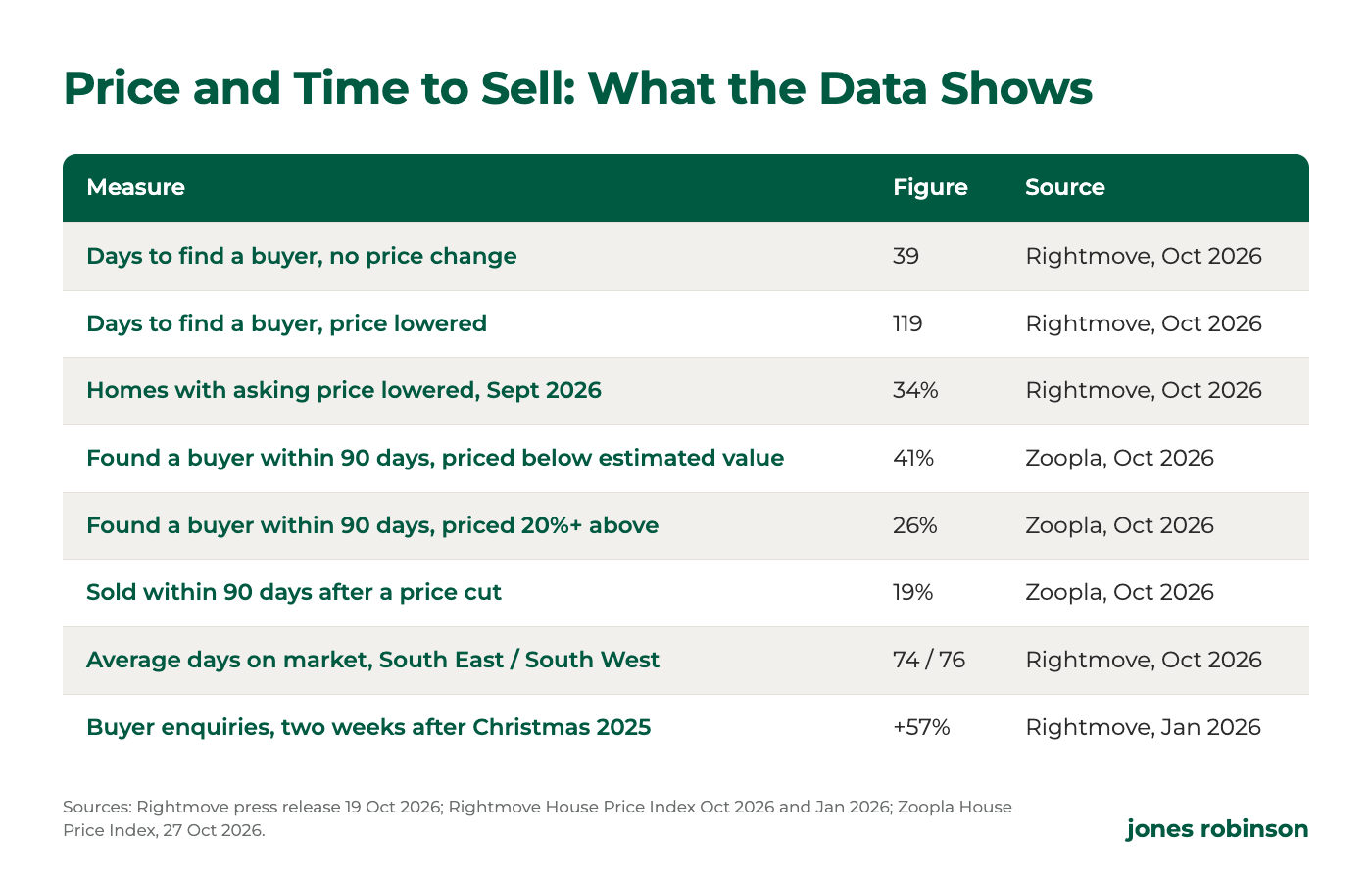
- Price is the usual culprit: homes that did not need a price change found a buyer in 39 days on average, against 119 days for those that did (Rightmove, October 2026).
- Rightmove's price filters run in £25,000 steps between £300,000 and £500,000, so a well-judged change of asking price can put your home in front of a new set of buyers.
- Homes in the South East and South West take 74 and 76 days on average to find a buyer (Rightmove, October 2026), so a few quiet weeks is not automatically a problem.
- Before switching agent, check your sole agency period and notice terms.
- Over winter, either keep marketing through December or plan a refreshed January relaunch: buyer enquiries rose 57% in the fortnight after Christmas 2025 (Rightmove, January 2026).
How Long Should It Take to Sell a House?
Across the UK, homes that sell find a buyer in 44 days on average, according to the Zoopla House Price Index (27 October 2026). Rightmove's regional figures for October 2026 are higher: 74 days in the South East, which includes West Berkshire and South Oxfordshire, and 76 days in the South West, which includes Wiltshire. Treat these as a guide, not a deadline.
Local prices have held steady. The latest ONS and HM Land Registry figures (published 21 October 2026) put the provisional average for August 2026 at £402,000 in West Berkshire, broadly flat on a year earlier. Wiltshire stands at £328,000 (up 1.5%) and South Oxfordshire at £471,000 (up 2.2%). For a closer look at one town, see what percentage of homes actually sell in Devizes.
What Is Happening in the Market This Autumn?
Zoopla reports 7% more homes for sale than a year ago and 7% fewer sales agreed. Rightmove's October 2026 report says stock is at its highest for the time of year since 2014, while the average two-year fixed mortgage rate has risen to 5.55%, from 5.29% a month earlier. Buyers can afford to compare carefully. If a month has passed with few viewings, or a run of viewings has produced no offers, review the plan rather than wait.
How to Tell Why Your House Is Not Selling
Start with the evidence you already have. Match what you are seeing to the closest row below, then read the section that covers it.
| Symptom | Likely Cause | What to Do |
|---|---|---|
| Few portal views or saves | Price outside buyers' search bands, or a weak lead photo | Check price thresholds and reshoot the main image |
| Good views, few viewing requests | Weak photos or a thin description | Rewrite the listing and add a floorplan and material information |
| Viewings but no offers | Price high for the condition, or presentation | Act on the feedback, then review the price |
| Second viewings that do not convert | A specific objection, such as parking or room size | Ask your agent to find out exactly what stopped the buyer |
| Offers well below asking | Asking price ahead of recent sold evidence | Ask for a fresh valuation based on comparable sales |
| Sales agreed, then falling through | Legal, survey, lease or chain problems | Prepare documents early and progress the sale closely |
| Interest faded after launch week | The listing has gone stale | Reprice into a new search band or plan a relaunch |
| Little contact from your agent | The strategy has drifted | Ask for a written marketing review with agreed next steps |
1. The Asking Price Is Too High
Price is the most common reason a home sits. The Zoopla House Price Index for October 2026 found that 41% of homes priced below their estimated value found a buyer within 90 days, compared with only 26% of homes priced at least 20% above it. Rightmove reports that around 34% of homes had their asking price lowered in September 2026 (Rightmove, October 2026).
The warning signs are offers well below asking, and viewers who like the house but then buy something similar nearby for less. Our guide to the real cost of overpricing your home looks at what launching too high can cost you.
How Portal Price Bands Work
Buyers on Rightmove pick minimum and maximum prices from a fixed list: £25,000 steps between £300,000 and £500,000, then £50,000 steps up to £700,000. A home listed at £410,000 is invisible to every buyer who sets a £400,000 maximum. In West Berkshire, where the average price is £402,000, that cap sits almost exactly at the local average.
Moving the asking price across a threshold brings the listing into a new set of searches straight away. A move from £435,000 to £425,000 puts the home in front of buyers capped at £425,000, who could not see it before. Your agent should be able to tell you which bands your likely buyers are searching in.
When Should You Change the Asking Price?
Give the launch around four to six weeks of steady marketing, then look at the evidence. If viewings are thin or viewers keep mentioning price, repricing is usually the right call. One decisive move into a new search band tends to work better than a string of small trims, which can make a listing look stale.
A new price is not a guaranteed fix on its own. Zoopla found only 19% of homes with a price cut sold within 90 days, against 41% with no change, so pair any new price with refreshed photos and wording. If your valuation is a few months old, ask for a fresh one based on recent local sales; our guide explains how long a house valuation takes.
2. The Photos and Listing Do Not Do It Justice
Buyers usually see your home online first, often on a phone. If views are reasonable but viewing requests are low, the listing itself is the likely problem. Dark rooms, a cluttered lead photo, a summer garden still showing in November or a missing floorplan all give buyers a reason to scroll on.
Ask for professional photography in good light, with the strongest image first, and a specific, accurate description. The listing should also give buyers the facts they need to decide, such as council tax band and tenure. Leaving out information the average buyer needs is a misleading omission under section 227 of the Digital Markets, Competition and Consumers Act 2024, and gaps make buyers wary.
3. First Impressions and Kerb Appeal Are Putting Buyers Off
Many buyers drive past before they book. If viewers seem subdued from the moment they step out of the car, the outside deserves a hard look.
Clear the path, cut back hedges, hide the bins, clean the windows and repaint a tired front door. Winter viewings often happen after dark, so working outside lights matter. For rural homes around Lambourn, Pewsey or the villages near Devizes, make the property easy to find with a clear name sign and accurate directions, so buyers do not arrive late and flustered.
4. The Condition or Presentation Inside Needs Work
Viewings without offers, plus feedback such as "needs too much work" or "smaller than expected", usually point to presentation. Buyers struggle to see past clutter, smells, damp patches or a list of small repairs, and they deduct generously for every job they spot.
Focus on low-cost fixes. Declutter so rooms look their true size, fix dripping taps and sticking doors, treat any condensation or mould, and repaint scuffed walls in neutral tones. Avoid large projects purely to sell, as the return is uncertain. Our guide on how to prepare to sell your house has more practical ideas.
5. You Are Not Getting Useful Viewing Feedback
"Not for us" is not feedback. If you cannot say why the last five viewers did not offer, you are guessing at the fix.
Ask your agent to collect specific feedback from every viewer within a day or two and share it in writing. Look for patterns rather than single comments: if three viewers mention the second bedroom, that is the issue to tackle. Accompanied viewings help here, because buyers tell an agent things they would never say to the owner.
6. The Timing Is Working Against You
Some quiet spells are seasonal. Rightmove's ten-year average shows new asking prices falling by 1.4% in December (Rightmove, December 2025). If interest has dropped across your area, not just at your home, timing is part of the answer.
Relaunching in the New Year
A stalled autumn listing has two sensible options. You can keep marketing through December, when fewer homes compete and the buyers still looking tend to be serious. Or you can pause and relaunch in early January with new photos and a reviewed price. In the two weeks after Christmas 2025, buyer enquiries rose by 57% and new listings by 81% compared with the fortnight before (Rightmove, January 2026).
That surge brings more competition as well as more buyers, so a relaunch only works if something has genuinely changed. Taking a home off the market is not the same as ending your agency agreement, so check the terms first. Our article on selling and buying a house in January covers the winter market in more detail.
7. The Marketing Is Not Reaching Enough Buyers
Listing on the portals is only the start. If nearly all your enquiries come from one town, or you do not know how many registered buyers have been contacted, reach may be the gap.
Ask your agent which portals the home appears on, and how many matching buyers on their database have been called rather than emailed. Our region draws buyers from further afield, including London commuters using the Paddington lines from Newbury and Didcot. Ask whether the marketing reaches people who do not yet know the area.
8. Buyers Are Finding Problems: EPC, Lease or Legal Issues
If sales fall through, or buyers go quiet after asking questions, something in the paperwork may be causing doubt. You must order an Energy Performance Certificate before you market a home, and it is valid for 10 years (GOV.UK). A low rating gets buyers thinking about heating bills, while a good EPC rating can be a selling point.
For leasehold homes, a short lease or high service charges can narrow the pool of buyers and lenders; our guide to freehold vs leasehold explains the differences. Other common snags include missing building regulations certificates, unclear boundaries, shared drives and private drainage on rural properties. Instruct your solicitor early, gather certificates and planning documents before a buyer asks, and disclose known issues upfront.
9. The Strategy and Communication Have Stalled
Sometimes the house is fine and the plan is the problem. Weeks without an update, with the same photos and price since launch, mean the sale needs a reset rather than more patience.
Ask your agent for a written review covering portal performance, viewings, feedback, comparable sales since you listed, and what they recommend next. A good agent will welcome the conversation. For a benchmark, our guide to the one number worth asking an estate agent for is a useful starting point.
Should You Switch Estate Agent? Check Your Contract First
If the review does not reassure you, switching is reasonable. Read your agreement first and check four things:
- The type of agreement: in the standard wording set by the Estate Agents (Provision of Information) Regulations 1991, sole agency means a fee is due if you exchange with a buyer introduced by that agent, or by another agent, during the agency period. Sole selling rights also cover a buyer you find yourself.
- The sole agency period and notice: how long exclusivity lasts and what notice ends it.
- Fees after you leave: a fee is usually owed if a buyer introduced during the agency period later buys your home.
- Withdrawal costs: any early-exit charges or a "ready, willing and able" clause.
Instructing a new agent while a sole agency period is still running can leave you liable for two fees, so time the change carefully. The Property Ombudsman has a plain-English guide to these terms, and our article on estate agent fees explained covers how fees are structured. If any clause is unclear, ask a solicitor to check it before you give notice. When you do move, tell your new agent who has already viewed.
How Jones Robinson Can Help
If your home is on the market and not moving, we can give you a fresh Valuation and a second opinion on how it is being marketed. Our team across six offices includes Jonathan Shortt MRICS, a Chartered Surveyor and RICS Registered Valuer. Our viewings are accompanied, with feedback passed back to you.
Once a buyer is found, a Dedicated Sales Progressor manages the sale through to completion. Between February 2025 and February 2026, 76% of the properties we marketed received more than one offer (Jones Robinson figures). Read more about selling with Jones Robinson and our sale process.
Frequently Asked Questions
What Is the Most Common Reason a House Does Not Sell?
An asking price above what buyers think the home is worth next to similar properties nearby. Weak presentation often makes a price problem worse.
How Long Should I Wait Before Changing My Asking Price?
Around four to six weeks of active marketing usually gives enough evidence. If viewings and feedback point to price by then, waiting longer rarely helps.
Should I Take My House Off the Market Over Christmas?
Not necessarily. December buyers tend to be committed and staying live keeps you visible, though a planned January relaunch is a sound alternative.
Can I Change Estate Agent Before My Contract Ends?
Usually, yes, by giving the notice your agreement sets out, though some agreements fix a minimum sole agency period first. You may still owe your first agent a fee if a buyer they introduced goes on to buy.
Is an Empty House Harder to Sell?
It can be, as empty rooms often look smaller. A few pieces of furniture help buyers judge scale, and keeping the heating on in winter helps the home feel cared for.
If your home has been on the market longer than you expected, a second opinion can show you why. Book a Valuation with your local Jones Robinson office for a fresh price and marketing review.