

In this blog
- How Much Do Estate Agents Charge to Sell a House in 2026?
- What Would You Pay on a Typical Home in Our Area?
- Percentage Fee or Fixed Fee: Which Is Better Value?
- When Do You Pay Estate Agent Fees?
- Sole Agency, Sole Selling Rights and Multi-Agency Explained
- What Your Estate Agent Contract Must Tell You
- Can You Negotiate Estate Agent Fees?
- What Should the Fee Actually Buy You?
- What Are the Other Costs of Selling a House?
- How Jones Robinson Can Help
- Frequently Asked Questions
UK high street estate agents typically charge between 1.2% and 1.8% of the sale price, including VAT, for a sole agency, no sale, no fee service, and published averages sit at around 1.3% to 1.42%. Multi-agency costs more, at up to about 3.6%. Fixed fees, often from online agents, usually run from £500 to £1,500.
On a home at West Berkshire's August 2026 average price of £402,000, that sole agency range works out at roughly £4,800 to £7,200. The percentage is only part of the picture, though. The contract behind it decides when you pay and what happens if you find a buyer yourself, and we cover both below.
Key Summary
- Published averages are about 1.3% including VAT (Rightmove, 2025) and 1.42% including VAT for high street sole agency (HomeOwners Alliance, 2026).
- Sole agency typically costs 1.2% to 1.8% including VAT. Multi-agency is quoted at up to 3.6%.
- Fixed fees are typically £500 to £1,500 and are often paid upfront, whether or not your home sells.
- By law, an agent must tell you in writing what you'll pay, and when, before you're committed.
- Before you sign, check how long the tie-in lasts and whether a withdrawal fee applies. Look out for "sole selling rights" or "ready, willing and able purchaser" wording.
- Budget for other costs too: conveyancing averages £929 and an EPC around £65 (HomeOwners Alliance), plus removals and any early repayment charge on your mortgage.
How Much Do Estate Agents Charge to Sell a House in 2026?
Traditional agents charge commission: a percentage of the price your buyer actually pays, not the asking price. Citizens Advice puts the overall market range at anything from less than 1% to 3.5%. Where you land depends mostly on the type of agreement you sign and the level of service you buy.
| Fee type | Typical cost | Source |
|---|---|---|
| Average paid by sellers (2025) | Around 1.3% inc. VAT | Rightmove |
| High street sole agency, no sale, no fee (2026) | 1.42% inc. VAT on average | HomeOwners Alliance |
| Sole agency | 1.2% to 1.8% inc. VAT | HomeOwners Alliance |
| Multi-agency | 3% to 3.6% inc. VAT | HomeOwners Alliance |
| Fixed fee (often online agents) | £500 to £1,500 | Rightmove |
Sources: Rightmove, estate agent fees guide (updated April 2026); HomeOwners Alliance, estate agent fees (updated October 2026); Which?, estate agent fees and contracts (June 2026).
Higher-value homes often attract a lower percentage. Ask every agent for a written fee in pounds at your expected sale price, so you are comparing like with like.
What Would You Pay on a Typical Home in Our Area?
Here is the arithmetic on the average house price in each district our offices cover, using the latest ONS figures (August 2026, provisional). Each row shows a fee quoted plus VAT at 20%, with its VAT-inclusive equivalent in brackets.
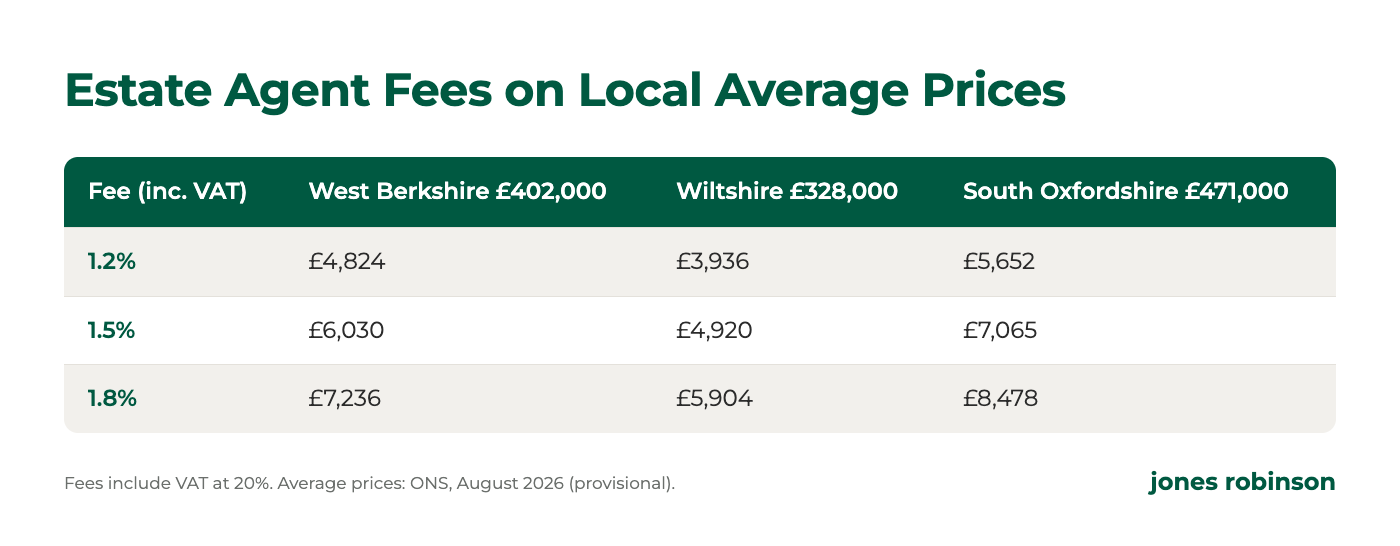
| Fee rate | West Berkshire (£402,000) | Wiltshire (£328,000) | South Oxfordshire (£471,000) |
|---|---|---|---|
| 1% + VAT (1.2% inc. VAT) | £4,020 + £804 VAT = £4,824 | £3,280 + £656 VAT = £3,936 | £4,710 + £942 VAT = £5,652 |
| 1.25% + VAT (1.5% inc. VAT) | £5,025 + £1,005 VAT = £6,030 | £4,100 + £820 VAT = £4,920 | £5,887.50 + £1,177.50 VAT = £7,065 |
| 1.5% + VAT (1.8% inc. VAT) | £6,030 + £1,206 VAT = £7,236 | £4,920 + £984 VAT = £5,904 | £7,065 + £1,413 VAT = £8,478 |
Average prices: ONS, Housing prices in West Berkshire, Wiltshire and South Oxfordshire (August 2026, provisional, published October 2026).
Notice how much "1.5%" can mean. Quoted plus VAT, it comes to £7,236 on a West Berkshire average home. Quoted including VAT, it is £6,030. The Property Ombudsman's Code requires member agents to quote percentage fees inclusive of VAT, but if anyone gives you a figure verbally, ask which version they mean.
Your own home won't sit exactly on a district average, of course. An Instant Valuation gives you a quick estimate to run these numbers against.
Percentage Fee or Fixed Fee: Which Is Better Value?
A percentage fee ties the agent's pay to your result. High street agents commonly work on a no sale, no fee basis, so you normally pay nothing unless the sale goes through, and the fee rises or falls with the price achieved.
Fixed fees work the other way round. Rightmove and Which? both note that they are often paid upfront and kept if the home doesn't sell, and Rightmove adds that pay-on-completion versions cost more. The real difference is who carries the risk. With an upfront fixed fee, you do. With no sale, no fee, the agent does.
When Do You Pay Estate Agent Fees?
On a no sale, no fee agreement, you usually pay on completion. Your conveyancer settles the agent's invoice from the sale proceeds, so the money doesn't normally come out of your own pocket first. Our guide to the sale process shows where each stage falls.
Some contracts make the fee due at exchange of contracts instead. Rightmove notes this matters only in rare cases, though it is worth checking if completion is set well after exchange.
Sole Agency, Sole Selling Rights and Multi-Agency Explained
These terms decide when you owe a fee. Three of them have exact legal definitions under the Estate Agents (Provision of Information) Regulations 1991, and an agent that uses them must set out the definition in full, as prominently as the rest of the contract.
- Sole agency: one agent markets your home for an agreed period and is paid if you exchange with a buyer it introduced, or with a buyer introduced by another agent during that period. Find a buyer yourself and you owe nothing.
- Sole selling rights: you owe the agent a fee if unconditional contracts are exchanged during the agreement period, even with a buyer you found yourself. Which? recommends not signing this type of contract.
- Multi-agency: several agents market the home and only the one that introduces the buyer is paid, at a higher rate than sole agency.
- Ready, willing and able purchaser: a fee can fall due once the agent introduces a buyer who is prepared and able to exchange unconditional contracts, even if you then decide not to sell.
For most sellers, sole agency strikes the right balance between commitment and cost. If a contract includes "sole selling rights" or "ready, willing and able purchaser", ask the agent to explain why, in writing, before you sign.
What Your Estate Agent Contract Must Tell You
Under section 18 of the Estate Agents Act 1979, the agent must give you its fee details before you enter the contract: when a fee becomes payable, how much it is (or how it will be worked out), and any other payments you may have to make. If it doesn't, the contract can't be enforced against you without a court order.
The National Trading Standards Estate and Letting Agency Team (NTSELAT), which regulates estate agency work under the Estate Agents Act, also says charges should be broken down rather than shown as a single total. Every agent doing residential estate agency work must belong to an approved redress scheme under the Estate Agents (Redress Scheme) Order 2008.
What The Property Ombudsman Code Requires
Agents registered with The Property Ombudsman (TPO) must follow its Code of Practice for Residential Estate Agents. Among other things, it requires:
- VAT-inclusive fees: percentage fees quoted inclusive of VAT, and fixed fees stated as the actual amount payable including VAT.
- A clear minimum term: the contract must state how long the instruction lasts and let you give notice so you can leave when it expires.
- Withdrawal fees stated upfront: any charge for ending the instruction must be specified in the terms and reflect work done, not act as a penalty.
- A 14-day cancellation right: if you sign at home, at work or online rather than at the agent's office, you can cancel within 14 days, in line with the Consumer Contracts (Information, Cancellation and Additional Charges) Regulations 2013.
- Clear terms on later claims: the agent must explain that it may still be owed a fee if, within 6 months of its instruction ending, you agree a sale through another agent to a buyer it introduced. Where no other agent is involved, that period is 2 years.
Tie-In and Notice Periods
The Code doesn't set a maximum tie-in. Which? suggests avoiding anything over eight weeks, while HomeOwners Alliance reports 4 and 12 weeks as the most popular terms. A notice period, often two weeks, may apply on top, and switching agent during the tie-in can leave you owing two fees. Your contract is a legal document, so if any term is unclear, ask a solicitor to check it against your circumstances before you sign.
Can You Negotiate Estate Agent Fees?
Yes. Fees vary from agent to agent, and Which? recommends inviting around three agents to value your home and quote. Ask each for the fee in pounds including VAT, along with a copy of the terms of business, then read them side by side.
Negotiate on structure as well as the headline rate. A shorter tie-in is a reasonable request. So is a sliding scale, where a higher sale price earns the agent a higher percentage.
Be wary of choosing purely on the lowest quote, or on the highest valuation. An inflated asking price can cost you far more in lost time than you save on commission, as we explain in the real cost of overpricing your home. Our article on how to choose an estate agent and the one number worth asking for sets out a better way to compare them.
What Should the Fee Actually Buy You?
Fee differences are easy to see. Differences in service are harder to spot, and they usually matter more. On a West Berkshire average home, the gap between a 1.2% and a 1.8% fee (both including VAT) is £2,412, while a 1% difference in the price you achieve is £4,020. No agent can promise a price, but those two numbers are why we'd look as hard at the service as at the rate.
When you compare agents, ask what each part of the fee pays for:
- Valuation: an asking price based on local sold evidence, not a flattering number. Our guide to what a good estate agent valuation should involve explains what to look for.
- Marketing: professional photography, floor plans, portal listings and active matching to registered buyers, including London commuters using the Paddington line from Newbury and Didcot.
- Viewings: accompanied, with prompt feedback.
- Offer handling: checking a buyer's position and finances before you accept.
- Sales progression: someone chasing solicitors and the chain every week until completion.
In a rural and market-town patch like ours, the valuation carries extra weight. Village homes and houses with land rarely have a neat set of comparables, and a cottage near Pewsey is priced very differently from a new-build in Didcot. For more to ask at the valuation appointment, see our 10 questions to ask when choosing an estate agent.
What Are the Other Costs of Selling a House?
The agent's fee is normally the largest selling cost. HomeOwners Alliance estimates the total at around £5,000 for an average UK home of £290,000 once conveyancing and an EPC are added, before removals or mortgage charges.
| Cost | Typical amount | Source |
|---|---|---|
| Conveyancing (selling) | £929 average, including disbursements and VAT | HomeOwners Alliance |
| Energy Performance Certificate | Around £65; valid for 10 years | HomeOwners Alliance; GOV.UK |
| Removals, 3-bedroom house | £792 average for a move within 25km | HomeOwners Alliance (August 2026 data) |
| Mortgage early repayment charge | Typically 1% to 5% of the balance, if you leave a fixed or discounted rate early | Moneyfacts |
Sources: HomeOwners Alliance, cost of selling a house (updated October 2026); GOV.UK, energy performance certificates; Moneyfacts, early repayment charges explained (August 2025).
You must order an EPC before your home goes on the market, unless you already have a valid one. Conveyancing has no set scale of fees, so compare quotes and check what you'd pay if the sale fell through. Our conveyancing service works with partner firms on fixed legal fees.
The early repayment charge can be the biggest surprise. On a £250,000 balance, a 3% charge would be £7,500, more than a 1.5% fee (including VAT) on an average West Berkshire home. Check whether your mortgage can be ported, and our mortgage advice service can look at your options. If you're buying again, you can estimate the Stamp Duty on your next home with our Stamp Duty calculator.
How Jones Robinson Can Help
We've sold homes across West Berkshire, Central Wiltshire and South Oxfordshire since 1998, from six offices, and every sale we agree is looked after by a Dedicated Sales Progressor. In 2025 we sold 820 properties, and 76% of the homes we marketed between February 2025 and February 2026 received more than one offer (Jones Robinson figures). We're registered with The Property Ombudsman, so the Code described above applies to our terms.
Ask us for a valuation and we'll set out our fee and terms in writing, including what the fee covers, so you can compare them with any other quote. You can also read more about selling with Jones Robinson.
Frequently Asked Questions
Is a 1% Estate Agent Fee Good?
It depends whether VAT is included. 1% plus VAT is 1.2% including VAT, the lower end of the typical high street sole agency range. A low rate is only good value if the service behind it sells your home at the right price.
Do I Pay Estate Agent Fees If My House Doesn't Sell?
Not on a no sale, no fee agreement, unless the contract includes a withdrawal fee or "ready, willing and able purchaser" wording. Fixed fees paid upfront are usually not refunded.
Do Buyers Pay Estate Agent Fees in England?
Normally no, because the seller's agent is paid by the seller. Citizens Advice notes one exception: in some tender sales, the buyer agrees to pay the agent's fee on completion.
Can I Change Estate Agent Before My Contract Ends?
You can, but within a sole agency tie-in you may end up paying both agents. Serve notice so you leave when the minimum term ends, and check the clause covering buyers your first agent introduced.
How Much Are Estate Agent Fees on a £300,000 House?
At Rightmove's 2025 average of about 1.3% including VAT, you would pay around £3,900. At the 1.42% high street sole agency average reported by HomeOwners Alliance, it would be £4,260.
If you're thinking about selling, Book a Valuation with your local Jones Robinson office and we'll give you a clear, written view of your home's value and what our service includes.