

In this blog
- What does "finding a buyer" mean?
- Why does this number matter more than how fast homes sell?
- Why do so many homes not sell?
- How do we get that result?
- How do you ask for the number, and check the answer?
- What else should you weigh up when choosing an agent?
- Choosing an estate agent: FAQs
We're an independent, owner-led agent across Berkshire, Wiltshire and Oxfordshire, and across our branches, 82% of the homes we put on the market find a buyer. Other agents across the area manage 56%. That figure holds across the towns we cover, earned by local teams, never a national average dressed up to look local. Same towns, same buyers, a very different result for you.
It's the one number worth asking any agent for, because it shows whether they can do the job you're hiring them for: getting your home to a buyer. And most would rather you didn't ask.
Nearly everything else about your sale, the price you achieve, how your home is presented, whether it sells at all, comes down to who you hand it to. It's the most important choice in the process, and the one most sellers spend the least time on. So it's worth judging on proof, not a pitch.
What "finding a buyer" really means
When we say a home finds a buyer, we mean a real offer, accepted, a sale agreed. Not a board in the ground, not a warm chat at the valuation. Words like "interested," "under offer" and "sold" can mean very different things, so we're careful to be clear about ours. When we say 82%, we mean a sale agreed, nothing softer.
A sale agreed is the point at which a listing usually changes to sold STC (subject to contract) on the property portals. It is not the finish line: until contracts are exchanged, either side can still walk away. That is why it is worth asking any agent not only how many homes find a buyer, but how many of those sales go on to complete.
Why this number matters more than how fast homes sell
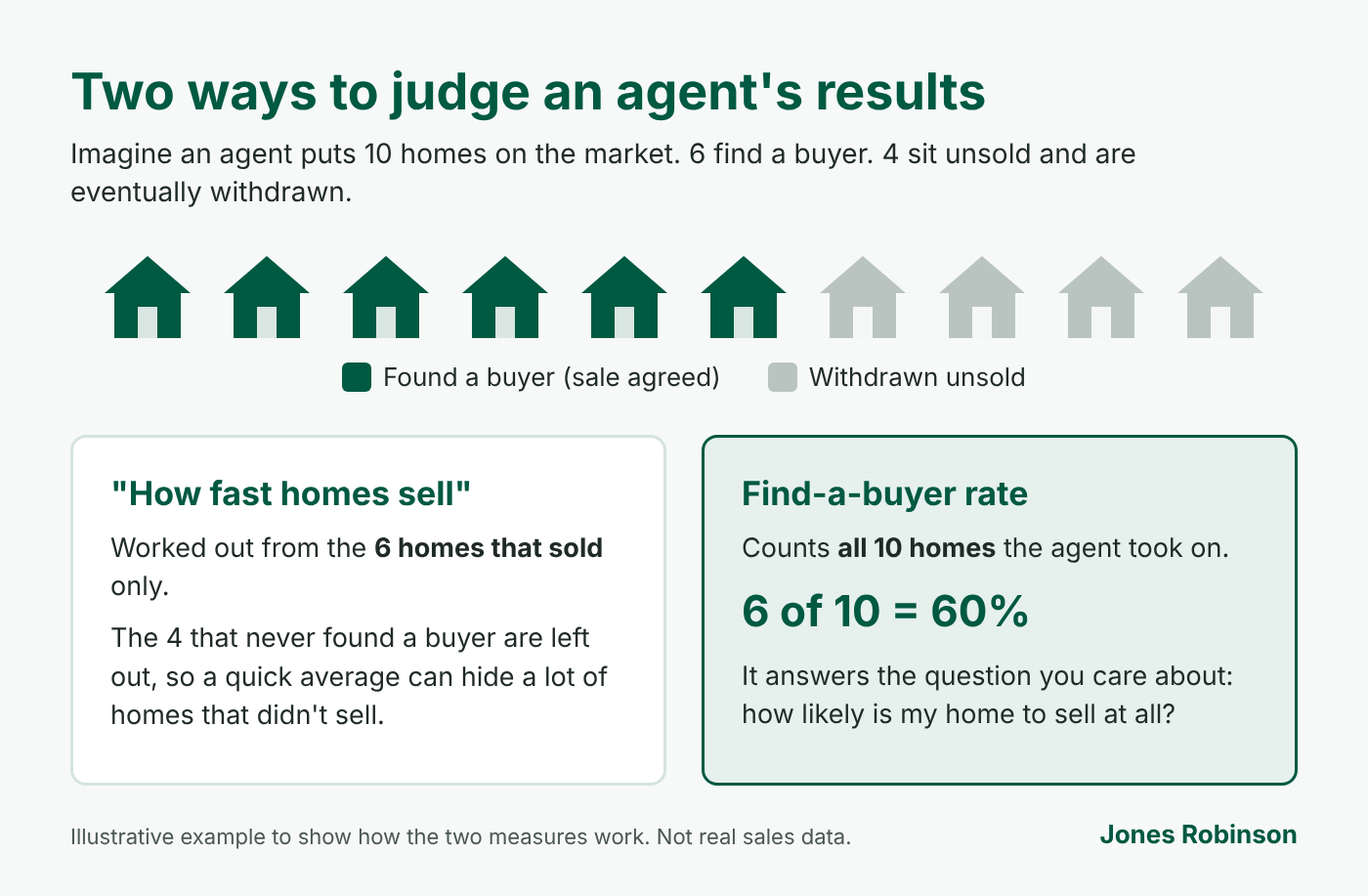
When you're choosing an agent, it's tempting to look at how quickly homes are selling in your area. But that figure has a catch: it's worked out only from homes that actually sold. The ones that sat on the market for months and were taken off unsold aren't counted at all.
So "how fast homes sell" only tells you about the homes that made it. It says nothing about how many didn't sell in the first place.
The find-a-buyer rate is different. It counts every home an agent takes on, sold or not, so it tells you the thing you actually want to know: how likely is your home to sell at all? And the answer is sobering. With a typical agent, close to half of homes never find a buyer. With us, it's around four in five.
Why so many homes don't sell
Close to half of homes never finding a buyer sounds unlikely, and most sellers assume it couldn't be them. But it's rarely the home itself. Homes usually fail to sell for one of three avoidable reasons, and every one of them comes down to the agent.
The most common is overpricing at the start. An agent quotes a tempting figure to win the instruction, the home launches too high, and by the time the price is corrected it looks stale, and buyers are wary. The best weeks were spent at the wrong price. Rightmove's own data backs this up: homes that don't need a price reduction find a buyer in 39 days on average, against 119 days for homes that are reduced, and homes are 13% more likely to sell if they avoid a reduction (Rightmove, October 2026). We look at this in more detail in the real cost of overpricing your home.
Then there's weak presentation, poor photos and a flat description that get scrolled past in the first few days, when attention is highest. And there's poor follow-up: enquiries not chased, viewings not fed back, offers not nurtured, a chain left to drift until it falls apart. Often the buyer was there all along. They were just allowed to slip away.
None of that is about the market or the house. It's about how the home is priced, presented and handled, which is exactly why the agent you choose makes the difference.
Why we get that result, and it isn't luck
It comes down to three things we've done the same way for years. We price your home honestly, to sell, not to flatter you into instructing us. We present it properly from the first day it goes live, because that's when it gets the most attention. And we stay close to every buyer and hold your chain together until the deal is done, a real local person who knows your sale, not a call centre. A board going up isn't the finish line. Your buyer is.
How to ask for the number, and how to check the answer
A percentage on its own can be shaped to look good, so when an agent gives you their figure, a few follow-up questions will tell you whether it means what you think it means:
- Over what period, and how many homes? A rate based on the last twelve months and a good number of homes tells you far more than one based on a handful.
- Does it include homes that were withdrawn or moved to another agent? It should. Those are exactly the homes that "how fast homes sell" leaves out.
- Is it sales agreed or completions? Both are useful, as long as you know which one you are being shown. Ask how often agreed sales fall through, and what the agent does to keep a chain together.
- Is it for your town and your type of home? A figure for flats in one town says little about a period cottage in a village a few miles away.
You can also do some checking yourself before the valuation. On Rightmove you can search your town and choose to include homes that are under offer or sold STC, so you can see which of each agent's current listings already have a buyer. Listings also show when an asking price has been reduced. If many of one agent's homes have been cut, it can be a sign of a habit of launching too high.
| The number an agent quotes | What it tells you | What it leaves out |
|---|---|---|
| The valuation figure | What the agent suggests your home could be marketed at | Whether buyers will pay it. The highest quote costs an agent nothing to give |
| How fast homes sell | How quickly the homes that sold found a buyer | Every home that sat unsold and was withdrawn |
| Number of homes on the market or boards up | How many instructions the agent has won | How many of those homes actually find a buyer |
| Find-a-buyer rate | The share of all homes taken on that reached a sale agreed | Whether those sales went on to complete, so ask about that too |
What else to weigh up
The find-a-buyer rate is the best single test of an agent, but it isn't the only thing to check. Fees, contract length and tie-in periods, who carries out viewings and how often you will hear from the agent all matter too. We cover those in 10 questions to ask when choosing an estate agent, and look at local knowledge, marketing and communication in how to choose an estate agent in Berkshire or Wiltshire.
It is also worth a quick check that any agent you are considering belongs to a redress scheme. Every estate agent dealing with residential property in the UK must be a member of one of the two approved schemes, The Property Ombudsman or the Property Redress Scheme, so you have somewhere independent to go if a complaint cannot be resolved (GOV.UK).
Choosing an estate agent: FAQs
Does it make a difference which estate agent you use?
Yes. Agents in the same town are marketing to the same buyers, so the difference comes from how each one prices, presents and handles a home. That is why find-a-buyer rates can differ between agents covering the same area.
What is a good find-a-buyer rate?
There is no single national benchmark, so the useful comparison is local: the same town, the same period and, ideally, similar homes. Ask each agent for their own rate and for the figure across all agents in your area over the same period, then compare like with like. You can see how this plays out in one town in what percentage of homes actually sell in Devizes.
Should I choose the agent who gives the highest valuation?
Not on that basis alone. Ask each agent to show you the comparable sales behind their figure and what they would do if there are no offers in the first few weeks. A price that needs cutting later usually costs more than an honest one at the start. Our guide to what a good estate agent valuation should actually involve explains what to look for.
Is "sold STC" the same as sold?
No. Sold STC means an offer has been accepted, subject to contract. The sale is only legally binding once contracts are exchanged, so it is worth asking how an agent keeps sales on track between the offer and exchange.
Before you choose
Choosing an agent is a decision every seller has to make. The only question is whether you make it on a pitch, or on proof. So ask each agent the same question: of the homes you put on the market, how many actually find a buyer? If they can show you, and it's a good number, listen. If they can't, you have your answer.
When you're ready, book a valuation with your local team at one of our offices in Newbury, Didcot, Marlborough, Devizes, Pewsey and Lambourn. We'll give you an honest price, show you the local proof behind our figure, and explain what it means for your home. No fuss, no spin, no pressure.