

In this blog
- What does Sold STC mean?
- What does Sold STC mean for sellers?
- What does Sold STC mean for buyers?
- Can a Sold STC property still fall through?
- What's the difference between Sold STC and under offer?
- Can you still make an offer on a property that's Sold STC?
- How long does it take to go from Sold STC to completion?
- Legal implications of Sold STC
- FAQs
What Does Sold STC Mean?
If you're searching for a new home, you've likely come across the term 'Sold STC', but what does it actually mean?
Sold STC (Sold Subject to Contract) means the seller has accepted an offer on the property, but the sale is not yet legally binding. The necessary legal checks, paperwork, and mortgage approvals must be completed before the transaction is final.
STC stands for 'subject to contract'. It tells you the deal depends on contracts being signed and exchanged, which can take several months. You may also see it written as SSTC (sold subject to contract), which means exactly the same thing.
How Sold STC Fits into the House-Buying Process
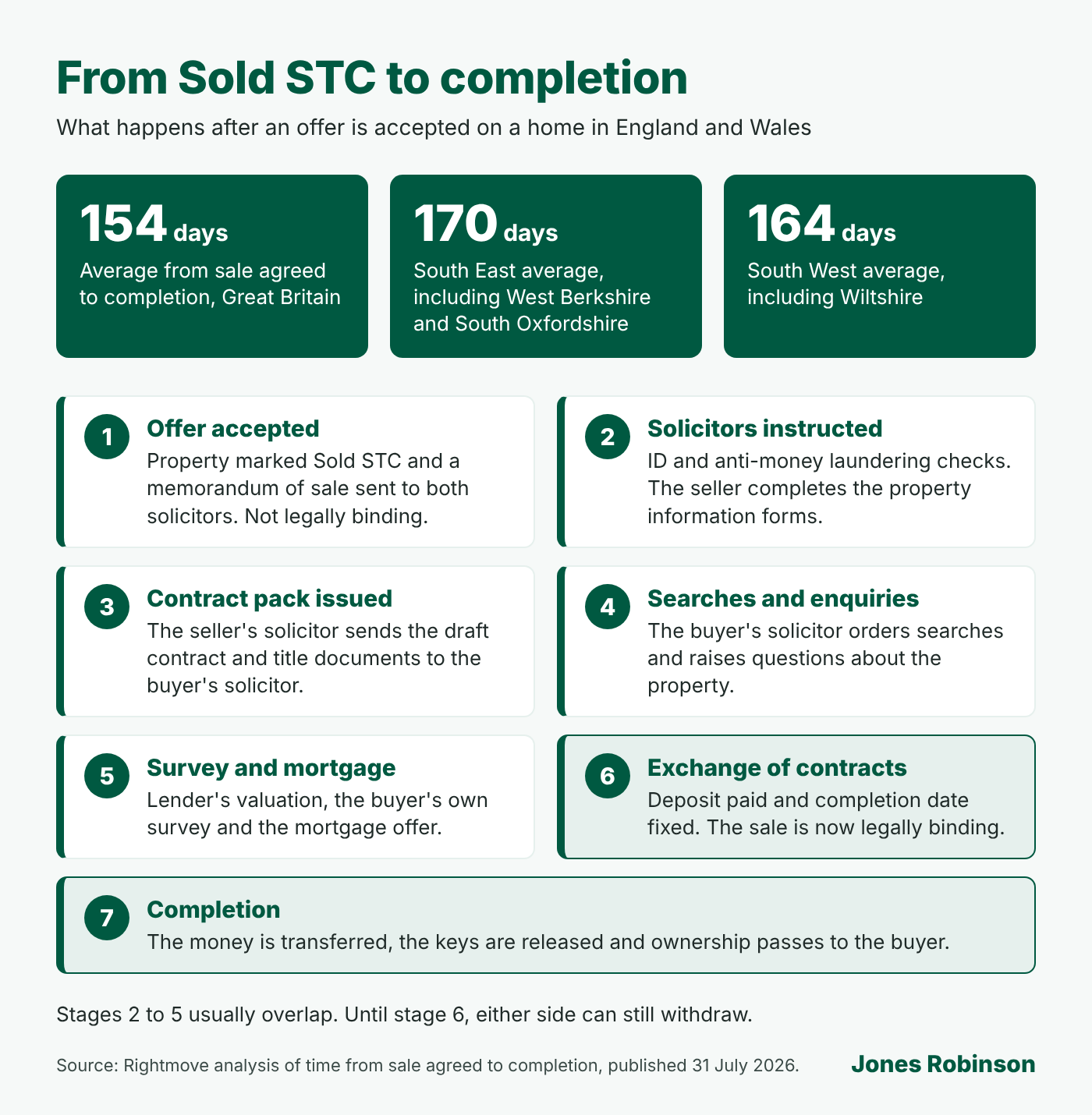
When a property is marked as sold STC, the following steps typically occur:
- The buyer's offer is accepted by the seller.
- The property is usually taken off the market while legal checks and mortgage approvals take place.
- Both parties instruct solicitors to handle conveyancing and contracts.
- The sale progresses to exchange of contracts, making it legally binding.
- The final step is completion, when ownership officially transfers to the buyer.
How Does Sold STC Differ from a Completed Sale?
A sold STC property is not yet a done deal. Either party can still withdraw from the sale, and complications such as mortgage delays, legal issues, or survey problems could cause the deal to fall through. The sale only becomes legally binding when contracts are exchanged. A completed sale is the final step after that: on completion day the money is transferred, the keys are released and ownership passes to the buyer.
What Does Sold STC Mean on Rightmove and For Sale Boards?
On Rightmove and other property portals, a Sold STC label means the same as it does on an agent's board: the seller has accepted an offer and the legal work is under way. Rightmove explains that these homes are usually no longer advertised to other buyers, but they can come back on the market if the seller withdraws, a survey uncovers problems or the chain breaks (Rightmove). The label usually stays in place until the sale completes, which is why you may see the same property marked Sold STC for several months.

What Does Sold STC Mean for Sellers?
For sellers, having a property marked as sold STC is a positive step, but it doesn't mean the sale is guaranteed. Until contracts are exchanged, there's still a chance the deal could fall through. However, a good agent will keep in touch with all parties connected with the sale, the sellers, buyers, both sets of solicitors and other agents up and down the chain if applicable. At Jones Robinson, once your sale is agreed your valuer hands it over to a dedicated sales progressor, who will introduce themselves and then update you every week, working to keep the sale on track and avoid a fall-through.
Sellers looking to put their property on the market or understand its value can book a valuation with Jones Robinson.
What Happens After a Property Is Sold STC?
Once your home is sold subject to contract, the agent sends a memorandum of sale to both solicitors, confirming the agreed price and who is involved. You should then:
- Instruct a solicitor to begin the conveyancing process. For in depth conveyancing advice consider consulting with Jones Robinson's conveyancing experts to help complete the process quickly and efficiently.
- Complete your solicitor's ID checks and return the property information and fittings and contents forms as soon as you can.
- Respond promptly to buyer enquiries and legal paperwork.
- Ensure the buyer's mortgage application is progressing smoothly.
- Allow access for the buyer's mortgage valuation and any survey they book.
Risks for Sellers
Common risks at this stage include:
- The buyer pulling out due to financial issues or a change of heart.
- A low mortgage valuation causing the lender to withdraw funding.
- Gazundering, when a buyer reduces their offer late in the process.
- A break elsewhere in the chain, such as your buyer's own sale falling through.
To avoid delays, sellers should ensure all necessary documents are ready, respond quickly to solicitor and estate agent communications, and push for a clear timeline for exchange and completion. Find out more about selling with Jones Robinson and see how our rigorous sales process helps minimise risks.
What Does Sold STC Mean for Buyers?
For buyers, seeing a property marked as sold STC means your offer has been accepted, but the sale is not yet legally binding.
Learn more about the buying process with Jones Robinson and make your move with confidence, or if you're a first-time buyer, check out our first-time buyer service.
What Should Buyers Do Next?
To keep the transaction on track, buyers should:
- Arrange their mortgage (if applicable) and secure a mortgage in principle.
- Conduct a property survey to check for structural issues. Our guide to level 2 vs level 3 surveys explains which one suits different homes.
- Work with their solicitor to review contracts and ensure all legal aspects are in order before exchange.
- Pay for searches promptly so your solicitor can order them early. Find out more about the three main searches when buying a house.
- Have your ID and proof of funds ready, as your solicitor and the agent must carry out anti-money laundering checks.
Can a Buyer Back Out?
Yes, buyers can withdraw before contracts are exchanged without legal penalties. However, any money spent on surveys, mortgage applications, or solicitor fees may be lost.
What If Another Buyer Makes a Higher Offer?
If another buyer submits a higher offer after a property is sold STC, the seller is legally allowed to accept it. This is known as gazumping. While legal in England and Wales, it is controversial and frustrating for buyers. Many sellers won't consider it, due to the risk of losing the original buyer if the second buyer then fails to proceed.
To reduce the risk of gazumping:
- Ask the seller to take the property off the market after accepting your offer.
- Move quickly with mortgage approvals and legal steps. Consider using our mortgage services for help with this stage.
- Consider a lock-out agreement, where the seller agrees not to deal with other buyers for a set period. Our guide to gazumping and gazundering explains how these and reservation agreements work.

Can a Sold STC Property Still Fall Through?
Yes, a property marked as sold STC can still fall through before contracts are exchanged.
It happens more often than many people expect. The government estimates that around one in three transactions fall through, costing consumers an estimated £400 million a year (MHCLG home buying and selling reform roadmap, June 2026). Rightmove's analysis found that 23% of transactions initially fall through before later completing successfully, while around 6% fall through and do not come back to the market within 12 months (Rightmove, February 2026).
Common Reasons a Sale Collapses
- Buyer financing issues.
- Survey problems leading to renegotiations or withdrawal.
- Legal complications with property deeds or outstanding disputes.
- Gazumping or the seller changing their mind.
- A problem further up or down the chain.
Will Sold STC Become More Secure?
Possibly, but not yet. In June 2026 the government published a roadmap to reform home buying and selling in England. It plans to require sellers and agents to provide key information upfront in a 'sales pack' when a property is listed, and later to introduce binding conditional contracts so that buyers and sellers cannot walk away months into a sale without a legitimate reason. These changes need legislation, which the government aims to bring in by the end of this Parliament, and binding contracts will only follow once sales packs are embedded. For now, nothing makes an accepted offer binding before exchange, although the government is encouraging the voluntary use of reservation agreements (GOV.UK).
What's the Difference Between Sold STC and Under Offer?
What Does Under Offer Mean?
Under offer usually means a buyer's offer has been accepted but contracts have not been exchanged, although some agents also use it while the seller is still deciding whether to accept. There is no legal definition, so it is worth asking the agent which applies.
How Is Sold STC Different?
In practice the two labels often mean the same thing. Where an agent uses both, Sold STC generally signals the later stage: the offer has been accepted, solicitors are instructed and both parties are moving towards exchanging contracts. However, the sale is still not legally binding.
Which One Is More Secure?
Sold STC usually indicates that a sale is further along than under offer, but neither label gives any legal protection. Both mean the sale is still in progress and either side can withdraw until exchange.
Can You Still Make an Offer on a Property That's Sold STC?
Is It Legal to Make an Offer on a Sold STC Property?
Yes, legally, a property is still available for offers until contracts are exchanged, and estate agents are generally required by law to pass offers on to the seller. However, some sellers prefer not to entertain new offers once they have accepted one, and many will stick with a buyer who is proceeding well.
Tips for Buyers Interested in a Sold STC Property
If you're interested in a sold STC property, speak to us at Jones Robinson and register your interest in case the sale falls through. A reputable agent will keep a list of interested parties.
Being ready to proceed puts you in the strongest position if the sale does collapse: have a mortgage agreed in principle, a solicitor lined up and, ideally, your own home sold or under offer. Our guides on how to make an offer on a house and what counts as a cash buyer explain how sellers weigh up competing offers.
How Long Does It Take to Go from Sold STC to Completion?
It now takes around five months on average to go from sold STC to completion. Rightmove's analysis, published in July 2026, found it took an average of 154 days from a sale being agreed to completion across Great Britain. The government's own estimate is shorter, at around 120 days from an offer being accepted. Simple, chain-free sales can move faster, while long chains and leasehold properties often take longer.
How quickly a sale moves from sold STC to completion depends partly on local conditions, which we explain in buyers vs sellers market.
Timings also vary by region. The South East, which includes West Berkshire and South Oxfordshire, and the South West, which includes Wiltshire, are both slower than the national average:
| Area | Average time from sale agreed to completion | Roughly |
|---|---|---|
| London | 174 days | 25 weeks |
| South East (including West Berkshire and South Oxfordshire) | 170 days | 24 weeks |
| South West (including Wiltshire) | 164 days | 23 weeks |
| Great Britain average | 154 days | 22 weeks |
| North East | 141 days | 20 weeks |
| Scotland | 98 days | 14 weeks |
Source: Rightmove, 31 July 2026. Government estimate: MHCLG, June 2026.
Factors That Affect the Timeline
- Mortgage approvals: Delays in securing a mortgage can slow the process.
- Property surveys: Issues uncovered may lead to renegotiations or even cause the buyer to withdraw.
- Legal checks: The conveyancing process involves property searches and legal paperwork, which can take weeks.
- Chain dependency: If part of a property chain, delays elsewhere can impact the timeline.
- Leasehold properties: Flats and other leasehold homes need extra information from the freeholder or managing agent, which often adds time. Rightmove lists chain length, searches and leasehold complexity among the causes of delay.
How to Keep Your Sale Moving
Delays usually build up from several small hold-ups rather than one big problem, so the basics make a real difference:
- Instruct a solicitor early: ideally before your offer is accepted, or straight away afterwards.
- Gather paperwork in advance: sellers can pull together guarantees, planning permissions, building regulations certificates and any leasehold documents before they are asked for.
- Book surveys promptly: buyers should arrange their survey as soon as the sale is agreed.
- Reply quickly: answer questions from your solicitor, lender and agent the same day where you can.
- Keep an eye on your mortgage offer: check when it expires, as a long transaction can put it under pressure.

Legal Implications of Sold STC
Is a Sold STC Agreement Legally Binding?
No, a property marked as sold STC is not legally sold. The sale only becomes binding once contracts are exchanged and the deposit is paid.
What Happens If a Buyer or Seller Pulls Out?
Either party can withdraw before exchange without financial penalties, but buyers may lose money spent on surveys and legal fees, while sellers may face delays in relisting the property.
How Do Contracts Work After a Sold STC Agreement?
Once contracts are exchanged:
- The buyer pays their deposit to the seller's solicitor.
- A completion date is set. On our sales there is usually around a week between exchange and completion, although this can vary depending on the rest of the chain.
- If either party pulls out after this stage, they may face financial penalties.
Our complete guide to exchange of contracts explains what happens on the day.
FAQs
What does STC stand for?
STC stands for 'subject to contract'. On a property listing, Sold STC means an offer has been accepted but contracts have not yet been exchanged.
Can you still view a house that is Sold STC?
Estate agents may allow viewings, but some sellers prefer to stop them.
Is gazumping illegal?
No, it is legal in England and Wales. Scotland has a different buying process, so it is much less common there.
Is Sold STC off the market?
Most estate agents will stop actively marketing the property, but the seller can still accept offers.
What does Sold STCM mean?
Sold STCM (sold subject to conclusion of missives) is used for property in Scotland and is broadly the Scottish equivalent of Sold STC. An offer has been accepted, but the contract only becomes binding once the missives, formal letters exchanged between the buyer's and seller's solicitors, are concluded.
Why is a house still Sold STC after several months?
Because the label stays in place until completion, and the average sale now takes around five months from agreement to completion. A long chain, slow searches or a leasehold property can stretch this further. If you are interested in the home, ask the agent to let you know if the sale falls through.
Buying or Selling with Jones Robinson
Jones Robinson is here to help. Whether you have just agreed a sale or are thinking about putting your home on the market, our team can guide you every step of the way, from the first valuation through to completion. You can also browse our properties for sale.
Contact your local branch for expert advice if you're looking to buy or sell a property:
Estate agents in Devizes: 01380 730200
Estate agents in Didcot: 01235 816222
Estate agents in Lambourn & Hungerford: 01488 73337
Estate agents in Marlborough: 01672 556640
Estate agents in Newbury: 01635 35010
Estate agents in Pewsey: 01672 556640
Related Articles:
Under Offer Meaning: What It Means When Buying a House
What Happens on Completion Day
Change of Address Checklist