

In this blog
- How do I choose the right estate agent to sell my home?
- How do I know if an agent is overvaluing to win my instruction?
- What should I look for in an agent's marketing?
- Independent agent or corporate chain: what is the difference in practice?
- Why does local knowledge matter so much here?
- How do I know an agent will keep me informed throughout?
- Which track record figures should I ask for?
- What should I check before signing with an agent?
- What questions should I ask at a valuation?
- FAQs
Most homeowners invite two or three agents to value their home before deciding. The choice often comes down to gut feeling, and gut feeling is not always wrong, but it should be backed by evidence. A confident presentation and a high figure are persuasive. They are not the same as a track record. Here are the questions worth asking at each valuation, and the answers worth listening for.
The valuation: what it tells you beyond the number
The figure matters, but how an agent reaches it matters as much. One doing the job properly walks you through comparable properties, recent sale prices on your road or nearby villages, and current demand for your type of home, and can explain why they landed on the figure rather than just stating it. An agent who opens with a high number before they have seen the garden, asked about the boiler or understood your timescale is worth treating with caution. We set out what a thorough appraisal should cover in our guide to what a good estate agent valuation actually involves.
Overvaluing to win the instruction is a known practice and rarely works in the seller's favour: a home that draws no offers and then needs a reduction signals to the market that something is wrong. Rightmove's latest analysis shows homes that did not need a price reduction found a buyer in 39 days on average, against 119 days for homes that were reduced, and homes were 13% more likely to sell at all if they avoided a reduction. In September 2026 around 34% of homes on Rightmove had their asking price cut, with more than 3,000 listings reduced each day, the highest of any month since September 2011 (Rightmove, October 2026). With more homes for sale than at any point in 12 years, buyers have plenty to compare yours against. Our article on the real cost of overpricing your home looks at this in more detail.
Worth asking: 'What comparable sales is this figure based on, and what would you advise if we get no offers in the first three weeks?'
Marketing: what to actually look at
Most buyers start online and form a first impression fast. Before instructing anyone, look at each agent's current listings. Is the photography genuinely professional? Are rooms shown clearly and in good light? Does the description tell you something useful, or just list rooms? Jones Robinson treats premium photography and presentation as standard on every instruction, not an optional extra. Ask any agent directly whether professional photography is included, then check their live listings against the answer.
It is also worth asking what happens in the first fortnight. A new listing is usually at its most visible when it first goes live, so ask how the agent will use those early weeks: who they will contact from their existing list of buyers, when the first viewings will take place, and when they will sit down with you to review the response.
Independent versus corporate
Corporate agencies offer brand recognition and national reach, which suits some properties. Independents tend to decide locally, act flexibly and build longer relationships in their area. For a home in Newbury, Marlborough, Devizes or a surrounding village, local presence usually means a sharper read of what buyers there want and will pay, knowledge built through years in one market rather than from a central office. Jones Robinson has operated across West Berkshire, Wiltshire and South Oxfordshire since 1998, and many of the team have been here over a decade, which counts when someone needs to hold a chain together or negotiate with a buyer playing for time.
Local knowledge: why it matters more here
This is a varied market. Demand in Newbury differs from a Pewsey Vale village; Marlborough attracts different buyers to Didcot. Catchments, transport links, equestrian land, planning history and the character of individual roads all affect value in ways a generalist will not know instinctively. Ask: 'What have you sold within half a mile of here recently, and what did it achieve?' A detailed answer means they know your market; a broad regional figure does not. Jones Robinson holds the number one position for sales instructions across several core areas, including Newbury, Lambourn, Marlborough and Pewsey, which means the team is in the buyer market every day.
Communication: the thing vendors wish they had checked
When a sale goes badly, sellers often say communication was the biggest frustration: not knowing what was happening, chasing updates, feeling out of the loop. Address it at the valuation. Ask: 'Who is my main contact, how often will you update me, and what happens if they are unavailable?' A good agent answers clearly and specifically. Proactive communication is not just reassuring, it is how a sale stays on track.
Ask the same question about the weeks after an offer is accepted, because that is where many sales stall. Who chases the buyer's mortgage, survey and solicitor? How will you hear about progress further up and down the chain? Our guide to your sale process shows each stage from valuation to completion, so you know what a good agent should be managing at each point.
Track record: how to read it
Market share, sale-to-asking-price ratios and average days-to-sale mean most when read together. A big book of instructions with long selling times and frequent reductions is not strong performance. The most revealing figure is the share of homes an agent takes on that actually find a buyer, because it counts every home, including the ones that never sell. Across our branches, 82% of the homes we put on the market find a buyer, meaning a sale agreed, against 56% for other agents across the area. We explain why that is the one number worth asking any agent for, and how to check the answer you are given.
When an agent quotes a figure, ask what period it covers, whether withdrawn homes are included, and how many agreed sales go on to complete. A sale agreed is not legally binding until contracts are exchanged, so an agent who keeps sales together through to completion is doing the part of the job that matters most.
Read reviews for detail, not just stars: a review describing someone kept informed through a complication tells you more than a score. Independent benchmarks can help too. The Trusted Agent awards assess offices on sales performance, time to sell, fall-through rates and customer reviews, and Jones Robinson was named the UK's number one estate agent office in the Trusted Agent 2026 awards. You can also read what our sellers say on our testimonials page.
Checks to make before you sign
Once you have a favourite, a few quick checks protect you if anything goes wrong later.
- Redress scheme. Every estate agent dealing with residential property in the UK must belong to an approved redress scheme, either The Property Ombudsman or the Property Redress Scheme, so you have somewhere to take a complaint the agent cannot resolve (GOV.UK). The scheme logo is usually shown on the agent's website and in the office.
- Professional memberships. Membership of a body such as NAEA Propertymark or RICS is voluntary, but members work to a code of practice, and you can confirm membership on the trade body's own website (Rightmove guide).
- Terms of business. Ask for the agreement in writing before you commit and read it in full: the fee and when it is payable, the type of agency, any tie-in period and the notice needed to end it. Our 10 questions to ask when choosing an estate agent explains fees, sole agency and sole selling rights, and who conducts viewings.
Comparing agents side by side
After two or three valuations in a week, the details blur. Asking each agent the same questions, and noting whether the answer was clear and specific, makes the comparison fair and keeps the conversation on evidence rather than the headline figure. The scorecard below brings together the questions in this guide.
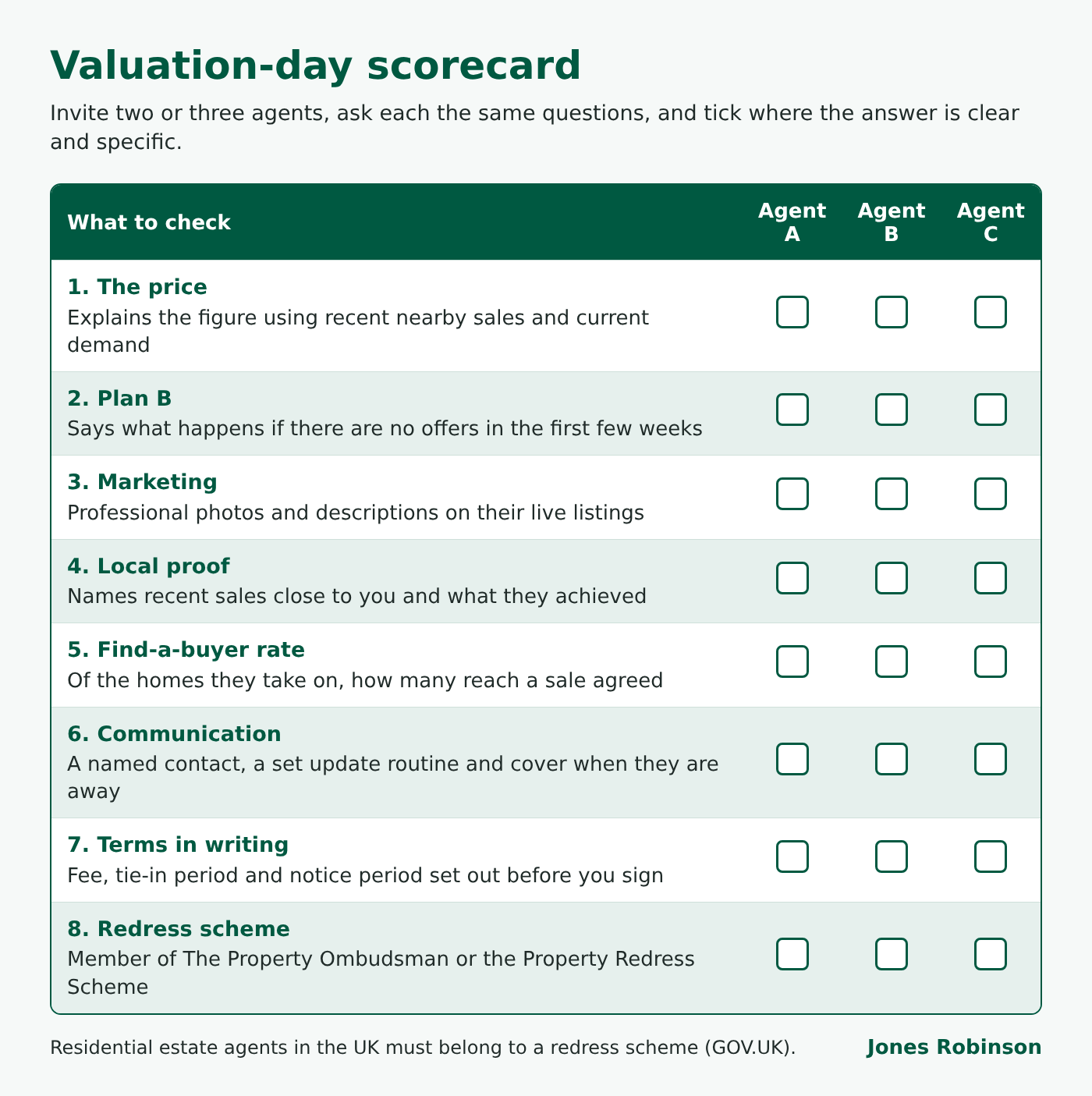
If two agents score similarly, the tie-breaker is usually the one whose price you understood best and whose answers you did not have to chase.
FAQs
Does it make a difference which estate agent you use?
Yes. The agent sets the asking price, presents your home in its first, busiest weeks on the market and keeps the buyer and chain together after an offer. Each of those affects whether your home sells and how long it takes, which is why the share of homes that find a buyer can differ so much from one agent to another in the same area.
How many estate agents should value my home?
Two or three is usually enough to compare pricing, marketing and approach without the figures becoming confusing. Ask each one the same questions so you are comparing like with like.
Should I choose the agent with the highest valuation?
Not on that basis alone. The asking price is your decision, and a high figure is only useful if the agent can show the comparable sales behind it. A home that launches too high and then needs a reduction typically takes far longer to sell than one priced right from the start.
Can I change estate agent if I am not happy?
Usually, but check your terms of business first. Look at the tie-in period, the notice required, and whether a fee could still be due to your first agent if a buyer they introduced goes on to buy. Understanding these terms before you sign makes any change later much simpler.
Looking ahead
Choosing an agent is one of the most consequential decisions in selling your home. The right choice does not just find a buyer, it finds the right buyer, at the right price, and sees the sale through. Book a free, no-obligation valuation with Jones Robinson. With offices in Newbury, Lambourn, Marlborough, Pewsey, Devizes and Didcot, we will give you an honest, evidence-based view of what your home could achieve and the right approach for your area.