

In this blog
- Does a higher asking price get me more money?
- What happens if I price my house too high?
- How much does a price reduction cost me?
- How do I know if my house is overpriced?
- Why do price brackets and stamp duty thresholds matter?
- What's the right way to price a home to sell?
- Frequently asked questions
It's natural to want the highest possible price for your home. You've lived in it, looked after it, and you know what it's worth to you. So, when one agent suggests a higher figure than the others, it's tempting to go with them.
Here's the truth backed by the numbers. The highest asking price often leads to the lowest result. Pricing too high is one of the most common and costly mistakes a seller can make, and it's worth understanding why before you choose a figure.
Does a higher asking price get me more money?
It feels like it should. In reality, it usually does the opposite.
A home attracts the most interest in its first couple of weeks on the market. That's when it's new, when it appears in buyers' searches and email alerts, and when the right buyer is most likely to see it and act. Price it sensibly, and you capture that burst of attention while it counts. Price it too high, and you waste it; the buyers who would have been perfect see a figure that doesn't add up, and move on to something that does.
The home then sits. And a home that sits starts to raise questions in buyers' minds: what's wrong with it, why hasn't it sold, what will they accept? The longer it's on the market, the weaker your position becomes.
What happens if I price my house too high?
The pattern is consistent, and the data backs it up.
According to Rightmove analysis published in October 2026, homes that don't need a price reduction find a buyer in 39 days on average. Homes that have to be reduced take 119 days, around three times longer. That's months of extra time on the market, often ending in a sale below what a sensible price would have achieved at the start.
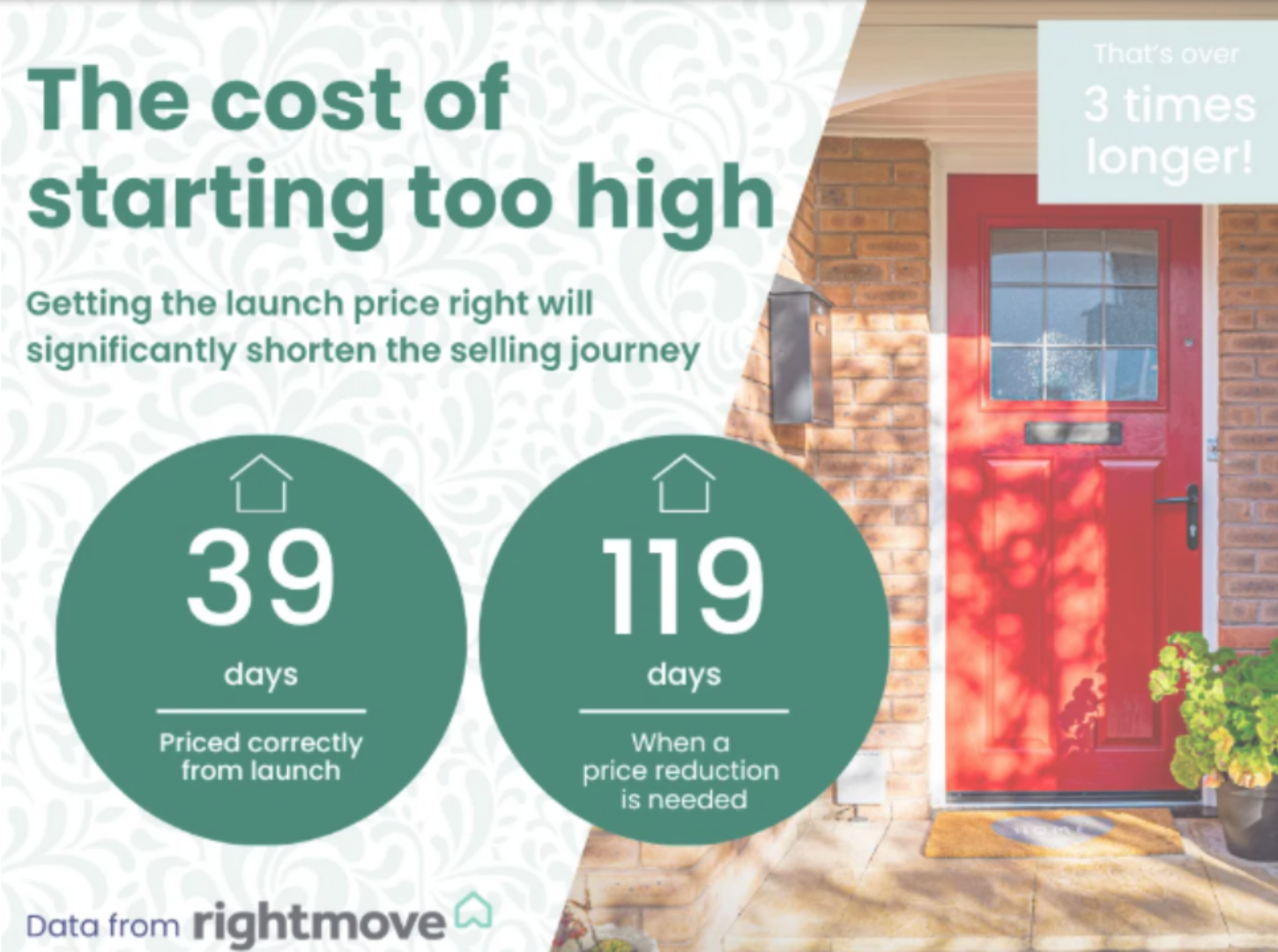
The same analysis shows why this matters right now. More than 3,000 property listings a day had their asking price cut during September 2026, the highest monthly figure since September 2011, and the number of homes for sale is at its highest level for 12 years. With that much choice, buyers can afford to ignore homes that look expensive.
| Measure | Rightmove figure |
|---|---|
| Average time to find a buyer, no price reduction needed | 39 days |
| Average time to find a buyer, price reduced | 119 days |
| How much more likely a home is to sell without a reduction | 13% more likely |
| Homes sold so far in 2026 that did not need a reduction | 74% (nearly three-quarters) |
| Homes on the market that saw a reduction in September 2026 | Around 34% |
| Average size of an asking price reduction, September 2026 | 6.6%, around £24,200 |
Source: Rightmove, 19 October 2026 (national figures, not specific to our area).
There's a knock-on effect too. A price reduction doesn't just lower the number. Many of the buyers who saw your home at the higher price have already moved on, and a "reduced" tag can make new buyers wonder what the problem is, rather than seeing the opportunity. You don't just lose time. You can lose the very buyers you needed.
We understand why this happens. Many homeowners are still anchored to the prices of a few years ago, when the market was running hot. But buyers today are comparing carefully, mindful of their budgets, and they simply won't pay a figure the evidence doesn't support. Pricing for the market as it is now, not as it was, is what gets you moved. If you're not sure which way your local market is leaning, our guide to buyers' and sellers' markets explains what to look for.
How much does a price reduction cost me?
More than most sellers expect. The cost isn't only the reduction itself. It's the weeks of lost momentum before it, the buyers who've already looked elsewhere, and the weaker negotiating position that comes with a home that's been sitting.
Put the Rightmove figures together and the hidden costs of starting too high look like this:
- Time: the gap between 39 and 119 days is 80 days, roughly 11 extra weeks before you even agree a sale, and the conveyancing only starts after that.
- Money: the average reduction in September 2026 was 6.6%, around £24,200 based on the average asking price.
- Running costs: every extra month means another month of mortgage payments, council tax, insurance and bills on a home you're trying to leave.
- Your onward move: if you've found your next home, a slow sale can put that purchase at risk, or mean you miss it altogether.
It also helps to remember that you're usually buying in the same market you're selling in. Accepting a little less for your current home may mean paying less for your next one too.
A home priced right from day one does the opposite. It arrives fresh, attracts competition while interest is high, and often achieves its asking price, or close to it, quickly. The sensible price isn't the cautious option. It's usually the one that gets you the better result.
How do I know if my house is overpriced?
The market tends to tell you quite quickly. Watch for these signs in the first few weeks:
- Plenty of online interest, few viewing requests. Buyers are looking at the listing, comparing it with others and deciding not to book.
- Viewings, but no offers. People like the home in person, but not at that price.
- The same feedback, again and again. If several viewers mention price, or say they preferred a similar home nearby, take it seriously.
- Similar homes are selling around you. If comparable properties in your street or village are going under offer while yours isn't, the price is the most likely difference.
- Offers well below the asking price. Low offers aren't always cheeky. Sometimes they're telling you where the market is.
If you're seeing these signs, it's worth sitting down with your agent to review the evidence rather than waiting and hoping. When you do adjust, one well-judged change to the right level usually works better than several small cuts, each of which adds another "reduced" tag without bringing new buyers. Presentation counts too, so it's worth checking the basics in our guide to preparing your house for sale.
Why do price brackets and stamp duty thresholds matter?
Most buyers find homes through property portals, and they search within a price range. On Rightmove, the price filters move in £25,000 steps between £300,000 and £500,000, then in £50,000 steps up to £700,000. A home listed at £510,000 won't appear for a buyer whose maximum is set at £500,000, even if they could stretch to it.
Stamp duty can have a similar effect in England. First-time buyers pay no Stamp Duty Land Tax on the first £300,000, and 5% on the portion between £300,001 and £500,000. Above £500,000 the relief is lost altogether, according to GOV.UK. That means a first-time buyer would pay £10,000 at £500,000 but £15,250 at £505,000, because standard rates then apply to the whole price. For homes that appeal to first-time buyers, that difference can decide whether they make an offer at all. You can check the figures for any price with our stamp duty calculator.
What's the right way to price a home to sell?
The right price isn't a guess, and it isn't the highest number an agent is willing to say to win your business. It's a figure based on real evidence: what genuinely comparable homes nearby have actually sold for, not what they were listed at.
You can see sold prices for yourself using HM Land Registry's search sold property prices service. It's a useful sense check, but bear in mind that no two homes are identical. Condition, plot, parking, outlook and even which side of a road a house sits on can make a real difference, especially in the villages and market towns across West Berkshire, South Oxfordshire and Wiltshire. That's where local knowledge matters. Our guide to what a good estate agent valuation should involve explains what to expect from the appointment, and why the highest figure is so often a trap.
That's how we price every home we take on. We'll show you the evidence behind the figure, and if we believe your home is worth less than another agent has told you, we'll say so and explain why. It isn't always what you want to hear on the day. But an honest price that sells beats a flattering one that sits, every time.
Frequently asked questions
Is it better to overprice or underprice a house?
Neither is ideal, but the evidence points firmly against overpricing. A realistic price based on recent sales, set to attract competition in the first few weeks, gives you the strongest position to negotiate from.
How long should I wait before reducing my asking price?
There's no fixed rule, as it depends on your local market and the time of year. What matters is the response you're getting. If the first few weeks bring few viewings and no offers, review the evidence with your agent rather than leaving the price unchanged for months.
Can I take my house off the market and relist it at a lower price?
You can, but it isn't a fresh start. Many buyers will remember the home, and portals show when a listing was added or reduced. Getting the price right before you launch is far more effective than trying to relaunch later.
Will an estate agent overvalue my home to win my business?
It does happen, which is why it pays to ask every agent for the evidence behind their figure and how many of their listings actually go on to sell. Our guide to choosing an estate agent and the one number worth asking for explains what to look for.
Get an honest, evidence-based valuation
If you're thinking of selling, book a valuation with your local Jones Robinson team. We'll give you an honest, evidence-based price, show you exactly how we'd market your home, and help you get the result you're after, not just a number that sounds good on the day. You can also read more about selling with Jones Robinson or find your nearest branch in Newbury, Didcot, Marlborough, Devizes, Pewsey or Lambourn. Because moving matters, and we'd love to help you get there.