

In this blog
- What buyers vs sellers’ market really means
- Market meaning: why it matters for your decision
- What tips the market towards buyers or sellers?
- Signs it’s a buyers’ market
- Signs it’s a sellers’ market
- Is it a buyers’ or sellers’ market in the UK right now?
- How to check which way your local market is leaning
- How to succeed as a buyer or seller today
- FAQs
What buyers vs sellers’ market really means
When people talk about a “buyers’ market” or a “sellers’ market,” they’re really describing who holds the advantage at a given time. In simple terms:
- Buyers’ market: there are more properties available than people looking to buy. This gives buyers greater choice and more room to negotiate.
- Sellers’ market: demand outstrips supply, meaning sellers are in a stronger position to set their price and often sell more quickly.
Between the two sits a balanced market, where the number of homes for sale roughly matches the number of active buyers. Prices tend to move gently, well-presented homes sell in a reasonable time and offers usually land close to the asking price, with neither side holding much extra leverage.
This balance between supply and demand is the foundation of property market conditions. It affects everything from how long homes stay on the market to whether asking prices are met or reduced. Importantly, the market is never static: shifts in interest rates, economic confidence and local housing supply can tip the scales from one side to the other. If you’re wondering how these changes could affect the value of your own property, you can get a free valuation to see where you stand.
Market meaning: why it matters for your decision
Understanding whether the market favours buyers or sellers isn’t just theory, it directly shapes the outcome of your move. The same home can achieve very different results depending on market conditions.
For example:
- In a buyers’ market, sellers may need to price competitively and be flexible on negotiations. Buyers, on the other hand, can take their time comparing options and pushing for better terms.
- In a sellers’ market, homes can sell quickly and close to (or above) asking price. Buyers must act decisively, often arranging finance in advance to avoid missing out.
Ignoring the market can lead to costly mistakes. Sellers may risk overpricing and seeing their property linger unsold, while buyers may lose opportunities by hesitating. We look at what that first mistake can cost in the real cost of overpricing your home. Recognising market meaning allows you to plan strategically, whether that’s timing your sale for maximum return or preparing to move fast when demand is strong.
What tips the market towards buyers or sellers?
No single factor decides it. The balance usually shifts when several of these move at once:
- Mortgage rates: when fixed rates rise, monthly payments go up and buyers can borrow less, so demand cools and sellers have to be more realistic. When rates fall, more buyers can afford to move and competition picks up.
- Economic confidence and policy: job security, inflation and announcements such as a Budget or changes to stamp duty can bring purchases forward or make people wait.
- Supply of homes: a wave of new listings or new-build schemes gives buyers more choice, while a shortage of homes coming to market favours sellers.
- Time of year: activity is seasonal. Rightmove notes that autumn typically brings more active buyers than the slower summer season, which is why some sellers with flexible timing wait until then to list.
- Local factors: school catchments, commuting links and the mix of homes in a town mean a period cottage in a village near Marlborough or Hungerford can behave very differently from a newer home in Didcot.
Signs it’s a buyers’ market
Knowing the signs of a buyers’ market can give you the edge, whether you’re looking to buy or sell. Key indicators include:
- High inventory: More properties are listed than there are active buyers.
- Longer time on market: Homes tend to take longer to sell, giving buyers more room to negotiate.
- Price reductions: Sellers often lower prices to attract interest, and a growing share of listings in an area show a reduced price.
- Flexible terms: Sellers may be more willing to agree a lower price after survey findings, include items such as appliances or carpets, or work around the buyer’s moving date.
Here’s a quick snapshot to make the differences clear:
| Market signal | Buyers’ market impact | Sellers’ market impact |
|---|---|---|
| Number of homes for sale | High: more choice for buyers | Low: scarcity drives demand |
| Time on market | Longer: negotiation leverage | Shorter: fast sales |
| Price trends | Stable or falling | Rising |
| Price reductions | Common | Rare |
| Offers | Below asking price is normal | At or above asking price, sometimes from several buyers |
| Buyer power | Strong | Limited |
Recognising these signals allows buyers to act strategically, negotiating better terms and identifying true value opportunities. Our guide on how to make an offer on a house explains how to pitch an offer the seller will take seriously.

The only reliable read on your own market is a current figure for your own home, which is what a free valuation gives you.
Signs it’s a sellers’ market
A sellers’ market flips the balance of power, giving homeowners an advantage when listing their property. Key signs include:
- Limited inventory: Few homes are available, so buyers compete for each listing.
- Quick sales: Properties often sell within days or weeks.
- Frequent bidding: Multiple offers may push prices above the asking price, and agents may ask for “best and final” offers by a set deadline.
- Strong buyer interest: High demand often reduces negotiation room.
In a sellers’ market, positioning is crucial. Homes priced correctly and presented well can achieve maximum value. Sellers can also use competitive interest to choose the buyer best placed to proceed, such as a chain-free or cash buyer, and to agree a timescale that suits them. Competitive markets also bring a higher risk of gazumping, which we explain in gazumping and gazundering.
If you’re thinking about selling, see what we can do for you.

Is it a buyers’ or sellers’ market in the UK right now?
Updated October 2026. On most national measures, the market currently leans towards buyers, although homes that are priced realistically are still selling. The two most recent industry reports point the same way:
- The Rightmove House Price Index for October 2026 (published 19 October 2026) reports that the total number of homes for sale is at its highest level for this time of year since 2014. New potential buyers contacting agents are 9% lower than a year ago, new listings are 3% higher, and sales agreed are 8% lower.
- The RICS UK Residential Market Survey for September 2026 (published 6 October 2026) shows more surveyors reporting falls than rises in buyer enquiries, agreed sales and prices, while slightly more reported an increase in new instructions.
| Indicator | Latest reading | Which way it points |
|---|---|---|
| Average asking price of newly listed homes (Rightmove, October 2026) | £371,015, up 1.0% on the month but 0.1% lower than a year ago | Flat prices: a price-sensitive market |
| Average time to find a buyer, Great Britain (Rightmove, September 2026) | 67 days | Slower sales favour buyers |
| Average two-year fixed mortgage rate (Rightmove, October 2026) | 5.55%, up from 5.29% a month earlier | Higher borrowing costs limit what buyers can pay |
| New buyer enquiries (RICS net balance, September 2026) | -22% | Weaker demand |
| Agreed sales (RICS net balance, September 2026) | -18% | Fewer deals being agreed |
| New instructions to sell (RICS net balance, September 2026) | +6% | More supply coming to market |
| House prices over the past three months (RICS net balance, September 2026) | -32% | More surveyors seeing prices fall than rise |
| Price expectations for the next 12 months (RICS net balance, September 2026) | 0% | Surveyors expect broadly flat prices |
Source: Rightmove House Price Index, October 2026; RICS UK Residential Market Survey, September 2026. A RICS net balance is the percentage of surveyors reporting a rise minus the percentage reporting a fall.
What this means locally: West Berkshire and South Oxfordshire sit in the South East region, and Wiltshire in the South West. In Rightmove’s October 2026 report, average asking prices were £475,582 in the South East (0.9% lower than a year ago) and £376,189 in the South West (1.1% lower), with homes taking an average of 74 and 76 days respectively to find a buyer. Both are longer than the latest national average of 67 days. For buyers in our area that suggests time and choice; for sellers it means the first few weeks of marketing at the right price matter.
That said, a buyer-leaning market is not a stalled one. Rightmove notes that deals are still being agreed for the right properties at the right price, and its advice to sellers is that competitive pricing from the first day of marketing is critical. Rightmove, and many of the surveyors responding to RICS, also point to the forthcoming Budget as a source of uncertainty, so conditions could change over the coming months. For a closer look at our own patch, read what the property market in West Berkshire and Wiltshire tells us about selling in summer 2026.
How to check which way your local market is leaning
National headlines are an average of thousands of very different local markets. A three-bedroom family home in Newbury, a cottage in the Vale of Pewsey and a flat in Didcot can all be in different positions at the same time. To get a feel for your own corner of the market:
- Count the competition: search the portals for homes like yours (same area, type, size and price band) and note how many are for sale.
- Look at how long they have been listed: homes that have been on the market for months, or show a reduced price, suggest buyers have the upper hand.
- Compare asking prices with sold prices: use HM Land Registry’s sold property prices search to see what similar homes nearby actually sold for, rather than what they were advertised at.
- Watch how quickly “Sold STC” boards appear: if well-priced homes go under offer within a few weeks, local demand is healthy even if national figures look soft.
- Ask a local agent: agents see viewing numbers, offer levels and buyer positions that never appear online. Browse our current properties for sale to see what is available near you.
How to succeed as a buyer or seller today
Whether you’re buying or selling, understanding the market and taking strategic steps can make a big difference.
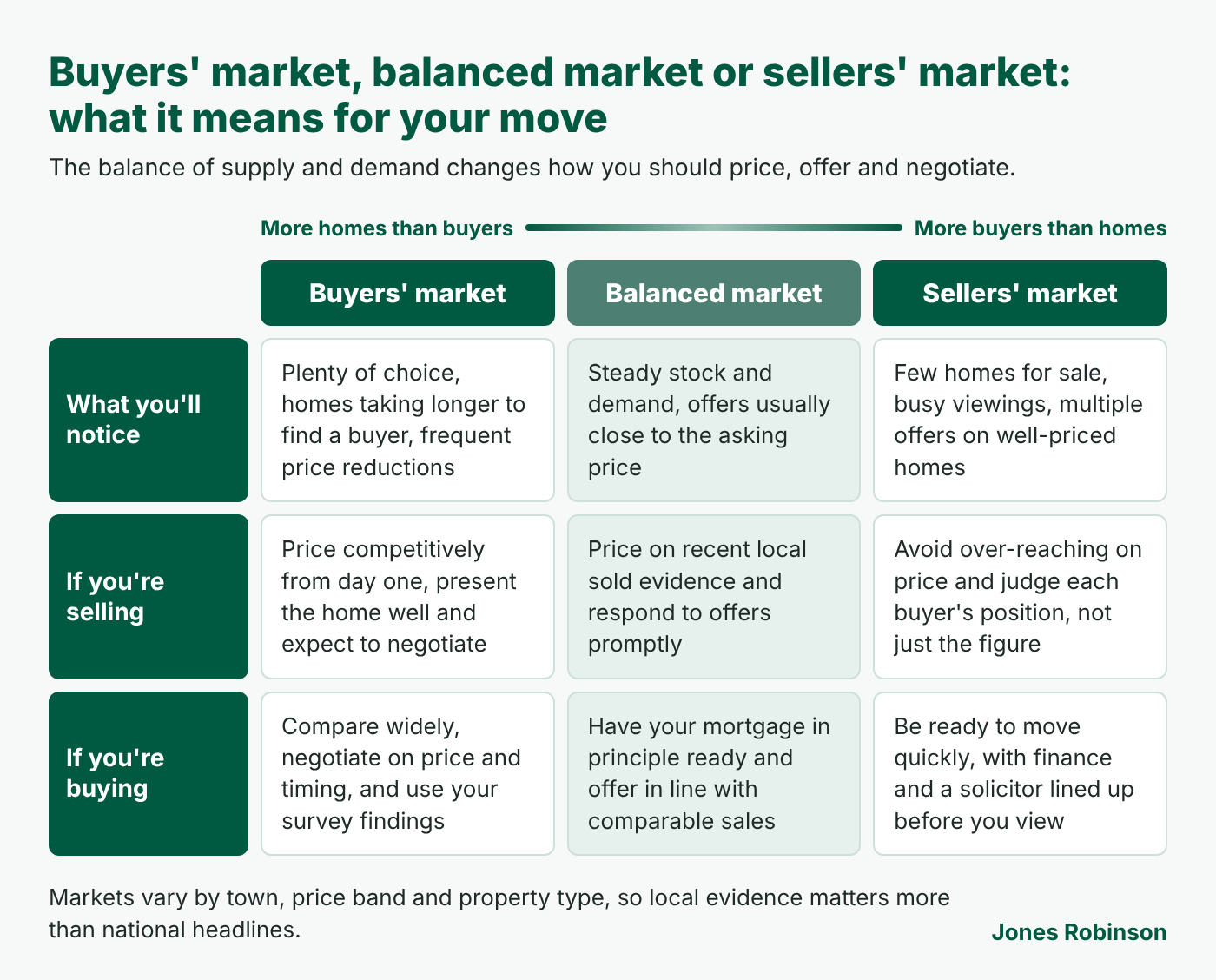
For buyers:
- Get a mortgage in principle (also called an agreement in principle) before you start viewing, so you know your budget and can act quickly. Our mortgage advice service can help you compare options.
- Research comparable properties to know true value.
- Be ready to move decisively when the right property appears.
- Consider flexible negotiation strategies, such as accommodating the seller’s timeline.
- In a buyers’ market, use your survey results to renegotiate if they reveal problems the price did not reflect.
For sellers:
- Price realistically based on current market conditions and recent local sold prices.
- Present your home well to highlight its best features and appeal to buyers. Our guide on how to prepare to sell your house covers the jobs worth doing.
- Work with an experienced agent to market your property effectively.
- Be prepared to negotiate strategically to maximise your return.
- Have your paperwork and a conveyancer ready early, so a buyer you have worked hard to secure does not lose interest during a slow legal process. Our conveyancing service can help with the legal side.
Jones Robinson’s local knowledge across West Berkshire, South Oxfordshire and Wiltshire helps both buyers and sellers read these conditions and plan their move around them.
In a sellers’ market, where demand outstrips supply, it's even more important to act quickly when you see a property you like, so start by browsing our latest properties for sale.
If conditions are in your favour and you are ready to move, here is how the sale process works from instruction to completion.
FAQs
What’s the main difference between a buyers’ and sellers’ market?
A buyers’ market gives the advantage to buyers, with more choice and negotiating power, while a sellers’ market favours sellers, with higher demand and faster sales.
What is a balanced market?
A balanced market is one where supply and demand are roughly level. Prices tend to be stable, homes sell in a reasonable time and offers usually come in close to the asking price, so neither buyers nor sellers have a strong upper hand.
How long do these market conditions usually last?
Market conditions can vary by region and economic factors. Some areas may stay in a buyers’ or sellers’ market for months, while broader shifts in the economy can change conditions more quickly.
Can a market be both a buyers’ and sellers’ market in different areas?
Yes. Local supply, demand and buyer behaviour mean one neighbourhood may favour sellers while another nearby favours buyers. It can also differ by property type: well-priced family homes can attract strong competition while flats or homes at the top of the price range in the same town take longer to sell.
How do rising interest rates affect whether it’s a buyers’ or sellers’ market?
Higher interest rates can reduce buyer affordability, often tipping the balance toward a buyers’ market by slowing demand. In its October 2026 report, Rightmove said the average two-year fixed mortgage rate had risen to 5.55%, and that new sellers in four of the five lowest-priced parts of Great Britain had responded by setting lower asking prices.
Should I wait for a sellers’ market to list my home?
Timing is important, but waiting can be risky. Market conditions are unpredictable, and if you are also buying, a softer market usually works in your favour on the purchase too. Working with an experienced agent helps you maximise value whenever you decide to sell. Our guide on when is the best time to sell a house looks at timing in more detail.
What steps help buyers compete in a strong sellers’ market?
Act quickly, have a mortgage in principle ready, research true property values, and consider flexible offers that meet the seller’s needs.
Contact your local branch
For expert advice on selling or letting your property, or to book a free valuation, reach out to your nearest Jones Robinson branch:
- Devizes: 01380 730200
- Didcot: 01235 816222
- Lambourn & Hungerford: 01488 73337
- Marlborough: 01672 556640
- Newbury: 01635 35010
- Pewsey: 01672 556640