

In this blog
- How do I get my house ready to sell?
- What paperwork do I need to sell my house?
- What is material information?
- What will selling cost me?
- How long does it take to sell a house?
- How do I choose the right estate agent?
- Does the time of year matter?
- Frequently asked questions
If you're thinking about a move, you've probably already asked yourself: is now a good time to sell my house? Is the housing market right?
It's a fair question, but it's the wrong one to start with. The market will do what it does, and you can't control it. What you can control, and what actually decides whether your move happens, is how well you prepare. A ready seller with the right home, the right plan and the right agent moves in almost any market. An unprepared one waits for a "perfect" moment that never quite arrives.
So here's the more useful question. Not is the market ready, but are you? Here's how to prepare to sell your house, and what being ready actually looks like.
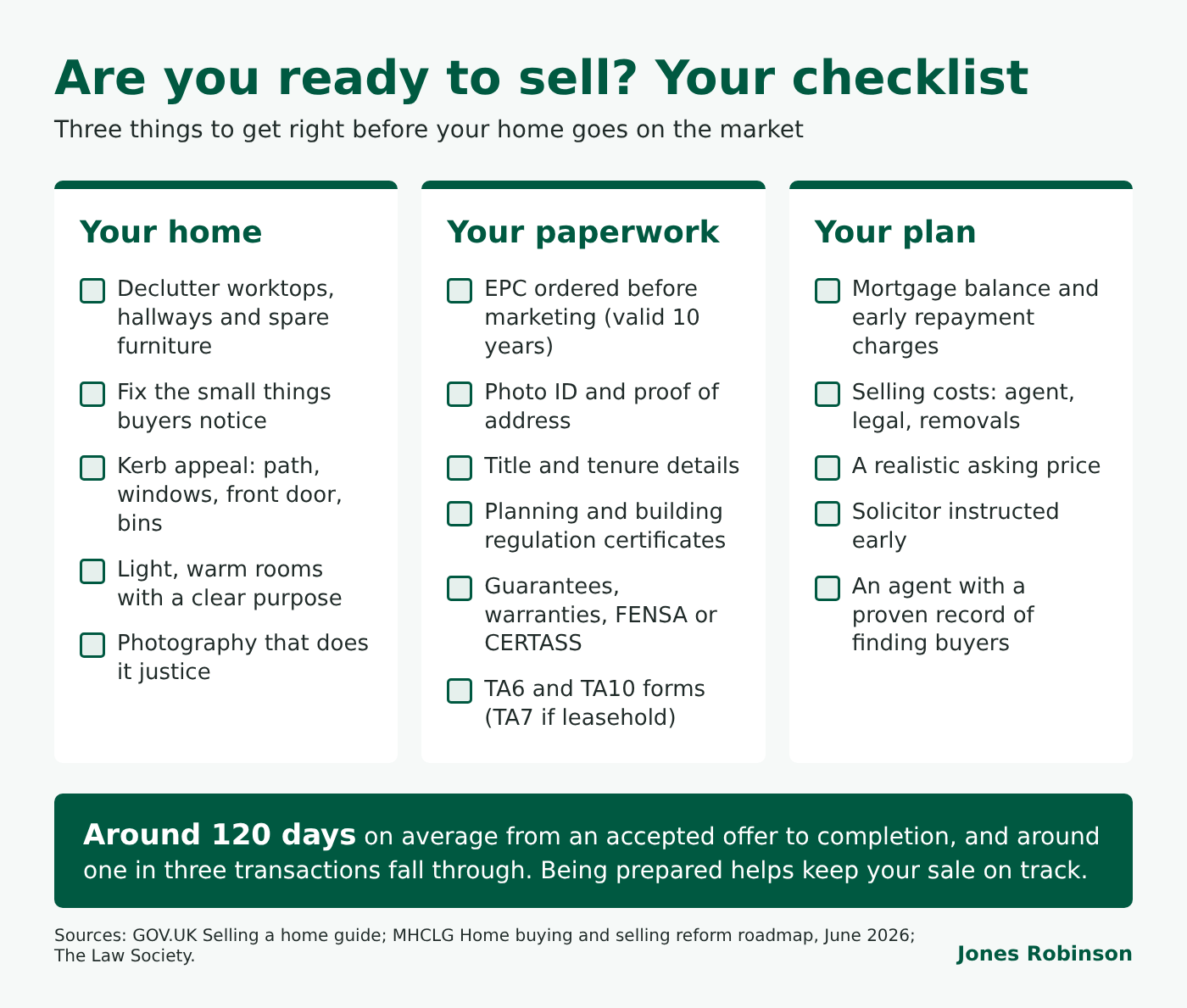
How to get your house ready to sell
You only get one chance at a first impression. A new listing usually attracts the most attention in its first couple of weeks online, and you only get those weeks once, so the home needs to look its best from day one, not three price reductions later.
Preparing your house to sell doesn't mean a full renovation. It usually means the simple things done well: decluttering, a fresh and tidy presentation, sorting the small repairs that catch a buyer's eye, and making sure the photography does the home justice. A good local estate agent will walk the home with you and tell you honestly what's worth doing and what isn't, so you spend your effort where it actually moves the needle.
The jobs that tend to make the biggest difference before photos and viewings:
- Kerb appeal: tidy the front garden and path, clean the windows, freshen up the front door and put the bins out of sight. Some buyers drive past before they book a viewing.
- Space: clear worktops, hallways and surplus furniture so rooms look as large as they are. If you're short of space, a few weeks of temporary storage is usually cheaper than a price reduction.
- Small fixes: dripping taps, sticking doors, blown bulbs, tired grout and scuffed paintwork. Individually minor, together they make buyers wonder what else has been left.
- Clear room purpose: if the box room is marketed as a bedroom, it should look like one on the day the photographer arrives.
- Light and warmth: curtains open, lights on and the heating on for autumn and winter viewings.
Be wary of bigger projects started just to sell. Some work rarely pays back its cost, as our guide to home improvements that do not add value explains, so ask your agent before you commit.
Get your paperwork ready before you list
Presentation gets buyers through the door. Paperwork keeps the sale together once they've made an offer. Questions that can't be answered quickly are one of the most common reasons a sale slows down, and gathering documents now, before you have a buyer waiting, takes the pressure off later.
| What you need | Why it matters |
|---|---|
| Energy Performance Certificate (EPC) | You must order an EPC before you market your home for sale. It rates the property from A to G and is valid for 10 years, so check whether you already have one that's still in date. You can be fined if you don't get one when you need it. |
| Photo ID and proof of address | You'll need to prove your identity and address to your estate agent, your solicitor or conveyancer and your mortgage lender. Anti-money laundering rules require these checks, and if you own the home jointly, expect each owner to be asked. |
| Title and tenure details | Your title deeds or HM Land Registry title, and whether the home is freehold or leasehold. If it's leasehold, your solicitor will also need information from the freeholder or managing agent, which is worth requesting early. |
| Planning and building regulations paperwork | Planning permissions and building regulation completion certificates for extensions, loft conversions, removed walls and similar work. Missing certificates are a classic cause of delay once the buyer's solicitor starts asking questions. |
| Certificates, guarantees and warranties | FENSA or CERTASS certificates for replacement windows, electrical and gas safety records, and any guarantees for damp proofing, a new roof or other work. |
| Property information forms | Your solicitor will usually ask you to complete the Law Society's TA6 property information form and TA10 fittings and contents form (plus the TA7 if the property is leasehold). Fill them in carefully and honestly: buyers rely on your answers. |
Source: GOV.UK, Selling a home: preparing to sell; GOV.UK, Energy Performance Certificates; The Law Society, transaction forms.
Two simple steps help here. First, instruct your solicitor or conveyancer as soon as you decide to sell, not once you have an offer, so the forms and title work can start straight away. Our conveyancing service can help with this. Second, have your ID ready; our guide on how long money laundering checks take explains what's involved.
Material information: what buyers need to know up front
Estate agents have a legal duty under consumer protection law, now the Digital Markets, Competition and Consumers Act 2024, not to leave out information a buyer needs to make an informed decision. This is known as material information. National Trading Standards guidance first published in 2022 said every listing should include the price, the council tax band and the tenure, with later phases set out to cover further details, such as utilities, that can affect a buyer's decision.
For you as a seller, it means your agent will ask more questions before your home goes live than they might have done a few years ago: things like service charges and ground rent for a leasehold flat, and anything that could affect a buyer, such as flood risk, planning restrictions or rights of way. Answering those questions fully at the start is in your interest. As the government's June 2026 home buying and selling reform roadmap points out, issues such as tenure, planning constraints, flood risk or service charges are often only discovered after an offer has been accepted, when they are harder to resolve and can cause a sale to fall through.
The rules are evolving. The Trading Standards guidance is currently under review, and the roadmap commits the government to publishing new guidance for agents and, when parliamentary time allows, legislating to require "sales packs" including searches and a property condition report to be prepared before a home is listed. For now, the practical advice is simple: the more you can tell your agent and solicitor at the start, the fewer surprises there are later.
Know your numbers
Being ready to sell is financial as well as practical. Before you list, it's worth checking:
- Your mortgage: how much you still owe, whether there are early repayment charges, and whether there are fees to move your mortgage to your next home. Your lender can tell you.
- Your selling costs: estate agent fees, legal fees, removal costs and any essential repairs. If the property isn't your main home, Capital Gains Tax may also apply.
- A realistic price: compare the likely value of your home against your mortgage and moving costs. Pricing too high to "test the market" usually backfires, as we explain in the real cost of overpricing your home.
Understanding the timeline
Part of preparing to sell your house is knowing what you're stepping into. A sale takes time, and the part that surprises most sellers is what happens after an offer is accepted. According to the government's June 2026 reform roadmap, it takes around 120 days on average to complete once an offer is accepted, and around one in three transactions fall through. The legal work, the searches, the buyer's mortgage and the length of the chain above and below you all play a part. If you want to be in your next home by a certain point, that's the timeline worth planning backwards from, and it's why the paperwork above is worth sorting before you list. You can see each stage in our sale process.
What most sellers miss: does your agent actually find buyers?
You can be perfectly prepared, and still not move, if the estate agent you choose can't actually get you to a buyer. This is the part people think about least, and it matters most.
So it's worth judging an agent on proof, not promises. Here's ours. Across our branches, 82% of the homes we put on the market find a buyer (Rightmove Plus, July 2025 to June 2026). By finding a buyer we mean a real offer, accepted, a sale agreed, not just a board going up outside your home.
That number is the clearest sign of whether an agent can do the job you're hiring them for. Being ready means choosing on that, not on whoever quotes the highest price at the valuation. We explain why in how to choose an estate agent: the one number worth asking for.
Why a local estate agent makes the difference
This is where local estate agents earn their place. We're independent and owner-led, with teams who have sold in these towns for years, so the person who values your home is the one who sees it through to completion. They know the local market, they know the buyers, and they stay with you the whole way, rather than handing you to a stranger the moment you sign.
That local knowledge is what turns a well-prepared home and an honest plan into an actual sale. It's the difference between a home that's simply on the market and one that's genuinely being sold.
So, does the time of year matter?
Far less than being ready. If you're prepared, autumn is a genuinely good time to move: the buyers looking now tend to be serious, wanting to be settled before Christmas, and there's often less competition than the spring rush, so a well-presented home stands out. But the season is a detail. The real question was never whether the market is ready. It's whether you are.
Frequently asked questions
Do I need to find my next home before I sell?
Not always. Many sellers get their own home to a sale agreed first, which puts them in a stronger position to move quickly when they find the right place. A good agent will talk you through the best approach for your situation.
How do I get my house ready to sell?
Focus on presentation. Declutter, tidy, handle the small repairs that catch a buyer's eye, and make sure the photography shows the home at its best. The first couple of weeks online usually matter most, so the home should look its best from day one.
Do I need an EPC to sell my house?
Yes, in most cases. You must order an Energy Performance Certificate before you market your home for sale. EPCs are valid for 10 years, so if you had one done recently you may be able to reuse it. You can check on the government's register, and your agent can arrange a new one if needed.
What ID do I need to sell my house?
Expect to prove your identity and your address to your estate agent, your solicitor or conveyancer and your mortgage lender. Having photo ID and a recent proof of address ready, for each owner if you own the home jointly, avoids an early delay.
Does the time of year affect how much my house sells for?
Far less than most people expect. What a home achieves is driven mostly by how well it's priced, presented and marketed, not by the month it launches. A well-prepared home tends to achieve its value whatever the season.
How do I choose the right estate agent?
Ask for proof, not promises. The clearest question to ask any estate agent is what share of the homes they put on the market actually find a buyer. A strong, honest figure tells you far more than a flattering valuation ever could. Our 10 questions to ask when choosing an estate agent will help you compare.
Ready to talk about your move?
If you think you might be ready, book a free valuation with your local Jones Robinson team. There's no obligation, and even if you're only weighing up your options, you'll come away with a clear, honest picture of your home, your timeline and what your move could look like. Our teams cover West Berkshire, South Oxfordshire and Wiltshire from six local branches, including Newbury and Didcot. Because moving matters, and we'd love to help you get there.