

In this blog
- What is the difference between freehold and leasehold?
- What is freehold?
- What is leasehold?
- What are share of freehold and commonhold?
- Why does the length of the lease matter?
- What costs come with a leasehold home?
- What has changed with leasehold reform?
- Is buying a leasehold property a bad idea?
- How do you check the tenure before you buy?
- FAQs
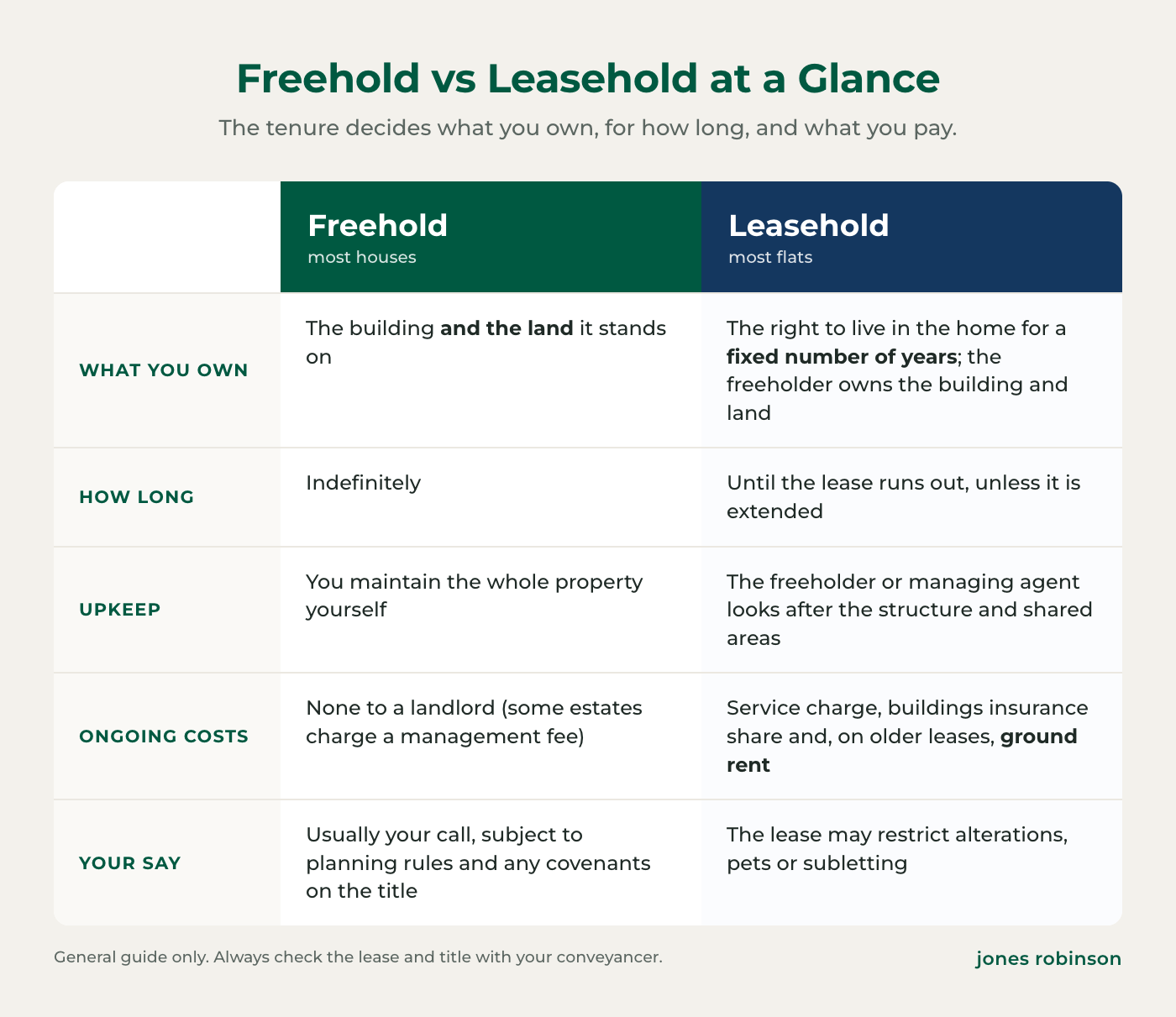
Freehold means you own the property and the land it stands on outright, with no time limit. Leasehold means you own the right to live in the property for a fixed number of years, set out in a lease, while someone else (the freeholder) owns the building and the land. Most houses in England are freehold and most flats are leasehold.
Leasehold is more common than many buyers expect. There were an estimated 4.90 million leasehold homes in England in 2024-25, around 20% of all housing, and 69% of them were flats (MHCLG, May 2026). This guide explains how each type of ownership works, what to check before you buy, and where the leasehold reforms you may have read about actually stand.
What Is the Difference Between Freehold and Leasehold?
The difference is what you own and for how long. A freehold owner owns the building and its land indefinitely and is responsible for all of it. A leaseholder owns the home for the length of the lease, pays towards the upkeep of the building, and has to follow the terms of the lease agreed with the freeholder.
The type of ownership is called the tenure. It affects your running costs, what you can change, how easy the home is to sell or mortgage later, and in some cases its value.
What Is Freehold?
Freehold is the most complete form of property ownership in England. You own the building and the land outright, with no end date, and you do not pay ground rent or a service charge to a landlord. You are also responsible for every repair, from the roof to the drains.
Most detached, semi-detached and terraced houses are sold freehold. That covers the majority of homes across our area, from period cottages around Marlborough and Pewsey to family houses in Newbury and Thatcham.
Freehold does not always mean free of obligations. The title can carry restrictive covenants, which are rules written into the property's legal title that limit what an owner can do, such as running a business from home or building an extension. Some newer estates also have a management company that charges freehold owners an annual fee to maintain roads, landscaping or play areas that the council has not adopted. Your conveyancer will flag both.
What Is Leasehold?
Leasehold means you buy a long lease on the property rather than the property itself. The lease is a legal contract between you (the leaseholder) and the freeholder, which sets out how long you own the home, what you pay, and the rules you agree to follow. When the lease ends, ownership returns to the freeholder unless the lease has been extended.
New leases are commonly granted for 99, 125 or 999 years. Because the freeholder owns the structure and shared parts of the building, they, or a managing agent they appoint, are usually responsible for maintaining the roof, walls, stairwells and grounds. Leaseholders pay for this through a service charge.
Flats and maisonettes are almost always leasehold, because several homes share one building and one piece of land. Some houses are leasehold too, often on newer estates or in older town-centre properties, so never assume a house is freehold.
What Are Share of Freehold and Commonhold?
Share of freehold is an arrangement where the leaseholders in a building jointly own the freehold, usually through a company in which each flat owner holds a share. You still have a lease on your own flat, but you and your neighbours collectively act as the freeholder, which gives you control over management, costs and lease extensions.
Commonhold is a separate form of tenure in which each owner holds the freehold of their own flat outright, with no lease and no landlord, and the building is run by a commonhold association of the owners. It has been available in England since 2004 but is still rare.
A third arrangement, the flying freehold, applies when part of a freehold property sits above or below someone else's, such as a room over a shared passage. Lenders and conveyancers look at these closely.
Why Does the Length of the Lease Matter?
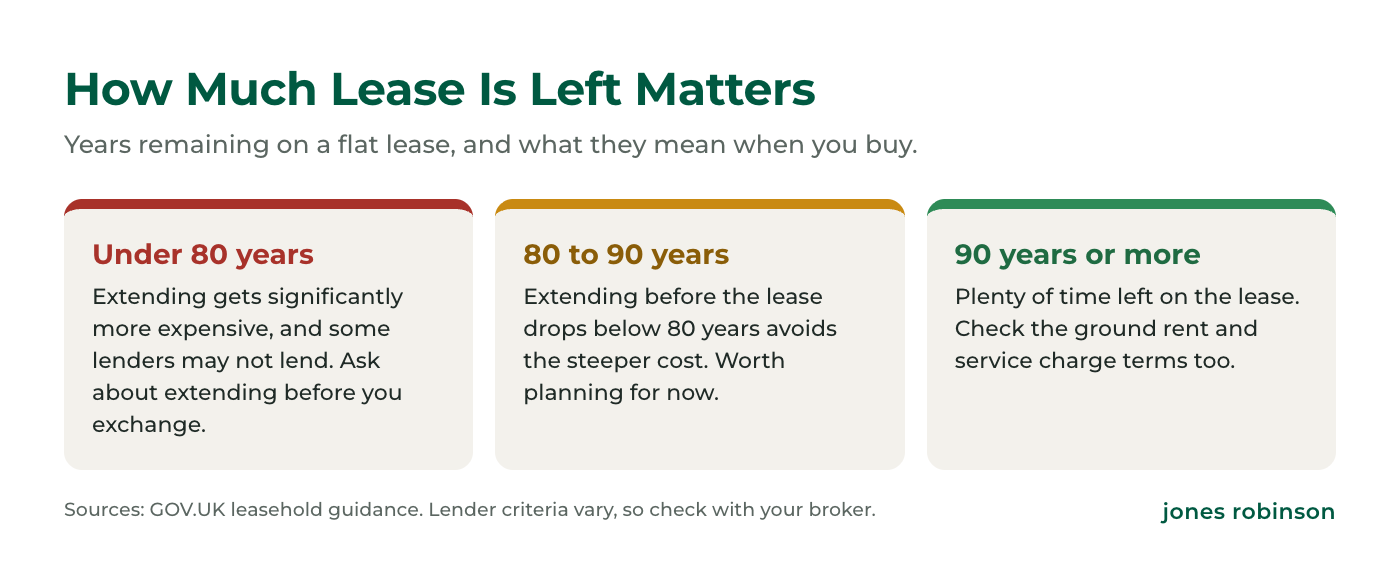
The number of years left on a lease affects the value of the home, whether a lender will offer a mortgage on it, and how much it costs to extend. GOV.UK guidance says that once 80 years or fewer remain, the cost of extending a lease increases significantly (GOV.UK).
Under current law, a qualifying leaseholder of a flat can extend the lease by 90 years, and a qualifying leaseholder of a house can extend by 50 years. Since January 2025, you no longer have to own the property for two years before you can use that right.
If you are buying a flat with a shorter lease, ask whether the seller will start the statutory lease extension before you exchange, or factor the cost into your offer. Our guide on how to make an offer on a house explains how to raise it with the agent.
What Costs Come With a Leasehold Home?
A leasehold home usually comes with a service charge, a share of the buildings insurance and, on many older leases, ground rent. You may also pay administration fees when you need the freeholder's consent, for example to sublet or make alterations.
- Service charge: your share of the cost of maintaining, cleaning, insuring and managing the building and shared areas, usually billed annually or half-yearly.
- Reserve fund: money set aside from service charges to pay for future major works, such as a new roof or lift. A healthy fund reduces the risk of a large one-off bill.
- Ground rent: an annual payment to the freeholder set by the lease. Most new long residential leases granted since 30 June 2022 have a ground rent of zero, known as a peppercorn. Our guide to ground rent explains how it works on older leases.
- Administration charges: fees for consents, notices or information requests under the lease.
Check whether ground rent can rise, and by how much. A ground rent that doubles every 10 or 25 years can make a flat harder to mortgage and sell. Build these running costs into your budget alongside the other hidden costs of buying a home.
What Has Changed With Leasehold Reform?
Leasehold law in England is changing, but only some of the reforms are in force. As at September 2026, the removal of the two-year wait to extend a lease and a wider right for leaseholders to take over management of their building are in force. Longer 990-year extensions, the removal of marriage value and a ban on most new leasehold houses are law but not yet in force.
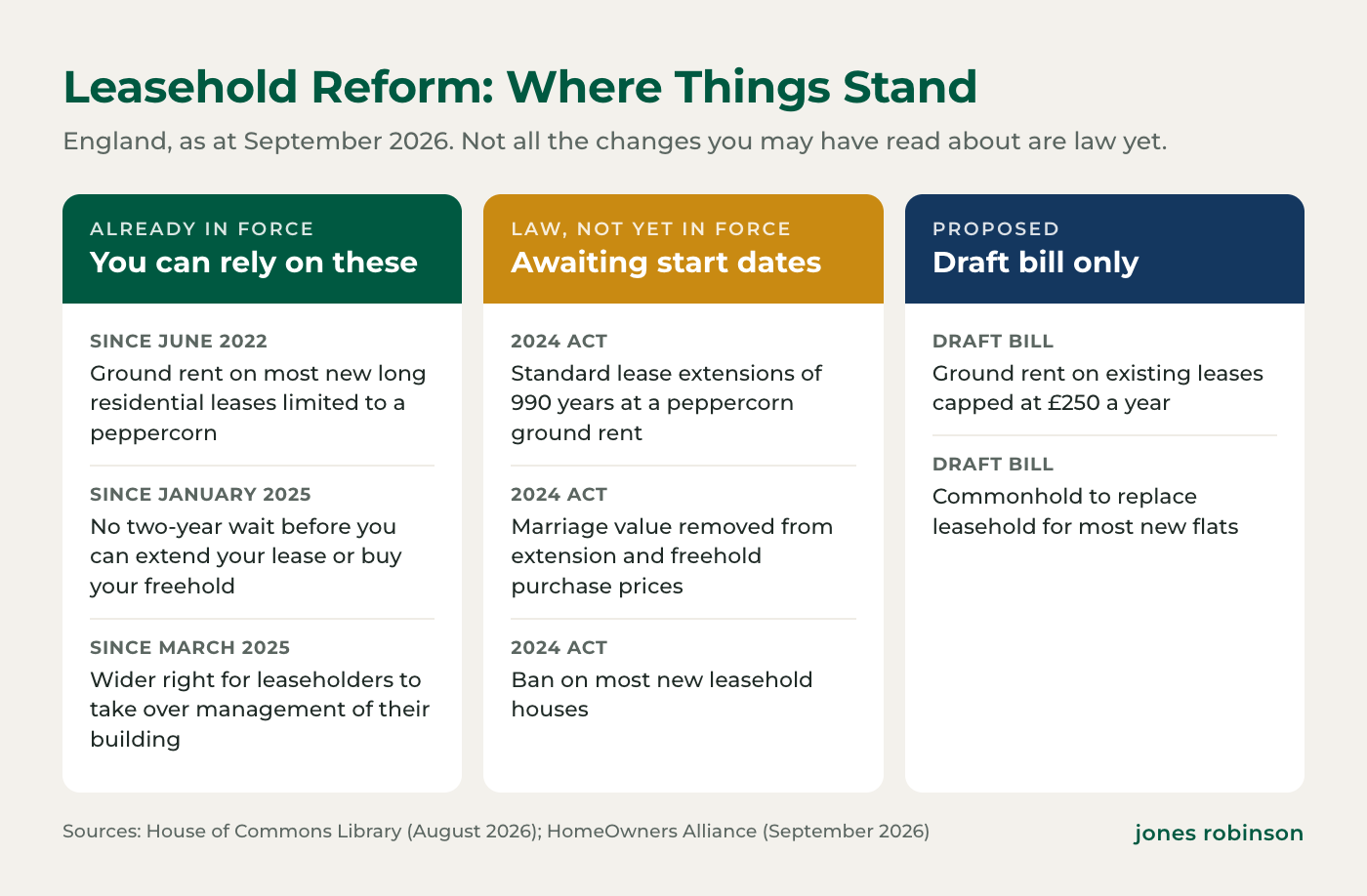
Marriage value is the extra value a property gains once its lease is extended, and under current law leaseholders with fewer than 80 years left must pay the freeholder half of it. The Leasehold and Freehold Reform Act 2024 will remove it, along with introducing standard 990-year extensions at a peppercorn ground rent, once the government sets the start dates (House of Commons Library).
Further changes are proposed in the draft Commonhold and Leasehold Reform Bill, including a £250 annual cap on ground rent for existing leases and making commonhold the default for most new flats. The government has committed to introducing the bill in the current parliamentary session, but it is not yet law (HomeOwners Alliance, September 2026).
For buyers, the practical point is simple: price a leasehold home on the rules that apply today, not the ones that may arrive later.
Is Buying a Leasehold Property a Bad Idea?
No. Buying a leasehold flat is normal, and a well-run building with a long lease, a fair service charge and a peppercorn or modest fixed ground rent can be a sound purchase. The risks come from short leases, ground rents that rise sharply, poorly managed buildings and service charges with no reserve fund behind them.
A leasehold house deserves closer scrutiny. Ask why the house is leasehold, how long the lease has left, what the ground rent terms are, and whether the freehold can be bought. Our guide to the pros and cons of buying a house or a flat covers the wider decision.
How Do You Check the Tenure Before You Buy?
Check the property listing first. The tenure, and for a leasehold home the lease length, ground rent and service charge, are key facts for any buyer, and under the Digital Markets, Competition and Consumers Act 2024 agents must not leave material information out of their listings (Propertymark, May 2025). If anything is missing, ask the agent before you view.
Once your offer is accepted, your conveyancer confirms the tenure from the title register held by HM Land Registry and reviews the lease in full. For a leasehold home they will also request a management information pack from the freeholder or managing agent, covering service charge accounts, the reserve fund, planned works and any disputes. Our guide to house deeds explains what the title documents show.
A survey complements the legal checks. For an older building or a converted flat, our guide to Level 2 vs Level 3 surveys will help you pick the right one.
FAQs
Is freehold better than leasehold?
Freehold gives you more control and no payments to a landlord, so it is generally preferred for houses. For flats, leasehold is the norm, and a long lease in a well-managed building is a sound choice. Share of freehold sits in between.
Can you buy the freehold of a leasehold house?
Usually, yes. Qualifying leaseholders of houses have a legal right to buy the freehold, and since January 2025 you no longer need to have owned the house for two years first. Get specialist valuation and legal advice before starting.
Can leaseholders of flats buy the freehold?
Yes, if enough qualifying leaseholders in the building join together. This is called collective enfranchisement, and it usually results in a share of freehold arrangement.
What happens when a lease runs out?
When a long residential lease ends, the leaseholder does not simply have to leave. In most cases they can stay on under an assured tenancy and pay rent to the freeholder, but the home loses its value as an asset they own. In practice, leases are extended long before this point.
How do I find out how long is left on a lease?
The listing or the agent should be able to tell you. Your conveyancer will confirm the exact figure from the lease and the title register, which records the start date and original term.
Do I pay stamp duty on a leasehold property?
Yes. When you buy an existing lease, Stamp Duty Land Tax is charged on the price in the same way as for a freehold home. Use our stamp duty calculator for an estimate.
Buying in Berkshire, Wiltshire or Oxfordshire?
Our local teams in Newbury, Didcot, Marlborough, Devizes, Pewsey and Lambourn can talk you through the tenure of any home we are selling, and our conveyancing partners can review the lease and title for you. Browse properties for sale, see our latest flats for sale, or find out more about buying with Jones Robinson.
Thinking of selling a leasehold flat? Book a Valuation with your local branch and we will advise on what buyers will want to know about your lease.