

In this blog
- What is share of freehold?
- How does share of freehold work?
- What are the pros and cons?
- Do you still need to extend your lease?
- Can you get a mortgage on a share of freehold flat?
- How do leaseholders buy the freehold?
- What to check before you buy
- Share of freehold vs commonhold
- FAQs
Share of freehold means you own a leasehold flat and, together with the other flat owners in the building, you also own the freehold of the building. You still have a lease on your own flat, but because the leaseholders collectively are the freeholder, there is no outside landlord, and you share control over the building's management, costs and lease terms.
It is often seen as the best of both worlds for flat owners, but it also comes with responsibilities that buyers do not always expect. This guide explains how share of freehold works, its advantages and drawbacks, what it means for your lease and mortgage, and what to check before you buy.
What Is Share of Freehold?
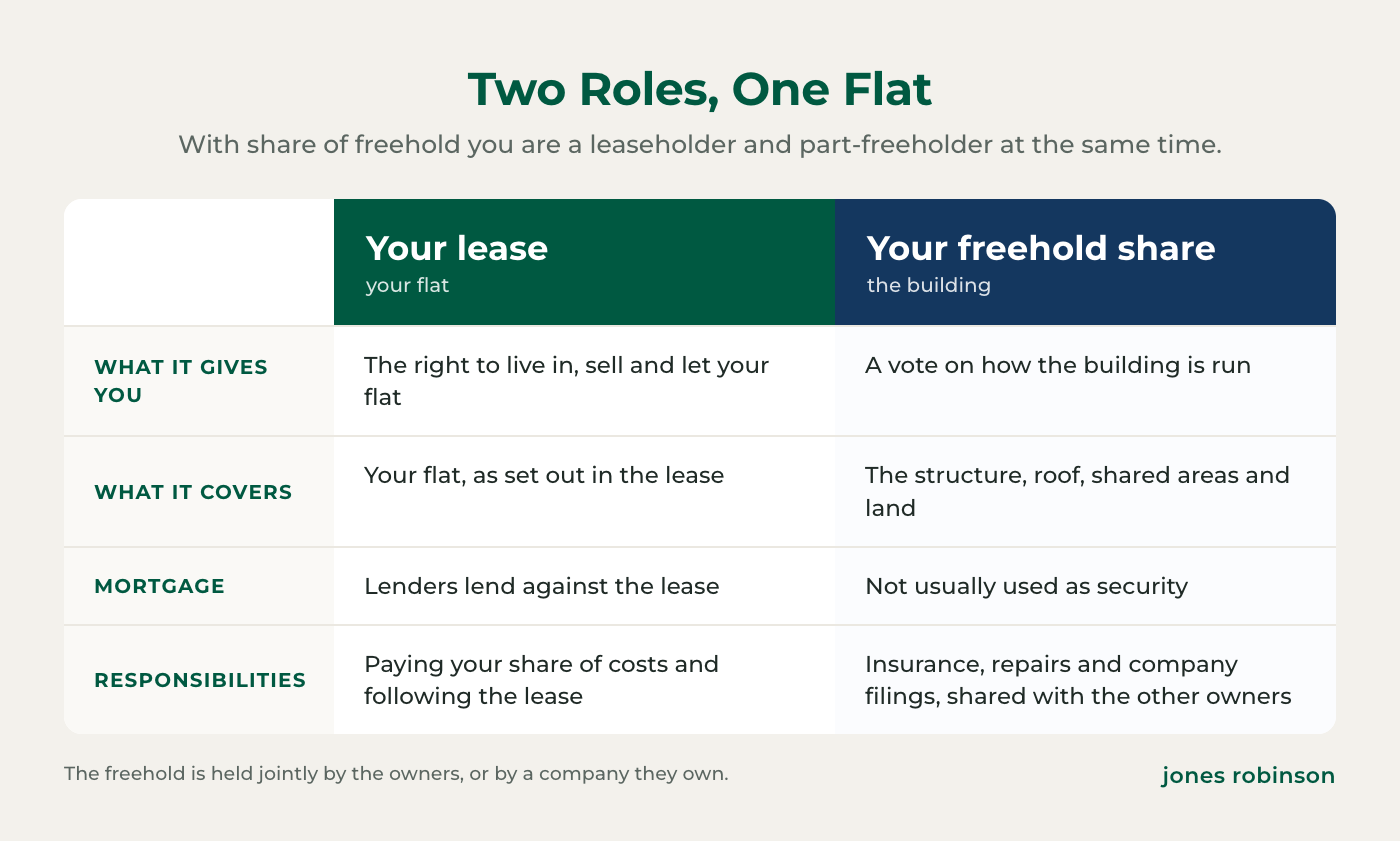
Share of freehold is an arrangement where the owners of the flats in a building jointly own the freehold. Each owner holds a long lease of their own flat, which is what they live in, sell and mortgage, and also holds a stake in the freehold, which gives them a say in how the building is run.
Freehold means owning the building and the land it stands on outright. Leasehold means owning the right to occupy a property for a fixed number of years under a lease. Share of freehold combines the two. Our guide to freehold vs leasehold explains the basic difference.
How Does Share of Freehold Work?
The freehold is usually held in one of two ways. In smaller buildings, the flat owners may hold the freehold title in their own names as joint owners. The law limits the number of legal owners of land to four, so in larger buildings the freehold is normally held by a company, with each flat owner holding a share or membership (Trustee Act 1925).
When the freehold is held by a company, the flat owners are its members and some or all of them act as directors. As freeholder, the company is responsible for the obligations set out in the leases, which usually include insuring the building, maintaining the roof, structure and shared areas, and collecting service charges to pay for them. It must also meet its own legal duties, such as filing accounts and confirmation statements with Companies House.
Decisions are made by the owners together, often at an annual meeting. In a small building of two or three flats this is usually informal. In a larger block, many companies appoint a managing agent to handle the day-to-day work.
What Are the Pros and Cons of Share of Freehold?
The main advantages are control and lower long-term costs: there is no external freeholder, so owners decide on repairs, insurance and service charges, and can usually extend their leases at a lower cost. The main drawbacks are the responsibility that comes with running the building and the risk of disagreements between owners.
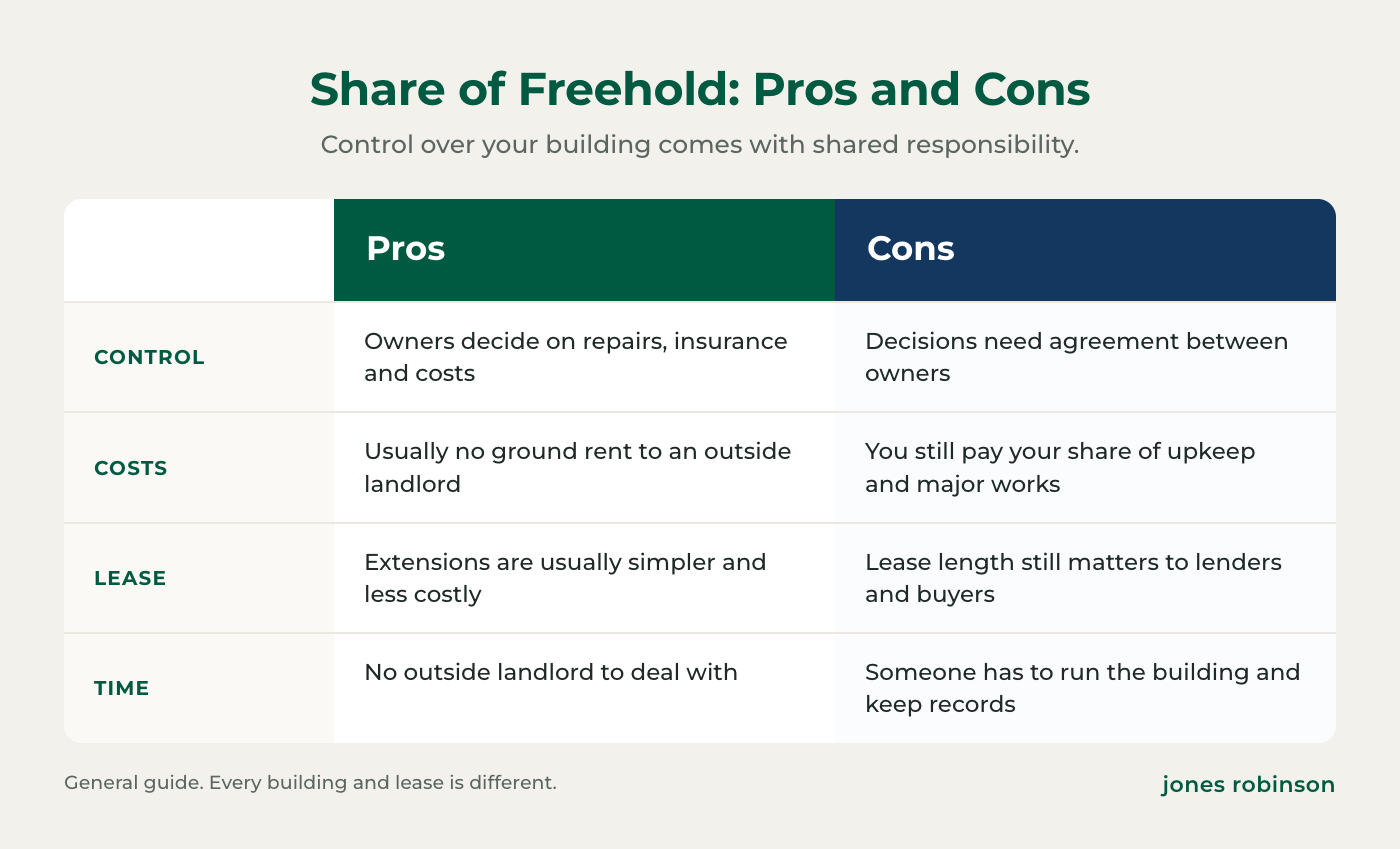
For context, ground rent and service charges are significant costs for many leaseholders. Among owner-occupier leaseholders in England, 77% reported paying ground rent, at an average of £304 a year, and 65% paid a service charge, averaging £1,720 a year (English Housing Survey 2023-24). In a share of freehold building, owners still pay for the upkeep of the building, but they set the budget themselves and there is usually no ground rent to an outside landlord.
Do You Still Need to Extend Your Lease?
Yes, the length of your lease still matters with share of freehold. Mortgage lenders lend against the lease, not the freehold share, so a short lease can affect both your ability to borrow and the value of your flat. The advantage is that extending is usually simpler and less costly, because you and your fellow owners are the freeholder.
Owners commonly agree to extend all the leases to 999 years at a peppercorn (zero) ground rent. This is typically done by surrendering the old lease and granting a new one, which needs the agreement of all the freeholders and the consent of any mortgage lender. Solicitors' fees and Land Registry costs still apply, so take legal advice on the process.
If you are buying a share of freehold flat with a short lease, ask whether the seller will extend it before completion. Our conveyancing partners can advise on this.
Can You Get a Mortgage on a Share of Freehold Flat?
Yes. Lenders treat a share of freehold flat much like any other leasehold flat, because their security is the lease. They will look at the length of the lease and its terms, and may ask to see the freehold company documents. Each lender sets its own criteria, so a mortgage broker can help if the lease or structure is unusual. Our mortgage advice service can talk you through your options.
How Do Leaseholders Buy the Freehold?
Leaseholders in a block of flats can buy the freehold together through a legal process called collective enfranchisement, even if the freeholder does not want to sell. Once they have bought it, the building becomes share of freehold.
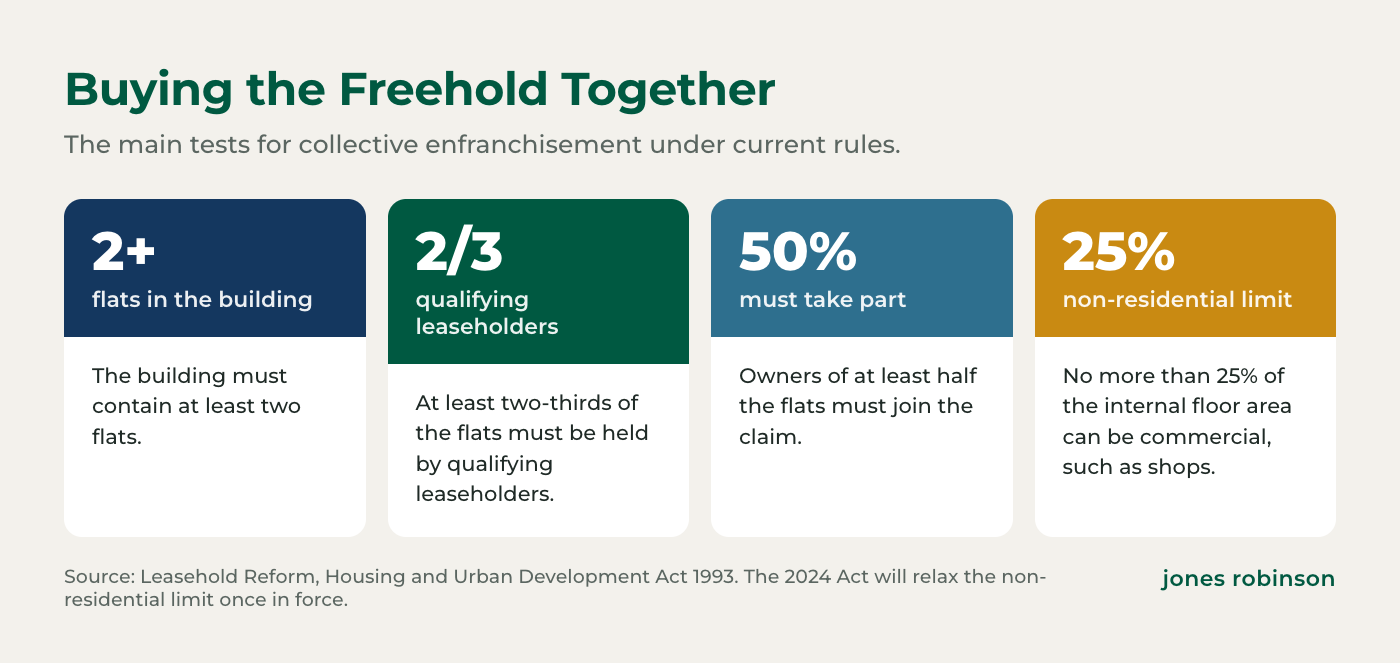
Under the current rules, the building must contain at least two flats, at least two-thirds of the flats must be let to qualifying leaseholders, the owners of at least half the flats must take part, and no more than 25% of the internal floor area can be in non-residential use such as shops (Leasehold Reform, Housing and Urban Development Act 1993). The Leasehold and Freehold Reform Act 2024 will relax the non-residential limit, but that change is not yet in force. Collective enfranchisement involves valuations and legal fees, so specialist advice is essential.
What to Check Before You Buy a Share of Freehold Flat
Before buying a share of freehold flat, check the lease, the freehold ownership structure and the building's finances. Your conveyancer will ask for most of this, but knowing what to look for helps you ask the right questions early.
- Lease length and terms: how many years remain, and whether the leases have already been extended.
- How the freehold is held: in the owners' names or through a company, and confirmation that your share transfers with the flat.
- Company records: the share certificate, recent accounts, Companies House filings and the Articles of Association, which set out how decisions are made.
- Money for repairs: the service charge, any reserve or sinking fund, and whether major works are planned.
- How the building is run: who arranges insurance and repairs, whether there is a managing agent, and any disputes between owners.
A survey is worth commissioning too, because you will share responsibility for the whole building, not just your flat. Our guide to Level 2 vs Level 3 surveys explains which to choose.
Share of Freehold vs Commonhold
Commonhold is a different form of ownership in which each owner holds the freehold of their flat outright, with no lease at all, and the building is run by a commonhold association of the owners. It has been available since 2004 but has rarely been used: the Commons Library reports fewer than 20 commonhold developments containing fewer than 200 units (House of Commons Library).
That may change. The draft Commonhold and Leasehold Reform Bill proposes making commonhold the default for most new flats, but it is not yet law. For now, share of freehold remains the most common way for flat owners to control their own building.
FAQs
Is share of freehold the same as freehold?
No. You still own a leasehold flat. The difference is that you also own part of the freehold, so there is no outside landlord.
Is share of freehold a good thing?
For most buyers, yes, because it gives control over the building and usually makes lease extensions simpler. It works best in buildings where the owners cooperate and the finances are well organised.
Who is responsible for the roof in a share of freehold building?
Usually the freeholder, which means all the owners together, paid for through the service charge. The lease sets out exactly who is responsible for what.
Do you pay ground rent with share of freehold?
Often not, or only a nominal amount, because the ground rent would be paid to yourselves. Check the lease, as some older leases still specify a ground rent.
Is it harder to sell a share of freehold flat?
Usually not. Many buyers see share of freehold as an advantage. Having the company paperwork and accounts ready helps the sale go smoothly.
What happens if the other owners disagree?
Decisions follow the company's Articles of Association or any agreement between the owners. If disagreements cannot be resolved, mediation or legal advice may be needed.
Buying or Selling a Flat?
Our teams in Newbury, Didcot, Marlborough, Devizes, Pewsey and Lambourn can explain the tenure of any flat we are selling. Browse our flats for sale, find out more about buying with us, or Book a Valuation if you are thinking of selling.