

In this blog
- What is the difference between a Level 2 and Level 3 survey?
- What does a Level 2 survey include?
- What does a Level 3 survey include?
- What do the condition ratings mean?
- Which survey do you need?
- How much does a Level 2 or Level 3 survey cost?
- Is a mortgage valuation the same as a survey?
- When should you book a house survey?
- What happens if the survey finds problems?
- FAQs
A Level 2 survey suits most conventional homes in reasonable condition. A Level 3 survey is the better choice for older, larger, altered or unusual properties, or anywhere you plan major work. Both are RICS Home Surveys, carried out by a surveyor after your offer is accepted and before contracts are exchanged.
Picking the right one matters more than the price gap suggests. In research for Direct Line Home Insurance, one in five (21%) of the 2,002 homeowners polled across England, Wales and Northern Ireland in May 2026 said they did not commission a survey at all, while those who did said it saved them £2,600 on average (Aviva, June 2026). This guide explains what each survey covers, what it costs, and how to choose between them for the kind of homes found across West Berkshire, Central Wiltshire and South Oxfordshire.
What Is the Difference Between a Level 2 and Level 3 Survey?
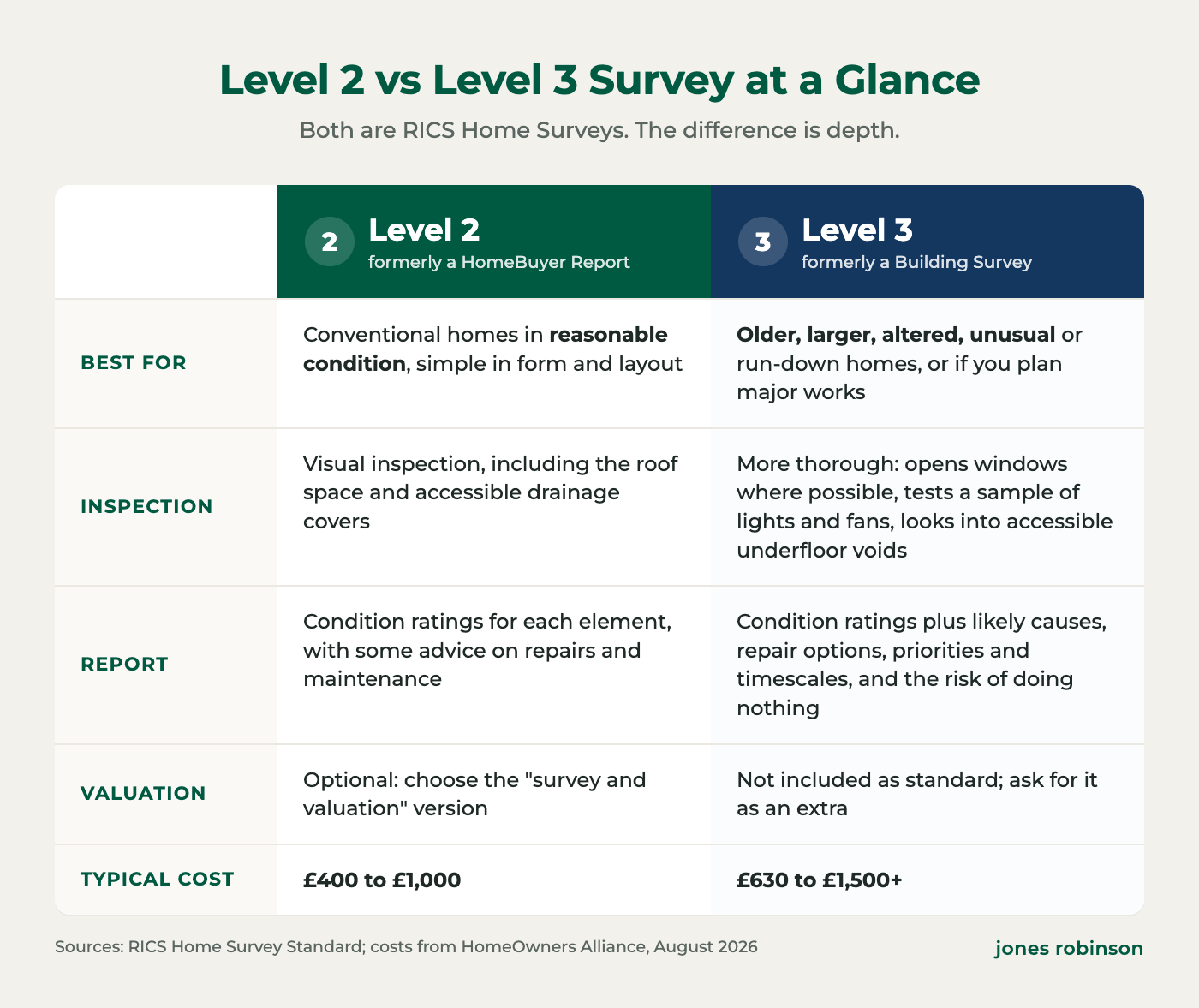
The difference is depth. A Level 2 survey is a visual inspection that flags defects and rates the condition of each part of the home, and it suits conventional properties in reasonable condition. A Level 3 survey is a more thorough inspection with a fuller report on each defect, its likely cause, the repair options and the risk of leaving it, and it suits older, altered or run-down homes.
RICS, the Royal Institution of Chartered Surveyors, is the professional body that sets the Home Survey Standard followed by its members across the UK. The standard has three levels, with Level 1 the most basic and Level 3 the most detailed. You will still hear the older names: a HomeBuyer Report broadly equates to a Level 2, and a Building Survey (often called a full structural survey) to a Level 3.
What Does a Level 2 Survey Include?
A Level 2 survey includes a visual inspection of the main parts of the home, a look inside the roof space, a check of accessible drainage inspection chambers, and a condition rating for each element. The report adds some advice on repairs and ongoing maintenance, and flags any legal issues your conveyancer should look into.
Under the RICS scope for Level 2, the surveyor enters the roof space, lifts accessible drain or septic tank covers where it is safe to do so, and inspects the parts of the heating, plumbing and electrical systems that can be seen during the visit. They will not lift carpets or floorboards, move furniture, or test the services and appliances.
Level 2 comes in two versions:
- Survey only: a report on the condition of the property.
- Survey and valuation: the same report, plus the surveyor's opinion of market value and an insurance reinstatement figure, which is the estimated cost of rebuilding the home for buildings insurance purposes.
A Level 2 is the natural fit for a 1990s family home in Thatcham, a newer house on the edge of Didcot, or a well-kept bungalow that has not been extended.
What Does a Level 3 Survey Include?
A Level 3 survey covers everything a Level 2 looks at, with a more thorough inspection and a more detailed report. For each defect, the surveyor explains the likely cause, the options for repair and the consequences of doing nothing, and recommends the priority and likely timescale for the work.
On site, the surveyor looks harder. The RICS scope for Level 3 includes trying to open all windows where possible, operating a sample of lights and extractor fans, asking the occupier to run the heating, lifting corners of loft insulation to check its type and thickness, and looking into accessible underfloor voids. They still will not take up fitted carpets or floorboards, or move heavy furniture, without the owner's consent.
A Level 3 does not include a valuation as standard (RICS Level 3 service description). If you want one, ask for it as an extra when you book. Where it is practical and agreed in advance, the surveyor can also estimate repair costs.
A Level 3 survey is all but essential on a renovation project, as our guide to buying a derelict property explains.
What Do the Condition Ratings Mean?
Level 2 and Level 3 reports give each part of the property a condition rating. Rating 1 means no repair is currently needed. Rating 2 means defects need repairing or replacing but are not serious or urgent. Rating 3 means defects are serious or need urgent repair, replacement or investigation. NI means the element was not inspected.
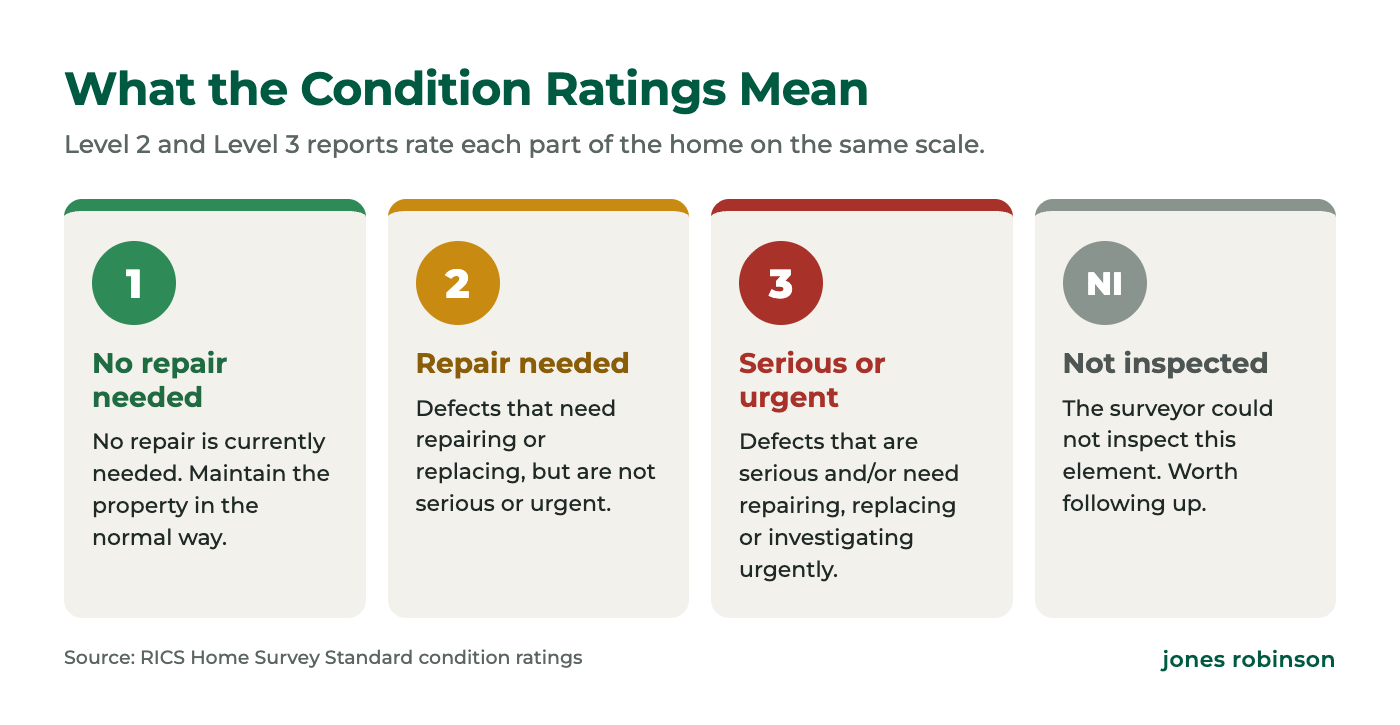
Every rating 3 deserves a conversation with your conveyancer before you exchange, and often a quote or report from a specialist such as a structural engineer, roofer or electrician. Follow up NI ratings too. They tell you exactly where the surveyor could not see.
Which Survey Do You Need?
Choose a Level 2 survey if the home is conventionally built, in reasonable condition and you do not plan major changes. Choose a Level 3 survey if the property is older, large, unusual in construction, significantly altered or extended, in poor condition, or you plan major renovation.
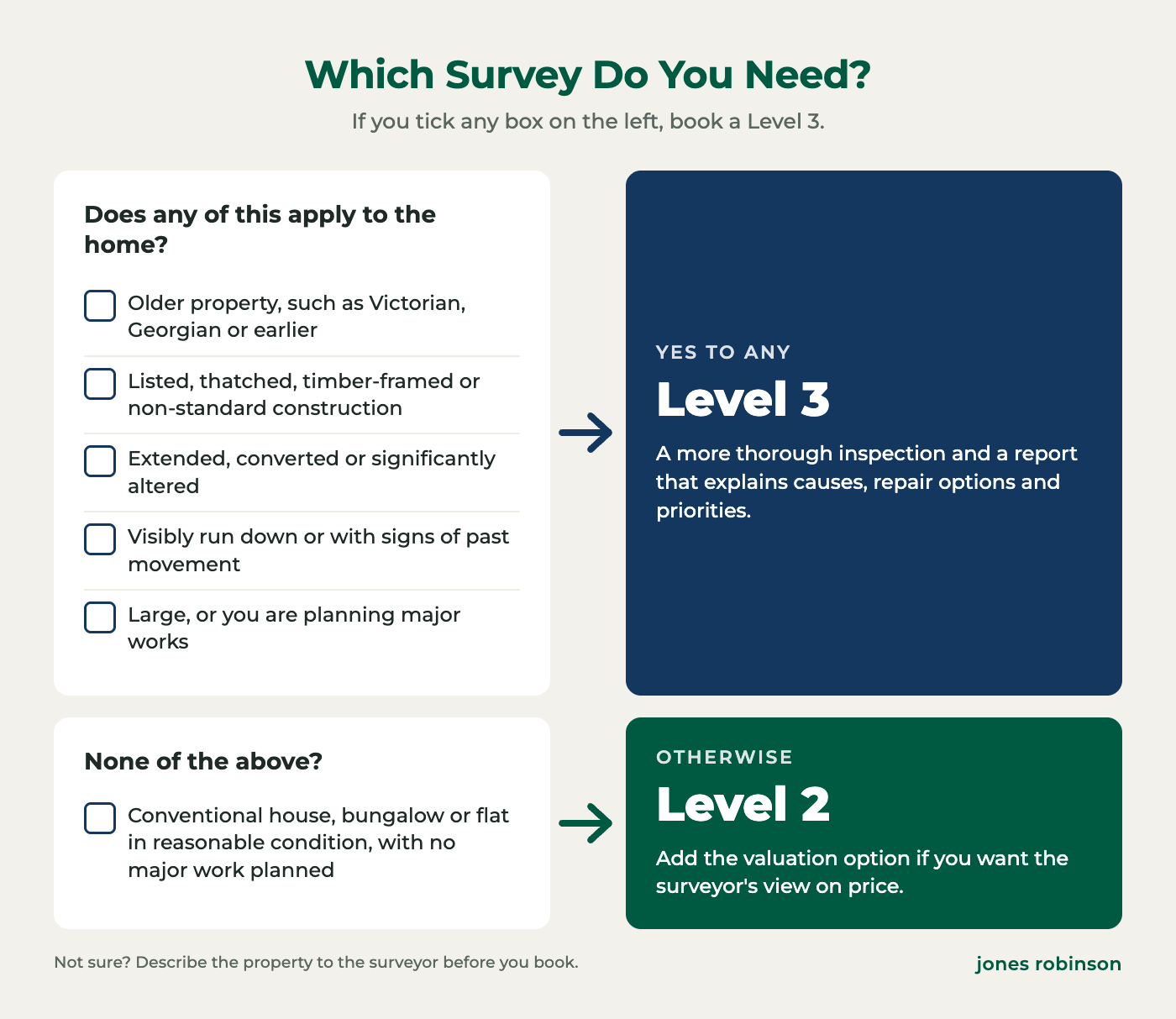
A lot of homes in our area sit firmly in Level 3 territory. Think of a thatched cottage in the Vale of Pewsey, a timber-framed house in Marlborough, a Georgian townhouse in Devizes or a converted barn outside Lambourn. Listed buildings, homes of non-standard construction and properties with signs of past movement all benefit from the extra detail. If you are worried about cracking, our guide to subsidence cracks explains what to look out for.
Level 1 is the third option. RICS describes it as suited to conventional properties and newer homes, and it gives condition ratings without detailed repair advice.
Still unsure? Describe the property to the surveyor before you book: its age, how it is built, and any extensions or conversions you know about. A good surveyor will tell you plainly if a Level 2 will not do the job.
The age and construction of the property matter as much as its condition, so it is worth reading our guide to the types of houses in the UK before you decide which level to book.
How Much Does a Level 2 or Level 3 Survey Cost?
A Level 2 survey typically costs £400 to £1,000 and a Level 3 survey £630 to £1,500 or more, according to HomeOwners Alliance figures updated in August 2026. The fee rises with the value, size and complexity of the property.
| Property value | Level 2 survey | Level 3 survey |
|---|---|---|
| £100,000 to £249,000 | £400 to £600 | £630 to £800 |
| £250,000 to £349,000 | £600 to £700 | £800 to £900 |
| £350,000 to £499,000 | £700 to £800 | £900 to £1,100 |
| £500,000 to £1 million | £800 to £1,000 | £1,000 to £1,500 |
Source: HomeOwners Alliance, August 2026. Prices vary by surveyor and region, so get two or three quotes.
Against the price of a home, the gap is small. On a £450,000 house, those ranges put a Level 3 only a few hundred pounds above a Level 2. A survey is one of several costs to budget for alongside the deposit, and our guide to the hidden costs of buying a home covers the rest.
Is a Mortgage Valuation the Same as a Survey?
No. A mortgage valuation is carried out for your lender to confirm the property is suitable security for the loan. RICS describes it as a limited check for the benefit of the lender, not the buyer (RICS consumer guide). A Level 2 or Level 3 survey is commissioned by you and reports to you.
If you are buying with a mortgage, the lender's valuer will still visit, and the visit is usually arranged through the selling agent. Our mortgage advice service can explain how the valuation and your own survey fit together.
When Should You Book a House Survey?
Book your survey as soon as your offer is accepted and the property is marked Sold STC, and make sure the report is back before you exchange contracts. Once contracts are exchanged you are legally committed to the purchase, so any problems need to be dealt with before that point.
RICS says a survey inspection usually takes between two hours and a full day, depending on the level and the size of the home. Ask the surveyor when to expect the report so you can plan it alongside your conveyancer's property searches. Our guide to exchange of contracts explains what happens next.
What Happens If the Survey Finds Problems?
If a survey finds problems, you can ask the seller to fix them before completion, renegotiate the price to reflect the cost of repairs, arrange further investigation by a specialist, or withdraw before exchange if a defect is serious enough. Talk it through with your conveyancer before you respond.
In the Direct Line research, 45% of surveys identified issues with the property and one in twenty (5%) found major issues. Of the homeowners whose survey saved them money, 45% did so by negotiating a lower purchase price and 35% by having the seller fix issues before completion.
Get quotes before you go back to the seller. A builder's or roofer's figure carries more weight in a renegotiation than a line in a report, and it keeps the conversation factual. Our guide on how to make an offer on a house covers how offers and renegotiations are handled.
FAQs
Is a Level 3 survey worth the extra cost?
For an older, altered or unusual home, usually yes. The difference in fee is typically a few hundred pounds, and the extra detail on causes, repair options and timescales gives you firmer ground if you need to renegotiate.
Does a Level 2 survey include a valuation?
Only if you book the survey and valuation version. That adds the surveyor's opinion of market value and an insurance reinstatement figure. The survey-only version reports on condition alone.
Is a HomeBuyer Report the same as a Level 2 survey?
Broadly, yes. The HomeBuyer Report was the older name for what is now the RICS Level 2 survey, and a Building Survey or full structural survey broadly equates to a Level 3.
Do cash buyers need a survey?
There is no lender to insist on a valuation, so a survey is often the only independent check a cash buyer gets on the condition of the home. Our guide to cash buyers covers the rest of the process.
Do you need a survey on a new-build home?
Most new homes come with a structural warranty from the developer, so many buyers choose a Level 1 survey or a professional snagging inspection instead of a Level 2 or Level 3. Check what the warranty covers before you decide.
Can a survey stop a house sale?
A survey cannot stop a sale by itself, but its findings can lead a buyer to renegotiate or withdraw before exchange. In the Direct Line research, 35% of homeowners said they would pull out of a purchase if structural issues were discovered.
Buying in Berkshire, Wiltshire or Oxfordshire?
Our local teams in Newbury, Didcot, Marlborough, Devizes, Pewsey and Lambourn can guide you from offer to completion, and our conveyancing and mortgage partners can help with the legal and finance steps. Browse properties for sale, or find out more about buying with Jones Robinson.
Selling first to fund your move? Book a Valuation with your local branch.