

Understanding the Role of Cash Buyers in Today’s Property Market
Imagine selling your home without mortgage delays, chain complications or deals collapsing at the last minute. That’s what can happen when a cash buyer is involved, someone who has the money ready to complete the purchase without needing to borrow.
In property terms, being a cash buyer sounds simple, but the meaning often gets blurred. Some buyers claim to be cash-ready, but still rely on finance that hasn’t cleared. Knowing the difference matters, especially when time and certainty are priorities.
Cash buyers are a significant part of the market. In HM Land Registry’s UK House Price Index, cash purchases made up around a quarter (about 26%) of the sales recorded in England between June and December 2025. For sellers, that makes cash offers common, and it raises some important questions about how to judge them.
In this blog
- Key summary
- What does cash buyer mean?
- Cash buyer vs mortgage buyer: key differences
- How the sales process works for cash buyers
- Benefits of selling to or being a cash buyer
- Selling a house to a cash buyer: checks before you accept
- Risks and limitations of cash buying
- Essential checks and legal considerations
- The 2026 UK property market for cash buyers
- Special scenarios for cash buyers
- FAQs
Key Summary
- A cash buyer uses their own funds to purchase a property without a mortgage.
- The term is used loosely, so proof of funds is essential.
- Cash buyers can be individuals or companies, including investors and developers.
- Cash purchases are typically faster, with fewer risks and less paperwork.
- Sellers benefit from quicker sales and reduced chance of fall-throughs.
- Surveys and legal checks are still recommended for cash buyers.
- Cash buyers pay Stamp Duty Land Tax at the same rates as mortgage buyers.
- Risks include tied-up capital, lower liquidity, and potential for missed issues.
- Anti-money laundering checks still apply, even without a mortgage.
If you're thinking of selling, get in touch with Jones Robinson for expert sales support to help you assess offers and complete your sale with confidence.
What Does Cash Buyer Mean?
A cash buyer is someone who can buy a property using money they already have, with no mortgage or loan involved. The funds must be available and accessible at the time of making the offer.
The strict definition
There is no single legal definition of a cash buyer in UK law, but in practice solicitors and agents treat someone as a genuine cash buyer only if they have:
- The full purchase amount available in liquid funds
- No dependency on a mortgage, loan, or sale of another property
- No financial conditions attached to their offer
In other words, the money should be confirmed, cleared and ready to complete the transaction without borrowing.
Estate agent usage
In everyday use, the label is sometimes applied more broadly. Buyers may describe themselves as cash buyers when they:
- Have a mortgage agreement in principle
- Plan to use equity from the sale of their current home, which has not yet completed
- Are waiting to access funds from investments, a pension or an inheritance
None of these buyers is a true cash buyer yet: someone who needs to sell first is still in a chain, and an agreement in principle is not a mortgage offer. Sellers should ask for verified proof of funds before accepting an offer, and ask whether the money depends on anything else happening first.
Individual vs company buyers
Cash buyers can be:
- Private individuals using savings, inheritance, or equity
- Investment companies, developers or quick-sale firms with funds on hand
Quick-sale firms usually buy below market value, so treat their offers with care (see selling to a quick-sale company below).
Common misconceptions
- A cash buyer does not need to pay in physical cash. The term refers to available bank funds.
- A buyer with pre-approved finance is not a true cash buyer.
- Cash buyers often negotiate below the asking price, using their speed and certainty as leverage, but a lower offer is not guaranteed to be accepted.
Cash Buyer vs Mortgage Buyer: Key Differences
The difference goes beyond how the purchase is funded. It affects speed, paperwork, risk and negotiating power.
Key Differences at a Glance
| Feature | Cash Buyer | Mortgage Buyer |
|---|---|---|
| Funding | Uses own funds with no borrowing | Relies on mortgage approval |
| Transaction speed | Typically faster | Slower due to lender checks and approvals |
| Risk of sale falling through | Lower, especially in chain-free scenarios | Higher if finance is declined, delayed or the lender down-values |
| Paperwork | Fewer documents and no lender requirements | Extensive due to mortgage conditions |
| Proof required | Bank statements or solicitor confirmation, plus evidence of source of funds | Mortgage offer, agreement in principle, plus evidence of the deposit |
| Surveys and valuations | Optional, though still recommended | Lender valuation required; survey optional but recommended |
| Stamp Duty Land Tax | Same rates apply | Same rates apply |
| Negotiation leverage | Stronger due to speed and certainty | Weaker if seller wants a quick, risk-free sale |
| Chain involvement | Often chain-free | More likely to be part of a chain |
Cash buyers appeal to sellers because they reduce the chance of a collapsed deal and can usually complete faster. That doesn't put mortgage buyers at a disadvantage: a first-time buyer with a mortgage offer and nothing to sell is also chain-free, and can be just as strong a proposition.
If you're buying and unsure whether a cash purchase is right for you, contact Jones Robinson for step-by-step buying support. For those considering mortgage options, we work with our trusted finance partner FirstXtra, who provides our mortgage advice service, to help you secure the right deal.
How The Sales Process Works For Cash Buyers
A cash purchase skips the lender, not the legal steps. The process is the same, just more streamlined.
1. Making the offer
The buyer submits an offer through the estate agent. Cash buyers may offer below asking price, using their ability to move quickly as part of their negotiation strategy. For tips on pitching an offer, see our guide on how to make an offer on a house.
2. Proof of funds
The buyer provides clear evidence that the full amount is available, such as recent bank statements, investment account records or a solicitor’s confirmation. Sellers should see this before accepting an offer (more on proof of funds requirements below).
3. Instructing a solicitor
The buyer appoints a solicitor to carry out the legal checks, prepare the contract, and manage the transaction. Even without a mortgage, conveyancing is essential, and the seller needs their own solicitor or conveyancer too.
4. Searches and surveys
Searches and surveys are not compulsory for cash buyers, but they are strongly recommended. These might include:
- Local authority and environmental searches
- Drainage and water checks
- A homebuyer report or full structural survey
Skipping these can lead to costly surprises later. For a breakdown of which searches apply and why, read Three Main Searches When Buying a House.
5. Exchange of contracts
Once both parties agree and the legal work is complete, contracts are exchanged. At this point, the buyer usually pays a 10% deposit and the sale becomes legally binding. Until then, either side can still withdraw, even with a cash buyer. Our complete guide to exchange of contracts explains this stage in more detail.
6. Completion
The remaining funds are transferred on the completion date agreed at exchange. With no lender to release money, this can follow soon after exchange, sometimes on the same day, though the date often depends on the seller’s own move.
What affects transaction times
| Stage | Cash Buyer | Mortgage Buyer |
|---|---|---|
| Offer to exchange | Searches, enquiries, any survey and the seller’s onward chain | The same, plus mortgage application and lender valuation |
| Exchange to completion | Can be very short, even the same day | Lender funds must be requested in time |
| Total transaction time | Can be a matter of weeks with no chain | Usually longer |
Individual cases vary, but cash sales are typically faster, more flexible and less likely to fall through.

Benefits Of Selling To Or Being A Cash Buyer
Advantages for sellers
Working with a cash buyer can make the sales process more efficient and reliable.
- Faster completion with no lender delays
- Reduced chance of the sale falling through
- No risk of a lender’s down valuation forcing a renegotiation
- Simpler progression, often without a chain
- Proof of funds offers added peace of mind
That certainty can matter more than the headline figure: you may decide a slightly lower offer from a cash buyer with nothing to sell gives you a better chance of securing your next home.
If you're thinking about selling and want to understand your home's current market value, book a valuation with Jones Robinson.
Advantages for buyers
- Greater leverage when negotiating on price
- Access to listings marked as “cash buyers only”
- No mortgage repayments or long-term borrowing costs
- A quicker and more flexible completion timeline
Selling A House To A Cash Buyer: Checks Before You Accept
An offer described as “cash” is only as good as the evidence behind it. Before you accept, work through these checks with your agent.
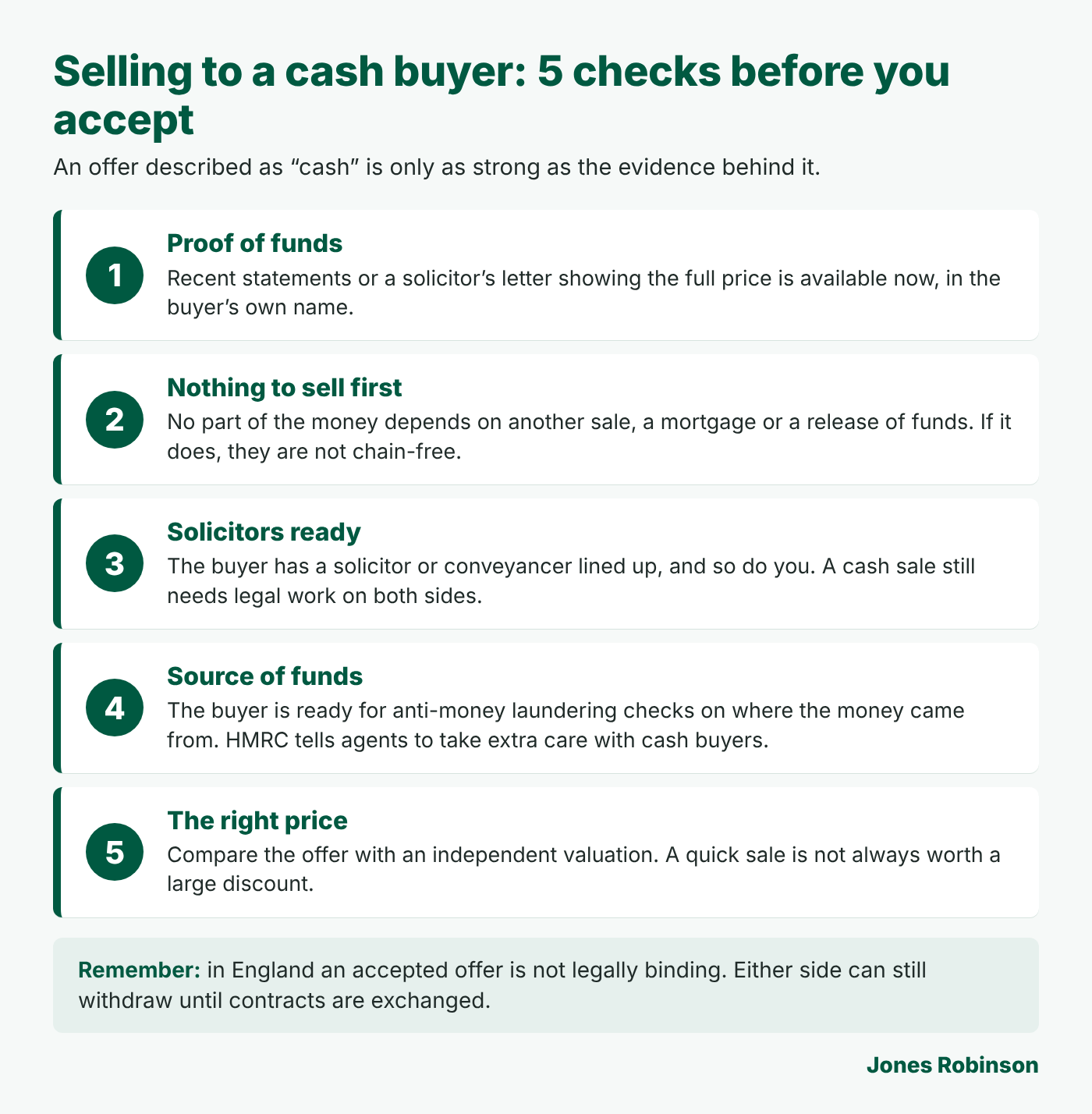
- Proof of funds: recent statements or a solicitor’s letter showing the full price is available now, in the buyer’s (or their company’s) name.
- Nothing to sell first: ask whether any of the money depends on another sale, a mortgage or a release of funds. If it does, the buyer is not chain-free.
- Solicitors ready: a buyer who has already chosen a solicitor is usually ready to move. Instruct your own conveyancer early too.
- Source of funds: HMRC tells estate agents to take extra care with cash buyers, so a buyer ready to show where the money came from is less likely to cause delays.
- The price: compare the offer with an independent valuation of what your home could achieve on the open market. A quick sale is not always worth a large discount.
Selling to a quick-sale company
Companies that advertise “we buy any house” are cash buyers too, but their model relies on buying below market value. Get an independent valuation first, check whether the price can be cut after their survey or fees apply, and check who you are dealing with. HMRC’s estate agency guidance treats businesses that offer to buy property for a quick sale as estate agency businesses for money laundering supervision, so they should be registered.
Pricing realistically from the start also helps attract strong buyers of every kind, as our article on the real cost of overpricing your home explains.
Risks And Limitations Of Cash Buying
Cash buying also has risks that are easy to overlook.
Tied-up capital
Once your money is tied up in bricks and mortar, you can only get it back by selling or borrowing against the property, which limits your ability to react to emergencies or other opportunities. Remember to keep enough aside for stamp duty, legal fees, removals and any work the property needs; our guide to the hidden costs of buying a home lists what to budget for.
Limited diversification
Putting a large sum into one property concentrates your risk. Property can take time to sell, and values rise and fall with the market.
Skipping due diligence
Cash buyers are sometimes tempted to skip surveys or legal checks to speed things up. Structural issues, boundary disputes or restrictive covenants may not surface until after completion, when they become the buyer’s problem.
Exposure to scams and fraud
With no lender involved, cash buyers rely more heavily on their solicitor to check the seller’s identity and ownership, especially in off-market or private sales. Always confirm your solicitor’s bank details by phone, using a number you already know, before sending large sums.
Essential Checks And Legal Considerations
Fewer procedural steps does not mean fewer responsibilities.
Should you still get a survey as a cash buyer?
Yes. With no lender requiring a valuation, some cash buyers skip the survey to save time, which can prove expensive. A survey helps uncover structural faults, subsidence or damp that aren’t always visible during a viewing, and can strengthen your negotiating position if repairs are needed.
Proof of funds requirements
Sellers and agents will expect evidence that the full purchase amount is available. This typically includes:
- Recent bank statements showing the funds
- A solicitor’s confirmation of cleared funds
- Documentation from savings or investment accounts
Providing this early avoids delays.
AML (Anti-Money Laundering) checks
Estate agents and conveyancers are covered by the UK’s anti-money laundering rules, so cash buyers must go through identity verification and may be asked for documents showing the source of their funds, such as a property sale, savings, an inheritance or a gift. HMRC’s guidance for estate agents specifically flags cash purchases, because buying without a mortgage carries a higher money laundering risk.
Your solicitor must also complete these checks before the purchase can go ahead. To understand what’s involved, see How Long Do Money Laundering Checks Take When Buying a House.
Stamp duty still applies
Paying cash doesn’t change your tax bill. In England, Stamp Duty Land Tax is charged at the same rates with or without a mortgage: nothing on the first £125,000, then 2%, 5%, 10% and 12% on higher portions of the price. First-time buyers pay nothing up to £300,000 on homes costing up to £500,000, and buyers who will own more than one residential property, as many cash investors will, usually pay an extra 5%. Try our stamp duty calculator for an estimate.
The 2026 UK Property Market For Cash Buyers
The property market in 2026 continues to reward buyers who can move quickly and with certainty.
Interest rates and buyer behaviour
The Bank of England held Bank Rate at 3.75% in September 2026, noting that higher energy prices are pushing inflation up and that mortgage rates are higher than before the conflict in the Middle East. Mortgage buyers are exposed to that uncertainty; cash buyers are not, which is one reason sellers find them attractive.
Cash buyers can also stand out in higher-value or rural markets, where some properties (for example those with unusual construction, land or annexes) suit fewer lenders.
Impact on property prices
Price growth has been modest. The UK House Price Index puts the average price in England at £294,000 in August 2026, up 0.4% on a year earlier. Cash buyers are using these steadier conditions to their advantage, targeting motivated sellers, probate sales and homes needing renovation.
Paying cash doesn’t automatically mean paying less, though. Cash purchases in England averaged about £20,000 less than mortgage purchases in August 2026, but that gap largely reflects the types of homes each group buys. In the South West, which includes Wiltshire, cash buyers actually paid slightly more on average.
| Area (August 2026) | Average cash purchase price | Average mortgage purchase price |
|---|---|---|
| England | £279,142 | £299,417 |
| South East (incl. West Berkshire and South Oxfordshire) | £370,690 | £383,699 |
| South West (incl. Wiltshire) | £307,180 | £302,598 |
Source: HM Land Registry, UK House Price Index England: August 2026 (provisional figures, published 21 October 2026).
Cash buyers are also well placed to act quickly on properties that come back onto the market after a failed sale.
Long-term investment confidence
Some investors continue to buy with cash to avoid borrowing costs, and the ability to complete quickly can help them secure better deals. Landlords should also factor in the Renters’ Rights Act, in force since 1 May 2026.
Special Scenarios For Cash Buyers
Some properties and sale methods suit cash buyers far better than mortgage buyers.
“Cash buyers only” listings, what sellers mean
Some properties are advertised as “cash buyers only.” This typically means the property:
- Has structural or legal issues that would prevent mortgage approval
- Is of non-standard construction, or in a position (such as above a commercial unit), that some lenders won’t lend on
- Is being sold under time pressure, such as probate or repossession
- Is being sold with tenants in situ, which many residential lenders won’t accept
- May be part of a complex chain the seller wants to avoid
Cash buyers can proceed without lender restrictions, but they should still carry out full legal and structural checks before committing, and bear in mind that a home that is hard to mortgage now may also be harder to sell later.
Buying at auction as a cash buyer
Auctions suit cash buyers because of the tight deadlines. At a traditional auction, once the gavel falls, the buyer is legally committed and typically required to:
- Pay a 10 percent deposit on the day
- Complete the purchase within 28 days
These timelines leave no room for mortgage delays, so inspect the legal pack and arrange any survey before the auction. Our guide to selling a house at auction explains how the process works from the other side.
Jones Robinson’s Virtual Auction is different: it is a marketing strategy, not a binding auction. Buyers submit best offers with details of their buying position, and a cash buyer with nothing to sell can stand out.
Buying a property to renovate or flip
Homes that require major renovation often won’t qualify for a mortgage until work is complete. Cash buyers are in a strong position to:
- Negotiate better prices
- Move forward quickly
- Add value through refurbishment
However, it’s easy to overspend or misjudge the resale value. For guidance on which improvements pay off, read Home Improvements That Do Not Add Value.
Conclusion
Cash sales tend to move faster and are less likely to fall through, giving sellers more certainty and buyers more negotiating power. The trade-off is responsibility: checks, surveys and proof of funds still matter, so combine speed with proper due diligence.
If you're selling to, or buying as, a cash buyer in Newbury, Didcot, Marlborough, Devizes, Pewsey, Lambourn or the surrounding villages, contact your nearest Jones Robinson office for advice on judging offers and moving with confidence.

FAQs
What does it mean by cash buyer?
A cash buyer is someone who can purchase a property using their own funds, without needing a mortgage or loan. The money must be available at the time of making the offer, not tied up in other assets or dependent on selling another property.
Is a cash buyer better than a mortgage buyer?
It depends on the seller’s priorities. Cash buyers can usually move faster and reduce the risk of the sale falling through. That makes them more attractive in competitive situations, even if their offer is slightly lower than one backed by a mortgage.
Why would someone want cash buyers only?
Sellers might request cash buyers only if the property has legal or structural issues that would prevent a mortgage. Others may want a quick sale and prefer not to deal with chains or finance-related delays.
How quickly can a cash buyer buy a house?
With no lender involved, a chain-free cash purchase can go through in a matter of weeks. The exact timeline depends on how quickly searches, surveys, legal enquiries and anti-money laundering checks are completed, and on whether the seller is buying another home.
What happens when you sell your house to a cash buyer?
The process is usually faster and more straightforward. Once the offer is accepted and proof of funds is confirmed, the legal work begins. If there are no delays, exchange and completion can happen within a few weeks.
Can cash buyers offer less than the asking price?
Yes, and they often do. Their ability to move quickly and with certainty gives them negotiating power. Some sellers are willing to accept a lower offer in return for a faster and more secure sale.
Do I need a solicitor to sell my house to a cash buyer?
Yes. A cash buyer removes the lender, not the legal work. You still need a solicitor or conveyancer to prepare the contract, answer enquiries, repay any existing mortgage and transfer ownership. Jones Robinson offers a conveyancing service.
How much should a cash buyer offer?
Base it on the property’s market value: recent sold prices for similar homes nearby, its condition and how much interest it has attracted. Cash strengthens a fair offer, but a seller with several interested buyers may still choose the highest one.
Get in touch with your local Jones Robinson office for expert property advice:
Estate agents in Devizes: 01380 730200
Estate agents in Didcot: 01235 816222
Estate agents in Lambourn & Hungerford: 01488 73337
Estate agents in Marlborough: 01672 556640
Estate agents in Newbury: 01635 35010
Estate agents in Pewsey: 01672 556640