

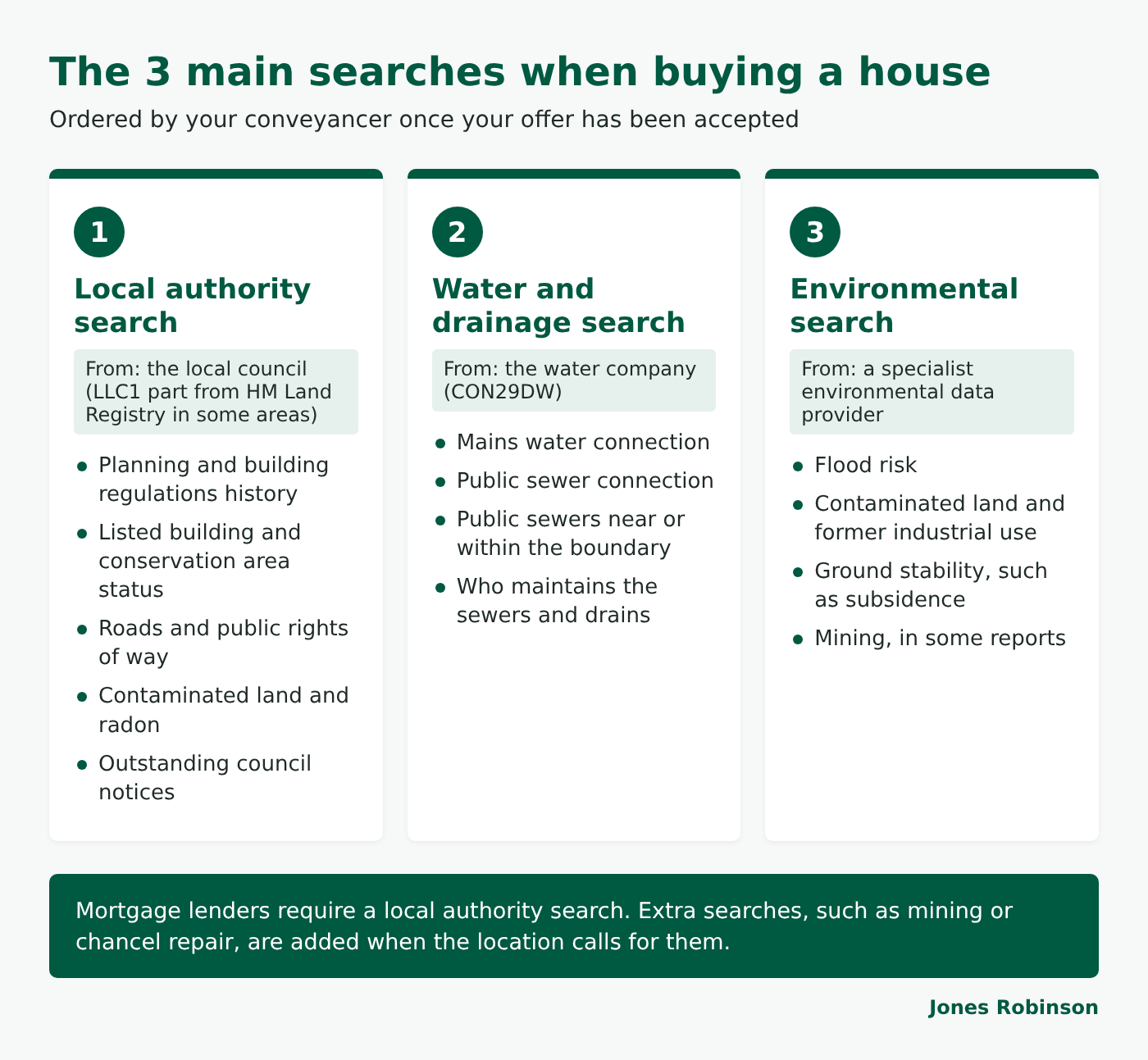
The three main searches when buying a house are the local authority search, the water and drainage search and the environmental search. Your conveyancer orders all three once your offer has been accepted. The local authority search checks council records such as planning history, building regulations and roads; the water and drainage search confirms how the property connects to mains water and public sewers; and the environmental search looks at risks such as flooding, contaminated land and ground stability. Other searches, such as mining or chancel repair checks, are added only when the location calls for them.
Whether you are a first-time buyer or adding to your portfolio, overlooking searches can lead to unexpected issues down the line. This guide explains what each search covers, what it costs and how long it takes in West Berkshire, Wiltshire and South Oxfordshire, and what to do if a search turns something up.
In this blog
- What are property searches?
- Local authority search
- Water and drainage search
- Environmental search
- Additional property searches
- Preparing for property searches
- FAQs
Understanding Property Searches
Property searches are enquiries your conveyancer makes of councils, water companies and specialist data providers to uncover any issues or obligations attached to a property. Your survey covers the condition of the building; searches cover what you cannot see on a viewing, such as planning decisions, nearby sewers or flood risk. If you are deciding which survey to commission, our guide to Level 2 vs Level 3 surveys explains the difference.
Property purchases in England work on a 'buyer beware' basis, so it is up to you and your conveyancer to find these things out before you commit. Mortgage lenders require a local authority search before they will lend, and your conveyancer will usually recommend the full set even if you are buying without a mortgage.
| Search | Who provides it | Example cost and turnaround (October 2026) |
|---|---|---|
| Local authority search (LLC1 and CON29) | The local council, with the LLC1 register search provided by HM Land Registry in areas that have moved over | From £196 in Wiltshire to about £346 in West Berkshire, and 5 to 15 working days. See the local table below |
| Water and drainage search (CON29DW) | The water company for the property | £72.60 including VAT from Thames Water, 5 working days |
| Environmental search | Specialist environmental data providers, ordered through your conveyancer | Set by the provider; your conveyancer will include it in their quote |
Sources: Wiltshire, South Oxfordshire and West Berkshire council local land charges fees 2026 to 2027; Thames Water property searches price list, checked October 2026.
Local Authority Search
Overview of Local Authority Searches
Local authority searches are a fundamental part of the conveyancing process. They involve checking with the local council to uncover any potential issues that could affect the property.
A local authority search is made up of two main parts. The LLC1 is a search of the Local Land Charges Register, which records things such as Tree Preservation Orders, listed building status and certain planning decisions. The CON29 is a set of standard enquiries that the council answers from its wider records, for example whether the road outside is adopted (maintained by the council). Your conveyancer can also add optional CON29(O) questions where relevant.
The LLC1 is gradually moving from councils to HM Land Registry. West Berkshire moved on 25 April 2024, though the council still answers the CON29; Wiltshire Council is preparing to move, and South Oxfordshire still provides both parts.
What Does a Local Authority Search Cover?
A local authority search typically includes information on:
- Planning permissions, listed building consents and other planning decisions affecting the property.
- Building regulations approvals and completion certificates for past work, and any recorded breaches.
- Roads and public rights of way, including whether the road is adopted.
- Conservation areas, compulsory purchase, outstanding council notices, contaminated land and radon gas.
If the search shows the property is listed, our guide to buying a Grade II listed property explains what that means for future work.
How Long Does a Local Authority Search Take?
Turnaround depends entirely on the council. Locally, Wiltshire Council says most searches are returned in 5 to 7 working days, although it warns of delays for its east area while its register is prepared for the move to HM Land Registry. South Oxfordshire District Council promises a response within 8 working days, and West Berkshire Council aims to complete searches within 15 working days, with possible delays at busy times. In practice this is often the search that takes longest.
Cost of a Local Authority Search
Fees are set by each council and reviewed every April. These are the standard residential fees for the councils covering the Jones Robinson areas from 1 April 2026:
| Council | Towns | Residential search fee | Stated turnaround |
|---|---|---|---|
| Wiltshire Council | Marlborough, Devizes, Pewsey | £196 including VAT (LLC1 and CON29) | Usually 5 to 7 working days; east area delays noted |
| South Oxfordshire District Council | Didcot | £264.80 (LLC1 and CON29R, VAT included on the CON29) | Within 8 working days |
| West Berkshire Council | Newbury, Thatcham, Hungerford, Lambourn | £276 plus VAT (£331.20) for the CON29, plus £15 for the HM Land Registry official LLC1 search: about £346 in total | Aims for 15 working days |
Sources: Wiltshire Council, South Oxfordshire District Council and West Berkshire Council local land charges pages; GOV.UK HM Land Registry Local Land Charges fees. Fees checked October 2026.
Optional enquiries and extra land parcels cost more, and your conveyancer passes all search fees on to you as disbursements. Our guide to the hidden costs of buying a home covers the other fees to budget for.
Water and Drainage Search
Importance of Water and Drainage Searches
Water and drainage searches tell you how the property is supplied with water and how its waste water is taken away. They confirm whether the property is connected to mains water and the public sewer, which matters for running costs and for any future building work.
Details Provided by Water and Drainage Searches
These searches will reveal:
- Whether the property is connected to public sewers and where they are located.
- Information on the source of the property's water supply.
- Who is responsible for maintaining the sewers and drains.
A public sewer running within or close to the boundary can prevent or restrict future building work, such as an extension. If you are planning work, ask your conveyancer to flag anything the search shows.
Process of Conducting Water and Drainage Searches
Your conveyancer orders the standard CON29DW Drainage and Water Enquiry, which is the version recommended by the Law Society, from the relevant water company. The company answers from its maps and records of water mains and sewers.
Cost and Duration of Water and Drainage Searches
As an example, Thames Water's current price list (checked October 2026) puts its residential CON29DW search at £72.60 including VAT, with an estimated delivery of 5 working days. An expedited version is available for £145.20 including VAT, delivered in 1 working day. Other water companies set their own prices, and your conveyancer will order from whichever company serves the property.
Environmental Search
Significance of Environmental Searches
Environmental searches identify environmental risks that could affect the property, its value or your ability to insure it. They are especially useful near former industrial land, landfill sites or rivers.
Information Provided by Environmental Searches
An environmental search will provide details on:
- Any previous industrial use or contamination risks.
- The likelihood of flooding affecting the property.
- Potential issues with ground subsidence or landslides.
Flood risk deserves attention locally, as towns such as Newbury, Marlborough and Lambourn sit in river valleys. Before you make an offer, you can use the GOV.UK check long term flood risk service, which shows an area's long-term risk from rivers and the sea, surface water, reservoirs and, where data is available, groundwater. It does not tell you whether an individual property will flood, so the environmental search and your own questions to the seller still matter.
Cost and Timeframe for Environmental Searches
Environmental searches are desk-based reports produced by specialist data companies rather than councils, so the price depends on the provider and the level of report your conveyancer chooses. Some of the more detailed reports also include a coal mining search. Ask your conveyancer which report they use and what it covers.
Additional Property Searches
Alongside the searches, your conveyancer checks the title register at HM Land Registry. This occasionally reveals that the seller holds possessory title rather than absolute title, which is worth understanding before you exchange.
Other Potential Searches Based on Location and Property Type
Depending on the property's location and type, additional searches might be necessary. These can include:
- Mining searches: Essential in areas with a history of mining activity.
- Chancel repair searches: Identifies any potential liability to contribute to the repair of the chancel of an Anglican parish church. Under the Land Registration Act 2002, this liability had to be protected by an entry on the register before 13 October 2013, otherwise someone buying after that date could take the property free of it. Any existing liability continues until the property is next sold, so your conveyancer may recommend a chancel search or an indemnity policy.
- Land Registry searches: Confirms ownership and any restrictions on the property.
When and Why Additional Searches Might Be Necessary
These additional searches might be necessary if the property is located in an area prone to specific risks, such as mining activity or flooding. Your conveyancer will recommend them based on the location, the type of property and the results of the main three searches.
Cost Implications of Additional Searches
Prices vary by provider and by how detailed the report is. Ask your conveyancer to list each search and its cost in your quote, so you can see what you are paying for and why. It is usually money well spent compared with discovering an issue after purchase.
Preparing for Property Searches
Choosing the Right Solicitor for Property Searches
Selecting a knowledgeable solicitor or licensed conveyancer is crucial for thorough property searches. Look for firms with good reviews and experience in residential property, or your local Jones Robinson branch can put you in touch with the recommended conveyancers we have worked with for many years. Our guide to understanding conveyancing explains how searches fit into the wider legal process.
Questions to Ask Your Solicitor
Ensure you ask your solicitor the following:
- What searches do you recommend for this property?
- How long will the searches take?
- Are there any specific risks associated with this property or area?
Checklist: Ensuring Comprehensive Searches
- Local authority search
- Water and drainage search
- Environmental search
- Additional searches based on property specifics
FAQs
Do I Need All Three Main Searches?
If you are buying with a mortgage, your lender will require a local authority search, and conveyancers almost always recommend the water and drainage and environmental searches as well. Together they give you the clearest picture of the property before you commit, so in practice most buyers have all three.
Can I Skip Any Searches if Buying with Cash?
Even if you're buying with cash, skipping searches can be risky. You are not bound by a lender's requirements, but searches uncover issues that could affect the property's value, your plans for it and your ability to sell it later. Our guide to what a cash buyer is covers the other checks cash buyers still go through.
Which searches take the longest?
Usually the local authority search, because it depends on council workloads. Locally, councils quote anything from 5 to 7 working days in most of Wiltshire to 15 working days in West Berkshire, compared with 5 working days for a Thames Water drainage search.
Can I check anything myself before I make an offer?
Yes, to a degree. Anyone can inspect the Local Land Charges Register, known as a personal search. In areas that have moved to HM Land Registry, such as West Berkshire, you can do this free of charge (you need to create an account) through the GOV.UK search local land charges service, and South Oxfordshire District Council has its own online register. A personal search is not a substitute for your conveyancer's official searches, but it can flag a Tree Preservation Order or listed status early.
How to Speed Up the Search Process
If you're buying or selling through us, you will have a dedicated, proactive sales progressor who will keep in touch with you and your solicitor every week to give you updates.
And whilst we can give you details of our recommended solicitors, you're under no obligation to use them, of course. If you're choosing your own, make sure you:
- Choose a proactive solicitor.
- Ask your solicitor to start the searches early in the conveyancing process, as soon as you have paid for them.
- Regularly follow up with your solicitor for updates.
How long after searches are contracts exchanged?
There is no fixed gap. Exchange can happen once the searches are back and any issues are resolved, your mortgage offer is in place, your survey is done and the rest of the chain is ready. Our guide to exchange of contracts explains what has to be in place first.
What to Do if a Search Reveals Issues
If a search reveals issues, discuss them with your solicitor. They can advise on whether the issues are deal-breakers or whether they can be resolved, for example through further enquiries of the seller, an indemnity policy or a renegotiation of the price.
Tips for Handling Property Searches Efficiently
- Stay organised and keep track of search progress.
- Communicate clearly and promptly with your solicitor.
- Be prepared for potential delays and factor them into your timeline.
Property searches give you the legal, environmental and infrastructure facts about a home before you are committed to buying it. Make sure the full set is carried out, even if you are buying with cash, choose a reliable solicitor, ask questions early and stay in touch throughout, and you can exchange with confidence.
Buying in West Berkshire, Wiltshire or South Oxfordshire?
Whether you are buying in Newbury, Didcot, Marlborough, Devizes, Pewsey or Lambourn, we can introduce you to recommended conveyancers and mortgage advice, and our sales progressors will keep your purchase moving through each stage of the buying process. Speak to our Newbury team or our Marlborough team, or find your nearest branch.