

In this blog
- What is completion day?
- How long is it between exchange and completion?
- What happens on completion day, step by step
- What time do you get the keys?
- How does completion work in a chain?
- What happens if completion is delayed?
- What happens after completion?
- Completion day checklist
- FAQs
Completion day is the day ownership of the property legally passes from the seller to the buyer. The buyer's conveyancer sends the purchase money to the seller's conveyancer, the seller's mortgage is paid off, and once the funds arrive the estate agent releases the keys. Most completions happen within a few weeks of exchanging contracts.
For most people it is the day they have been working towards for months, and it can feel like a lot of waiting around for a phone call. This guide walks through what happens on completion day, when you can expect the keys, what can cause a delay, and the jobs you need to do afterwards.
What Is Completion Day?
Completion day is the date set in the contract when the sale is finalised. On that day the buyer pays the balance of the purchase price, the seller hands over the property with vacant possession, meaning empty and ready to move into, and the buyer becomes the owner.
Completion is different from exchange of contracts. Exchange is the point when the sale becomes legally binding and the completion date is fixed. Completion is when the money moves and the keys change hands. Our guide to exchange of contracts explains the earlier stage.
How Long Is It Between Exchange and Completion?
Completion usually happens 7 to 28 days after exchange, according to the HomeOwners Alliance, although it can be the same day or several months later if everyone agrees (HomeOwners Alliance, January 2026). The date is agreed between buyer, seller and the rest of any chain before contracts are exchanged.
The whole process takes longer. Rightmove found an average of 154 days from sale agreed to completion across Great Britain in 2026, with 170 days in the South East and 164 days in the South West (Rightmove, July 2026). Exchanging and completing on the same day is possible, but it leaves no time to book removals with certainty, so most people allow a gap.
What Happens on Completion Day, Step by Step
On completion day the purchase money moves from the buyer's side to the seller's side, the seller's mortgage is repaid, and the keys are released once the seller's conveyancer confirms the funds have arrived. The buyer does not usually need to do anything except wait for confirmation.
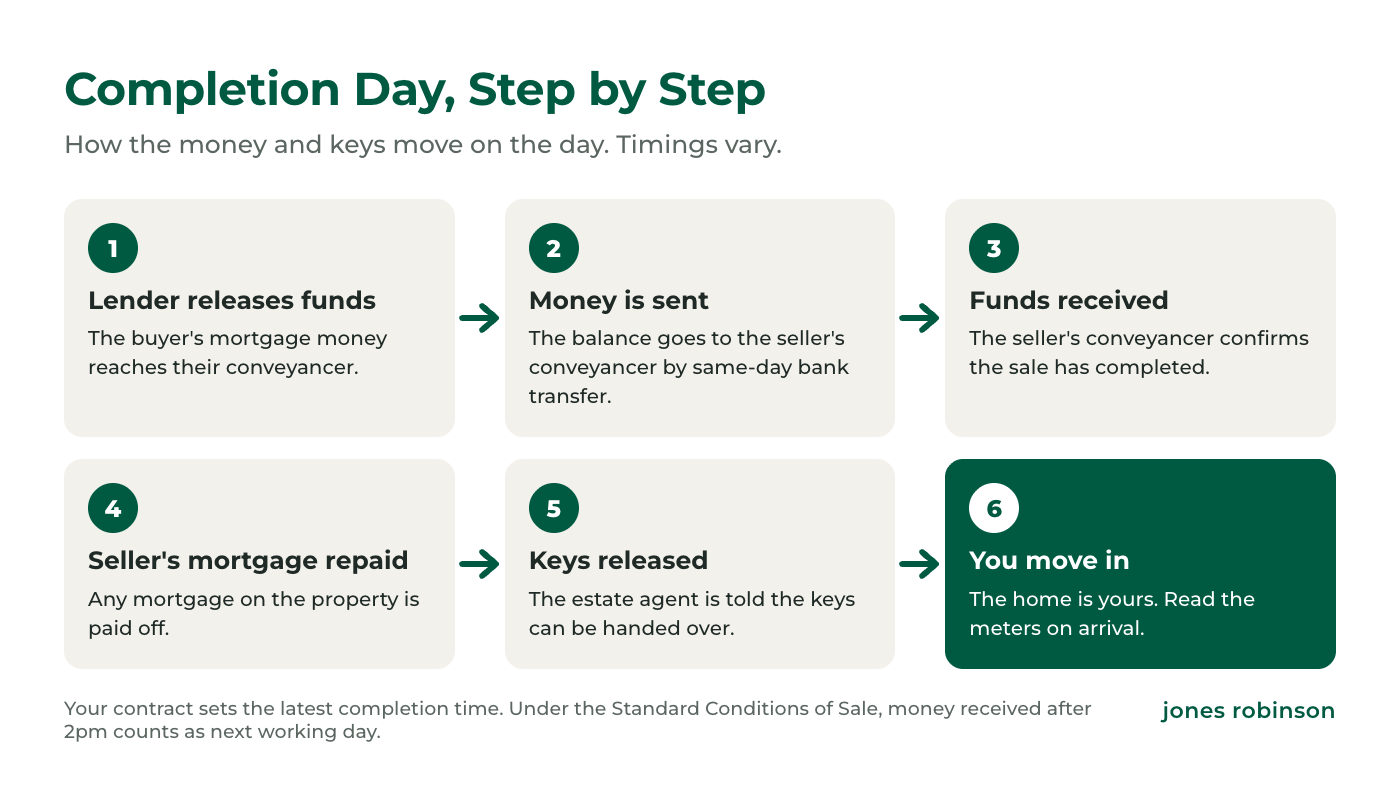
- Funds are sent: the buyer's conveyancer, who already holds the mortgage advance and the buyer's own money, sends the balance to the seller's conveyancer. This is usually done by CHAPS, a same-day bank transfer used for large payments.
- Funds are received: the seller's conveyancer confirms the money has arrived and the sale has completed.
- The seller's mortgage is repaid: the seller's conveyancer pays off any mortgage secured on the property.
- Keys are released: the seller's conveyancer tells the estate agent, who releases the keys to the buyer.
The seller needs to have moved out and left the property empty by the time completion takes place, unless the contract says otherwise.
What Time Do You Get the Keys?
There is no fixed time, but keys are usually released around the middle of the day or early afternoon, once the money has reached the seller's conveyancer. The contract sets a latest time for completion; under the Standard Conditions of Sale, money received after 2pm is treated as arriving on the next working day, and many contracts set an earlier deadline.
Bank transfers can queue at busy times, especially on Fridays and at the end of the month, so a morning completion is never guaranteed. Book your removal company with that in mind, and keep your phone switched on for the call from the agent or your conveyancer.
How Does Completion Work in a Chain?
In a chain, money moves up from the bottom. The first buyer's funds reach their seller, who then uses that money to buy their next home, and so on up the chain. Each completion depends on the one before it, so homes at the top of a chain often complete later in the day.
A delay anywhere in the chain can hold up everyone above it. That is one reason agents chase every link in the days before completion. At Jones Robinson, a Dedicated Sales Progressor stays in touch with every party in the chain so problems surface before the day itself.
What Happens If Completion Is Delayed?
If completion does not happen on the agreed date, the party at fault usually has to pay compensation under the contract. Under the Standard Conditions of Sale this is calculated as interest at the contract rate on the purchase price for each day of delay, less any deposit paid.
If the delay continues, the other side can serve a notice to complete, which gives ten working days to complete. If the buyer still fails to complete, the seller may be able to keep the deposit and sell to someone else. Most delays are short and caused by late funds rather than anyone refusing to complete, but your conveyancer will explain your position if it happens.
What Happens After Completion?
After completion, the buyer's conveyancer submits the Stamp Duty Land Tax return and pays any tax due, then registers the buyer as the new owner with HM Land Registry. In England, the SDLT return must be submitted and the tax paid within 14 days of completion (GOV.UK).
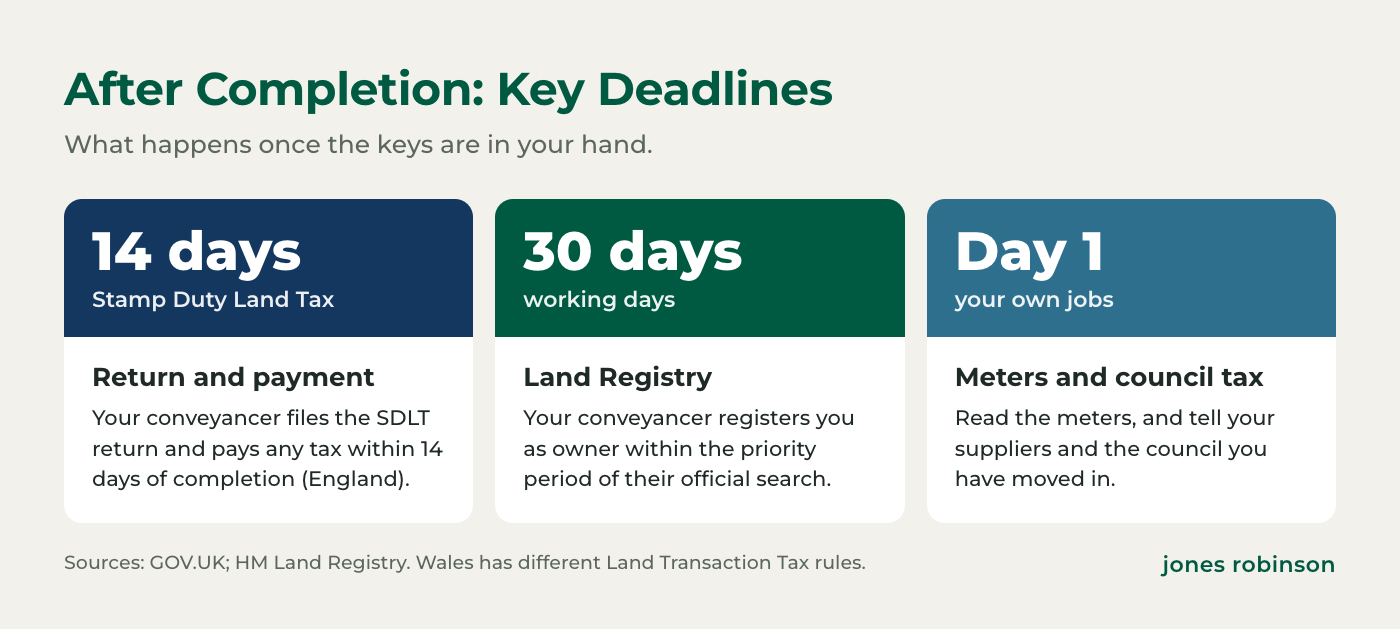
Your conveyancer should register the purchase within the priority period of their official Land Registry search, which is 30 working days, to protect your ownership. There are also a few jobs for you:
- Take meter readings for gas, electricity and water on the day, and pass them to your suppliers.
- Tell the council so your council tax is set up correctly.
- Update your address with your bank, employer, GP and the DVLA. Our change of address checklist covers the full list.
- Check your buildings insurance, which usually needs to be in place from exchange if you have a mortgage.
Use our stamp duty calculator to check how much SDLT you should expect to pay.
Completion Day Checklist
A little planning takes most of the stress out of completion day.
- Buyers: confirm your removal booking, arrange to collect the keys from the agent's office, keep essentials (kettle, bedding, phone chargers, cleaning kit) in the car, and read the meters when you arrive.
- Sellers: have everything out by the agreed time, leave the property clean, take final meter readings, and leave keys, alarm codes, manuals and guarantees for the new owners.
- Both: keep your phone charged, and do not hand over or collect keys until the agent or conveyancer confirms completion.
Our guide on the best day and time of year to move house may help you choose your date.
FAQs
Do you move in on completion day?
Usually, yes. Once the keys are released you own the property and can move in straight away.
Can you exchange and complete on the same day?
Yes, but it is less common. It gives neither side certainty until the day itself, which makes booking removals harder.
Why do so many people complete on a Friday?
A Friday completion gives the weekend to move and unpack. It is also a busy day for bank transfers, so keys can be released later than on other weekdays.
What can go wrong on completion day?
The most common problem is money arriving late, often because of delays further down a chain or with a lender. Occasionally a seller has not moved out in time. Both are usually resolved the same day.
When do you pay stamp duty?
Your conveyancer normally pays it for you on or shortly after completion. In England, the return and payment must be made within 14 days of completion.
Does the seller have to leave the property clean?
The contract requires vacant possession, meaning empty of people and belongings unless agreed otherwise. Leaving it clean is good manners rather than a legal requirement in most contracts.
Moving in West Berkshire, Wiltshire or South Oxfordshire?
Our teams in Newbury, Didcot, Marlborough, Devizes, Pewsey and Lambourn support every sale through to completion. Browse properties for sale, see how our conveyancing partners can help, or Book a Valuation if you are selling.