

In this blog
- What does Grade II listed mean?
- Listed buildings in West Berkshire and Wiltshire
- What does listing cover?
- When do you need listed building consent?
- What if a previous owner did work without consent?
- Running costs, insurance and mortgages
- Energy efficiency and EPCs
- Checks to make before you buy
- FAQs
A Grade II listed property is a building that Historic England has recognised as being of special architectural or historic interest, and it is protected by law. You can live in it, sell it and improve it, but most alterations that affect its character, inside or out, need listed building consent from the local council before work starts.
Grade II is by far the most common grade. Around 91.7% of listed buildings in England are Grade II, out of more than 370,000 listed building entries on the National Heritage List for England (Historic England). This guide explains what listing means for buyers, which works need consent, what to check before you buy, and how listing affects insurance, mortgages and energy efficiency.
What Does Grade II Listed Mean?
Grade II listed means a building is of special interest and is protected under the Planning (Listed Buildings and Conservation Areas) Act 1990. England has three grades of listing: Grade I for buildings of exceptional interest, Grade II* for particularly important buildings of more than special interest, and Grade II for buildings of special interest.
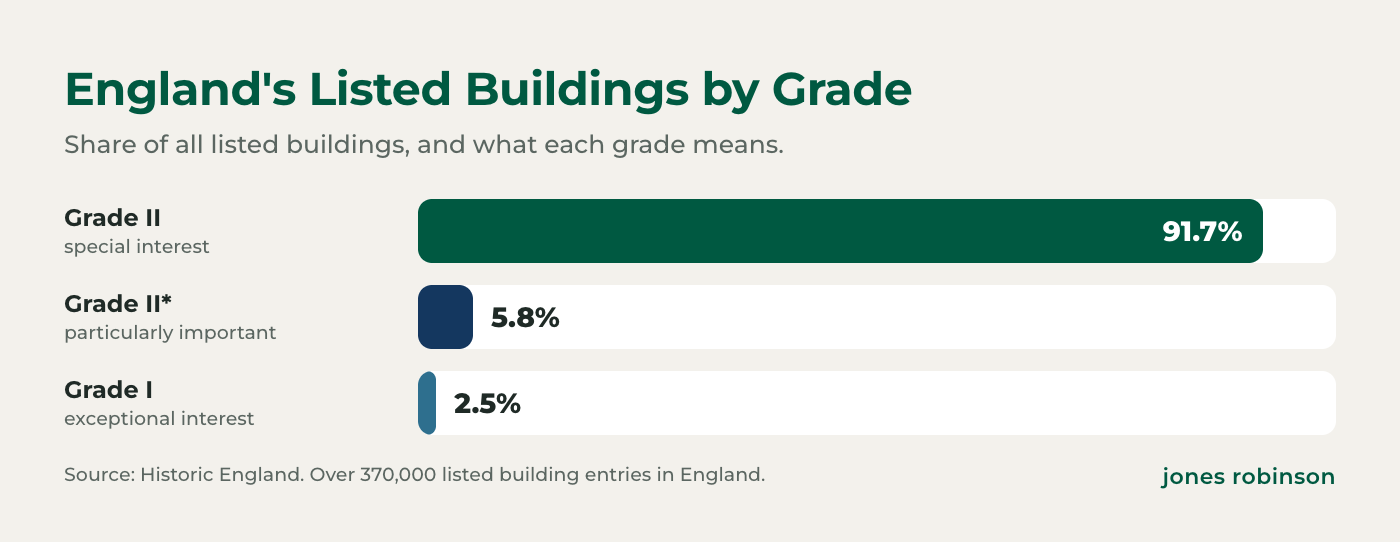
Listing does not freeze a building in time. It means that changes need to be considered carefully so the features that make it special are kept. Many listed homes have been sympathetically extended and modernised with consent.
Listed Buildings in West Berkshire and Wiltshire
Listed homes are a familiar part of the property market across our area. Wiltshire Council estimates the county has around 12,000 listed buildings and 245 conservation areas, and notes that Devizes alone has more than 500 listed buildings (Wiltshire Council, September 2024). West Berkshire Council has designated 53 conservation areas.
In practice, that means buyers in Marlborough, Devizes, Hungerford, Lambourn, Pewsey and the surrounding villages regularly come across listed cottages, Georgian townhouses, farmhouses and converted agricultural buildings. Our Marlborough, Devizes and Hungerford area guides describe the character of each town.
What Does Listing Cover?
Listing covers the whole building, inside and out, unless parts are specifically excluded in the list entry. It includes internal features such as staircases, fireplaces, panelling and floors, as well as later additions and fixtures attached to the building.
Listing can also extend to structures within the grounds, known as the curtilage. Historic England explains that pre-1948 structures within the curtilage, such as outbuildings, garden walls or barns, may be treated as part of the listed building. Whether a particular structure is covered can be complex, so ask the council's conservation officer if you are unsure.
The official list entry, which you can search on the National Heritage List for England, describes the building and the reasons for listing. It is a useful starting point, but it is not a complete inventory of everything protected.
When Do You Need Listed Building Consent?
You need listed building consent for any works that would affect a listed building's character as a building of special interest, including alterations, extensions and demolition. This applies inside and out, and it is separate from planning permission, although many projects need both. There is no fee to apply (Historic England).
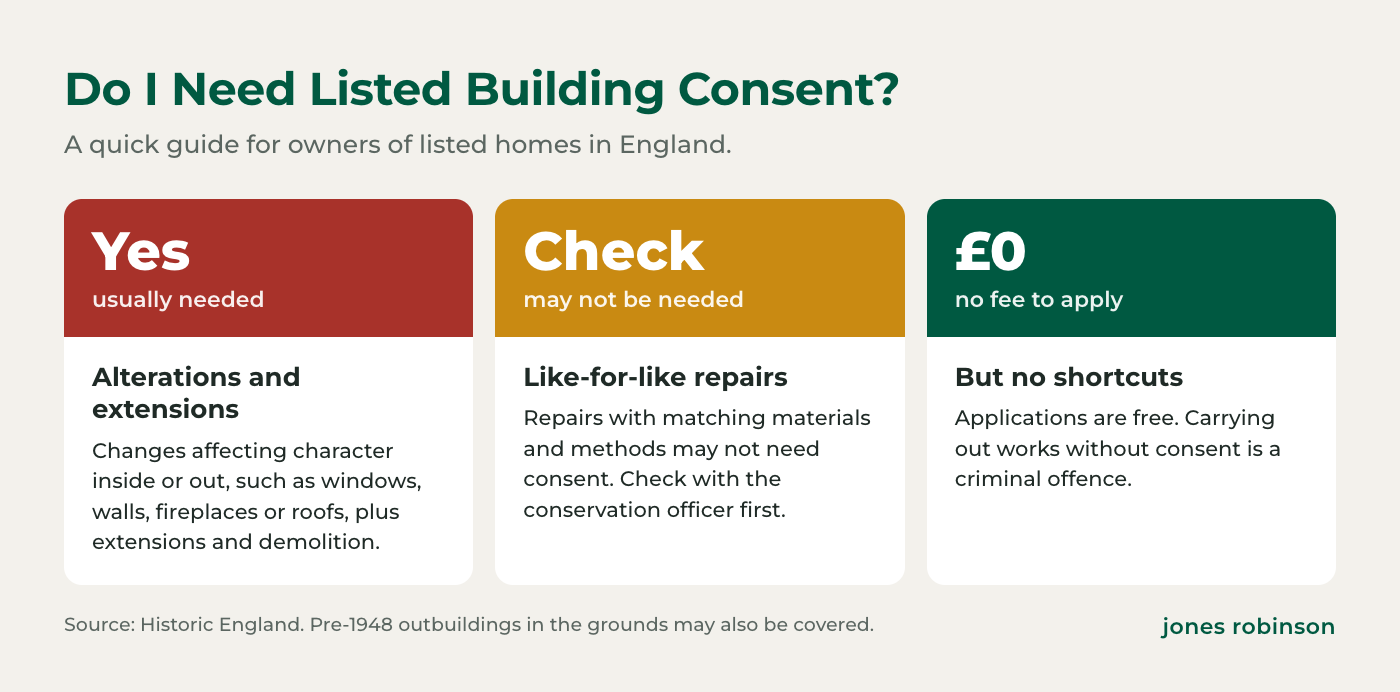
Examples that usually need consent include replacing windows or doors, removing internal walls or fireplaces, changing roof coverings, and adding an extension. Like-for-like repairs, which use matching materials and methods, may not need consent, but Historic England advises checking where there is any doubt.
Carrying out unauthorised works to a listed building is a criminal offence. The best approach is to speak to the local council's conservation officer early, before drawing up detailed plans. Consent is granted in the large majority of cases: Historic England reports that around 92% of listed building consent decisions for alterations and extensions in England were granted in 2024/25 (Historic England Heritage Counts).
What If a Previous Owner Did Work Without Consent?
If you buy a listed building that has had unauthorised work, you can become responsible for putting it right. The council can take enforcement action against the current owner, even if a previous owner carried out the work, and there is no time limit on listed building enforcement.
This is the single most important reason to check the property's history carefully before you buy. Ask the seller for copies of every listed building consent, planning permission and building regulations approval, and for the approved plans, so your conveyancer can compare them with what is actually there. If anything does not match, get specialist advice before exchanging contracts. Indemnity insurance is sometimes offered in these situations, but it has limitations, so ask your conveyancer to explain what it would and would not cover.
Running Costs, Insurance and Mortgages
Listed homes can cost more to maintain, insure and alter than similar unlisted properties. Repairs often need traditional materials such as lime mortar and specialist trades, and approved alterations to listed homes have been charged VAT at the standard rate since October 2012, when the previous zero rate was removed (HMRC VAT Notice 708).
- Insurance: tell your insurer the property is listed. Rebuilding with matching materials and methods can cost more, so many owners use a specialist insurer or broker.
- Mortgages: many lenders will consider Grade II listed homes, but they look closely at condition and any unusual construction, such as thatch or timber framing. A broker who knows the market can help.
- Surveys: Historic England notes that RICS recommends a Level 3 survey for older buildings. Our guide to Level 2 vs Level 3 surveys explains the difference.
Our mortgage advice service can help you understand your options before you make an offer.
Energy Efficiency and EPCs
Improving the energy efficiency of a listed home is possible, but some measures, such as replacing windows or adding external or internal wall insulation, need listed building consent and may not be approved. Reversible improvements such as secondary glazing, loft insulation and draught-proofing are often easier to agree.
Current GOV.UK guidance says listed buildings are exempt from needing an EPC only where meeting minimum energy performance requirements would unacceptably alter their character or appearance, and owners should check with their conservation officer. The government said in March 2026 that it intends to remove heritage exemptions as part of wider EPC reforms, so this is an area to watch, particularly if you plan to let the property.
Checks to Make Before You Buy
Before you buy a listed property, confirm its listing, check that past works had consent, commission the right survey and line up specialist insurance. These checks protect you from inheriting problems and help you budget realistically.
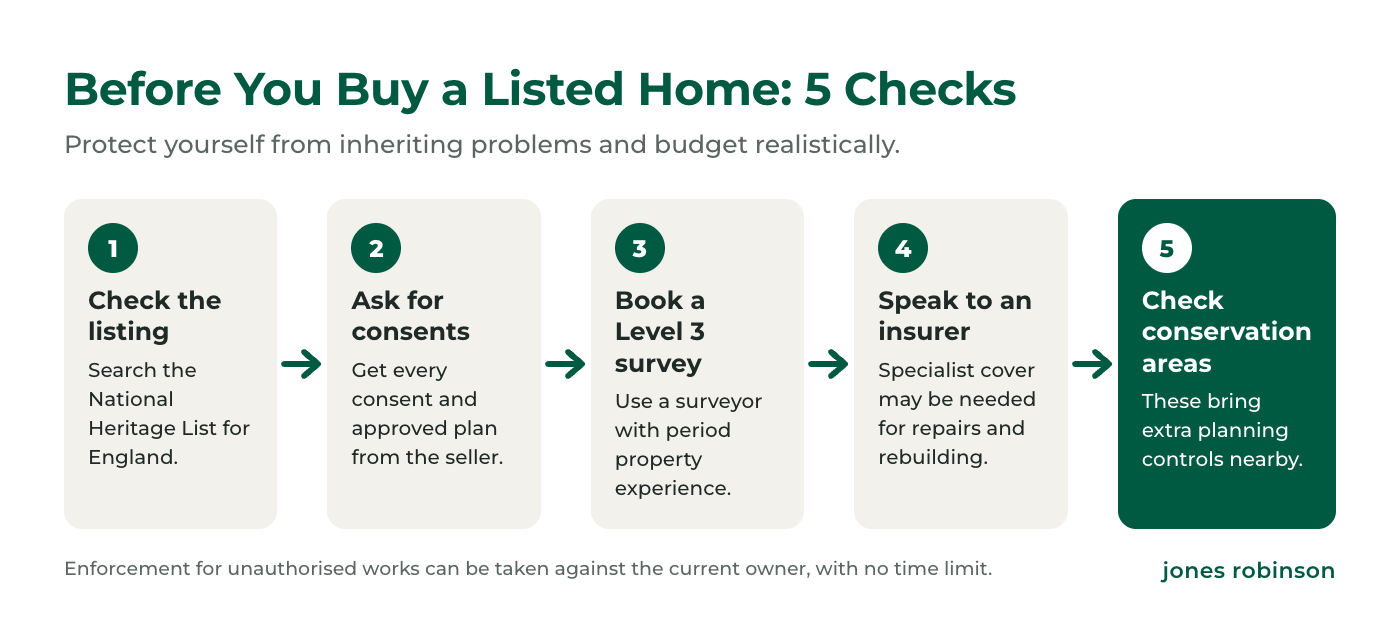
It is also worth checking whether the property is in a conservation area. A conservation area is a wider area the council has designated for its special architectural or historic interest, and it brings extra planning controls on things like demolition and some alterations, even for unlisted buildings.
FAQs
What are the drawbacks of buying a Grade II listed building?
The main drawbacks are the need for consent for many alterations, potentially higher maintenance and insurance costs, and responsibility for any unauthorised past works. For many buyers, the character of the home outweighs these.
Do I need permission to replace windows in a Grade II listed house?
Usually, yes. Replacing windows is one of the most common works that needs listed building consent, even if the new windows look similar. Speak to the conservation officer first.
Can you get a mortgage on a Grade II listed property?
Yes. Many lenders will lend on Grade II listed homes, although they will look at condition, construction and value carefully.
Is it more expensive to insure a listed building?
Often, because repairs and rebuilding may need specialist materials and trades. Premiums vary, so compare specialist insurers.
How do I find out if a house is listed?
Search the National Heritage List for England on the Historic England website, or ask the local council. Your conveyancer's local authority search will also confirm it.
Am I responsible for work done by previous owners?
Yes, potentially. Enforcement action for unauthorised works to a listed building can be taken against the current owner, with no time limit.
Buying or Selling a Period Home?
Our teams in Marlborough, Devizes, Pewsey, Lambourn, Newbury and Didcot sell listed and period homes across West Berkshire, Central Wiltshire and South Oxfordshire. Browse properties for sale, or Book a Valuation to find out what your period home is worth, and what buyers will want to see.