

Updated October 2026: the EPC rules for landlords have changed since this article was first published, so we have corrected the legal sections and added the latest research on whether a good rating pays off.
As energy prices rise and people make a conscious effort to be more sustainable, house hunters are looking for a new home with energy-saving features. For landlords, a good EPC rating is a huge selling point to prospective tenants and a legal requirement.

In this blog
- When is an EPC a legal requirement?
- EPC rules for landlords: what applies now and what is coming
- Does a good EPC rating add value?
- How to improve your EPC rating
- EPC FAQs
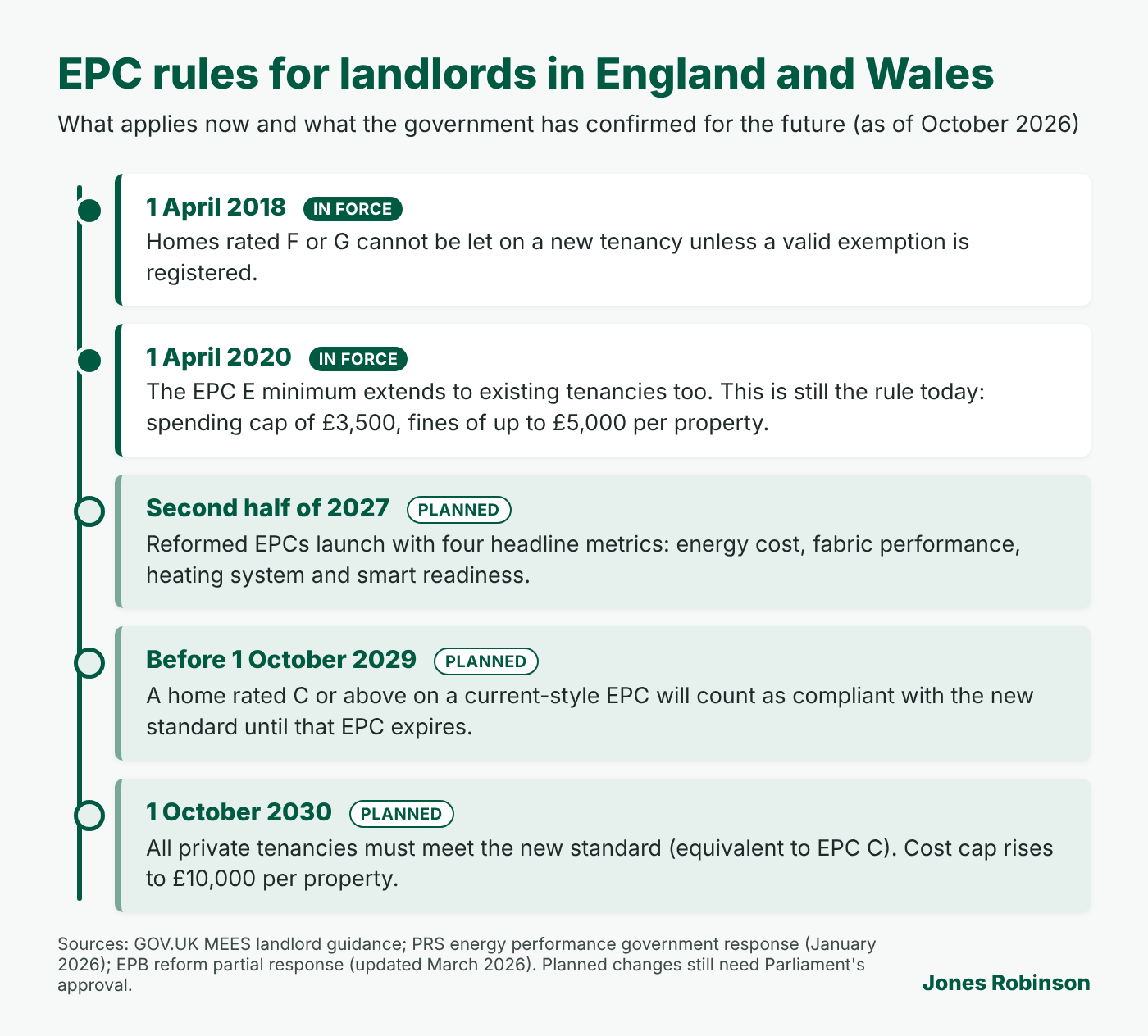
Currently, rented homes in England and Wales need an EPC rating of ‘E’ or above to be legally let, unless the landlord has registered a valid exemption. When this article was first written, a move to ‘C’ by 2025 was on the table, but that proposal never became law. In January 2026 the government confirmed a new plan instead: all privately rented homes will need to meet a higher standard, equivalent to EPC C, by 1 October 2030. That deadline still needs Parliament’s approval, so as of October 2026 the legal minimum remains E.
An Energy Performance Certificate is valid for ten years. Under the current rules you need a valid EPC whenever you market a property to sell or let, so if yours has expired you will need a new one before your next tenancy or sale. While the higher standard is still a few years away, it makes sense to plan improvements now. Under the government’s plans, a home rated C or above on a current-style EPC issued before 1 October 2029 will count as meeting the new standard until that certificate expires, so early improvements can buy you years of certainty.
The way a building is insulated, heated and ventilated affects its value as well as the cost of running it. The better you understand your property’s current energy performance, the better you can target improvements that make a real difference, especially given tenant demand for energy-efficient homes.
When Is an EPC a Legal Requirement?
According to GOV.UK, you must have an EPC when you are:
- selling a property
- renting out a property
- building a new property
You must order the EPC before you market the property, and the seller, landlord or letting agent must show it to prospective buyers or tenants. Providing an EPC for the property is also one of a landlord’s legal responsibilities. You can be fined if you do not get an EPC when you need one.
Each certificate rates a home from A (most efficient) to G (least efficient), shows typical energy costs and lists recommended improvements. You can check whether your property already has a valid certificate, and download it for free, using the government’s find an energy certificate service. If there is no valid EPC, you will need to book one with an accredited assessor.
A few buildings are exempt, such as some holiday lets and, in certain cases, listed buildings. If you own a listed home, check with your local authority’s conservation officer.
EPC Rules for Landlords: What Applies Now and What Is Coming
The Minimum Energy Efficiency Standard (MEES) has applied to privately rented homes in England and Wales since 2018. Here is where it stands in October 2026.
| Rule | Now (in force) | From 1 October 2030 (confirmed plan, not yet law) |
|---|---|---|
| Minimum standard | EPC E | A new standard equivalent to EPC C, measured using the new EPC metrics |
| Which tenancies | New and existing tenancies | All private tenancies, on a single compliance date |
| Most a landlord must spend | £3,500 (including VAT) | £10,000 per property over a 10-year period |
| Exemptions | Registered on the PRS Exemptions Register, most last 5 years | The cost cap exemption and some others last 10 years; most others 5 years |
| Maximum fine | £5,000 per property in total | Up to £30,000 per property, per breach |
Source: GOV.UK MEES landlord guidance (updated 5 May 2026) and the government response on improving the energy performance of privately rented homes (January 2026).
A few points are worth knowing about the 2030 plan:
- It is not yet law. The government will seek new powers through an Act of Parliament and aims for the updated regulations to come into force in 2027.
- The average spend is expected to be lower than the cap. The government’s impact assessment estimates an average of £5,400 per property to meet the standard.
- Heat pumps will not be forced on landlords. The standard looks first at the building’s fabric (insulation, windows and so on), then lets landlords choose between a heating system or a smart readiness standard. The government says landlords will not be required to replace working heating systems with heat pumps.
EPCs themselves are also changing. In March 2026 the government moved the planned launch of reformed EPCs from October 2026 to the second half of 2027. New-style certificates will show four headline measures: energy cost, fabric performance, heating system and smart readiness. The ten-year validity period is intended to stay, and existing EPCs keep their ten-year validity.
The 2030 deadline sits alongside other changes for landlords this year, including the Renters’ Rights Act, which came into force on 1 May 2026. Our landlord services team keeps up with each change so you do not have to.
Does a Good EPC Rating Add Value?
In a poll by Leaders Romans Group, reported by Property Industry Eye in November 2021, 66% of respondents said they would choose a property with eco-friendly features over one without. Among 25 to 34 year olds, 61% said they would look for these features. This age group is also more likely to still be renting, so it is important to appeal to them for future rental income.

More recent research from Nationwide and its buy-to-let lender, The Mortgage Works, puts numbers on the difference a rating makes. The effect is far stronger in the rental market than for owner-occupied homes:
| Compared with a similar D-rated home in England | Rated A or B | Rated C |
|---|---|---|
| Rent achieved | 8.1% higher (around £85 a month on a typical rent) | 1.8% higher (around £20 a month) |
| Price paid for buy-to-let purchases | 12.2% higher | 3.7% higher |
| Price paid by owner-occupiers | 1.6% higher | Little difference |
Source: The Mortgage Works, Private Rental Energy Performance Report (spring 2026), and Nationwide, Energy efficiency ratings have limited impact on owner-occupied house prices (2026). Both control for other factors such as new-build status.
Two honest caveats. These are averages across England, and the same report found the effect on rents is more modest in the South of England (a 4.5% premium for A or B ratings), with no clear rental uplift from moving a home from D to C. The bigger gains also come from A and B ratings, which are more common in newer homes. For a typical older house in West Berkshire or Wiltshire, the stronger case for reaching C is legal: it protects your ability to keep letting after 2030 and appeals to tenants watching their bills. Nationwide’s research found 77% of people surveyed said the EPC rating would be an important factor when choosing a property to buy in the future, and our guide to what tenants are looking for in 2026 covers the other features renters prioritise.
How to Improve Your EPC Rating
So, if your property is currently below a ‘C’ rating, what can you do to achieve a better EPC and attract tenants? Start with the recommendations section of your current certificate, which lists the measures an assessor thinks would improve the rating. Here are some improvements to consider:
- Examine and invest in better insulation: insulation helps keep the warmth in and makes a real difference to energy bills. Loft insulation is usually one of the simpler and cheaper upgrades, and wall insulation can help with your EPC rating too. Insulation also counts towards the fabric performance part of the future rental standard. There may be grants you qualify for to help with costs.
- Install a smart meter: see how much energy you are using, down to the pennies. This helps you and your tenants decide where and how to reduce energy use, although insulation and heating upgrades usually do far more for the rating itself.
- Invest in double glazing: if you do not already have double glazing, consider upgrading your doors and windows. Not only can this improve energy performance, but double glazing can also reduce noise, which will attract tenants if your property is in a busy area. If the property is listed or in a conservation area, check what consent is needed first.
- Check the lighting in your property: switch to energy-efficient bulbs to help reduce energy use and costs. LEDs are now the standard choice for low energy lighting.
- Purchase energy-efficient appliances: if you supply appliances to tenants, consider investing in efficient models to make long-term savings.
- Replace your boiler or consider a heat pump: if your boiler is old and inefficient, a new energy-efficient boiler can improve your EPC. A heat pump is another option, and through the Boiler Upgrade Scheme property owners in England and Wales, including landlords, can get £7,500 towards an air source or ground source heat pump. Our guide to heat pumps as a sustainable heating solution explains how they work and what to consider.
- Solar panels: a good way to produce cheaper and greener energy for your property, and they can reduce your electricity bills. Nationwide’s 2026 research found solar panels were among the most popular green improvements made by homeowners, and the most expensive, with an average spend of around £11,000, so get quotes and check the likely savings for your property before you commit.
- Secondary heating source: if you already have a working open fireplace, a modern wood-burning stove is more efficient than an open fire and can help heat the room. Check the local rules on smoke control areas and approved appliances first, and bear in mind it is unlikely to be the main route to a better EPC rating.
Many of these changes also cut a home’s emissions, and our practical tips for reducing your carbon footprint at home include simple steps tenants and owners can take straight away.
EPC FAQs
Is an EPC a legal requirement?
Yes. In England and Wales you need a valid EPC, which lasts ten years, to sell, rent out or build a property, and you must order it before marketing. You can be fined if you do not have one.
What is the minimum EPC rating to rent out a property?
As of October 2026 it is E, unless a valid exemption is registered. A standard equivalent to EPC C is planned for all private tenancies from 1 October 2030, subject to Parliament’s approval.
Do I need a new EPC for each new tenant?
Not if your current certificate is still valid. You can use the same EPC for new tenancies until it expires, as long as it meets the minimum rating. If you have made improvements, a new EPC may show a better rating.
About Jones Robinson Estate Agents
As leading, local letting agents in Newbury, Didcot, Lambourn & Hungerford, Marlborough, Devizes and Pewsey and the surrounding areas, we have vast experience in lettings and property management.
At Jones Robinson, we recognise that each property and landlord is unique and that landlords rent out properties for a variety of reasons.
By offering a personalised service we can tailor the letting and timeline to both landlord and tenant requirements, as we don’t believe the “one size fits all” approach works in this industry.
We are also very transparent, with clear and easy to understand information available to both landlords and tenants alike.
Contact your local branch to talk about your rental property and the EPC rules, or book a valuation if you are thinking of letting or selling.