

In this blog
- What defines a premium property in West Berkshire, Wiltshire and South Oxfordshire?
- Why does presentation matter so much when selling a premium home?
- How should you price a premium property to achieve the best result?
- How does stamp duty affect what premium buyers can pay?
- How do estate agents create demand for premium homes?
- How should you compare offers on a high-value home?
- Why is sales progression so important in a high-value sale?
- How does local expertise help you achieve the best price?
- Frequently asked questions
Selling a high-value property is a different experience from a standard house sale. The expectations around premium homes are higher, buyers are more informed, and every detail influences the final result.
For homeowners across West Berkshire, Wiltshire and South Oxfordshire, a successful premium property sale depends on far more than timing the market. It relies on careful positioning, considered marketing and the guidance of experienced estate agents who understand how to present homes at the top end of the market.
If you want to understand what makes a home premium in the first place, our guide to what sets a premium property apart in today's market covers that in detail. This guide focuses on the practical decisions that protect your price, from the first valuation through to completion day.
What defines a premium property in today's market
A premium property is not defined by price alone. While these homes often sit in the upper tier of the market, buyers are driven by a combination of lifestyle, quality and location.
In places such as Newbury, Marlborough and Didcot, demand is shaped by access to schools, countryside surroundings and transport links to major cities. A premium home will often combine these with thoughtful design, strong kerb appeal and a sense of scarcity. Buyers at this level are not simply looking for space; they are looking for a home that fits how they want to live, which is why positioning matters so much.
Why presentation is critical when selling premium homes
Presentation has a direct impact on how a property is perceived and, ultimately, what a buyer is willing to pay. At the top end of the market, first impressions are usually formed online before a viewing is ever arranged.
High-quality photos, video and clear descriptions help your property stand out from other homes for sale in the local market. Presenting your home well helps buyers picture themselves living there, builds confidence and creates a stronger emotional pull. This often leads to more interest and a better position when offers come in.
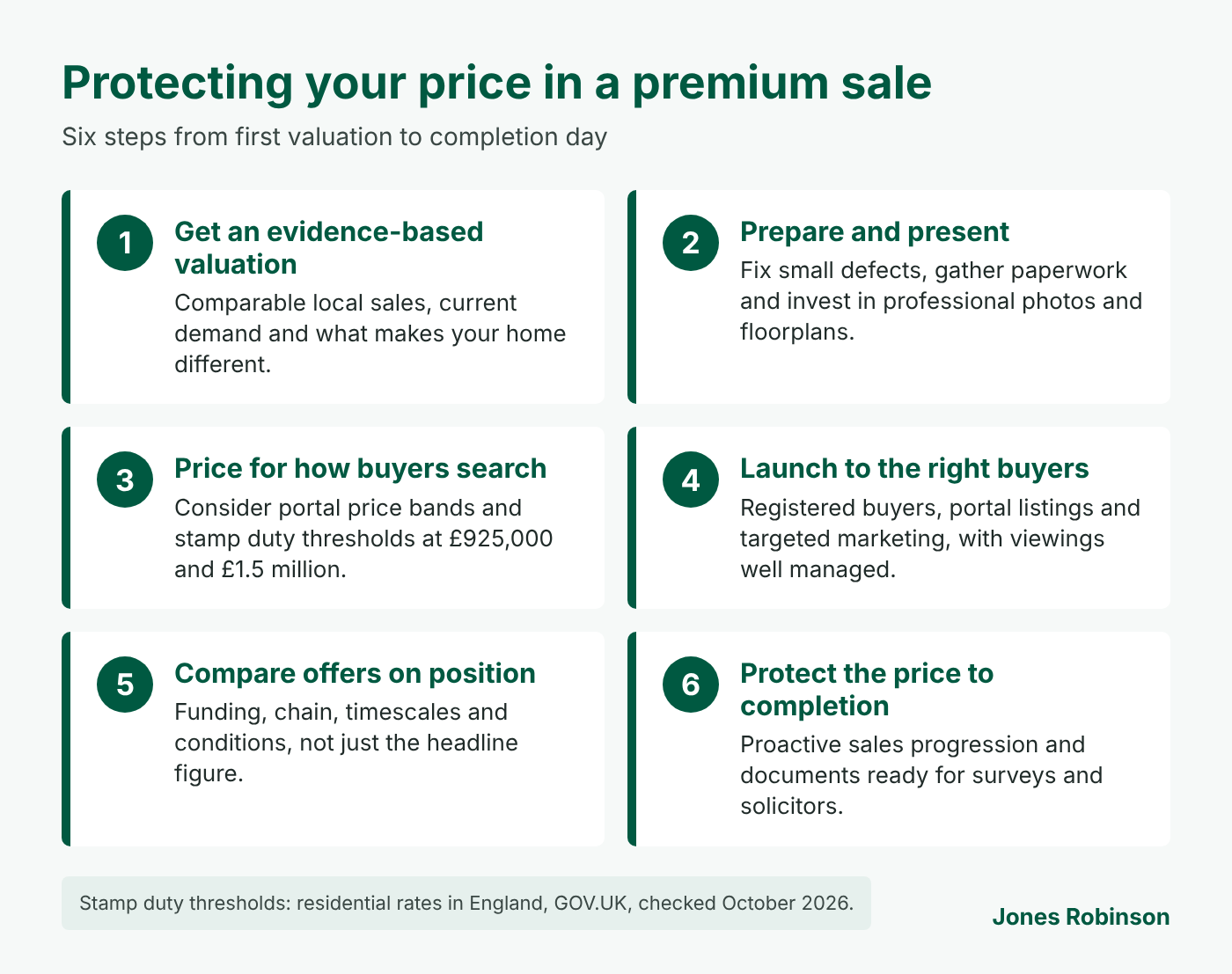
Before the photographer arrives, it is worth dealing with the small things a buyer or their surveyor will notice: a dripping tap, a sticking door, tired grouting, an overgrown boundary. Individually they are minor, but together they give a buyer reasons to offer less. Our guide on how to prepare to sell your house has a fuller checklist.
Pricing strategy for premium homes for sale
Pricing is one of the most important decisions in any property sale, particularly at the premium end. Setting the right price from the outset helps attract the right audience and encourages early engagement.
In areas such as Devizes and Pewsey, where supply can be limited, the right guide price can build interest quickly. Buyers looking at this level are often watching the market closely and know what comparable homes have achieved.
Overpricing can reduce visibility and slow momentum, while underpricing without a clear strategy can leave value on the table. A successful premium sale balances both, using pricing as a tool to drive competition. Our article on the real cost of overpricing your home explains what happens when a guide price is set too high.
Think about how buyers search. Buyers filter by price on property portals and agents' websites. On our own property search, for example, the price filter steps from £900,000 to £1,000,000 and then to £1,200,000. A home marketed at £1,025,000 will not appear for a buyer whose maximum is set at £1,000,000, even if they would happily stretch for the right house. Where a price sits in relation to these bands is worth discussing with your agent before launch, rather than after a quiet first few weeks.
How stamp duty affects what premium buyers can pay
Stamp Duty Land Tax (SDLT) is paid by the buyer, not the seller, but it shapes what buyers can afford to offer. In England the rate rises to 10% on the portion of the price between £925,001 and £1.5 million, and to 12% on anything above £1.5 million. Buyers who will own another residential property after the purchase usually pay an extra 5% on top.
| Purchase price | SDLT for a home mover (only property owned) | SDLT if the buyer will own another property |
|---|---|---|
| £750,000 | £27,500 | £65,000 |
| £925,000 | £36,250 | £82,500 |
| £1,000,000 | £43,750 | £93,750 |
| £1,250,000 | £68,750 | £131,250 |
| £1,500,000 | £93,750 | £168,750 |
| £2,000,000 | £153,750 | £253,750 |
Source: rates for residential property in England from GOV.UK, Stamp Duty Land Tax: residential property rates, checked October 2026. Figures exclude the 2% surcharge for non-UK residents and any reliefs.
Two practical points follow for sellers. First, every £10,000 of price above £925,000 costs a home mover another £1,000 in tax, so buyers in this bracket are often very precise about their ceiling. Second, a buyer who is replacing their main home but has not sold it by the day they complete will usually have to pay the higher rates up front and reclaim the extra later, provided they sell their previous home within 36 months. A buyer who has already sold, or is a cash buyer with no property to sell, avoids that cash-flow hurdle, which is one reason their position can be worth more than the headline figure suggests. Buyers can check their own figure with our stamp duty calculator.
Creating demand in the premium property market
At the top end of the market, the best results are rarely achieved through negotiation alone. They come from creating demand and encouraging competition between buyers.
This is where a coordinated marketing approach becomes essential. Matching a property with a database of motivated buyers, alongside portal listings and targeted promotion, helps it reach the right audience at the right time.
Premium homes often attract a smaller but more committed pool of buyers. By managing viewings, feedback and follow-up carefully, an agent can keep each interested party engaged, which increases the likelihood of competing offers and a stronger final price.
How to compare offers, not just the highest figure
When more than one buyer is interested, the highest offer is not always the best one. A slightly lower offer from a buyer who can proceed quickly and reliably can be worth more than a higher figure that depends on a fragile chain. When comparing offers, look at:
- Funding: is the buyer paying cash, or do they have a mortgage agreement in principle? Have they provided proof of funds or deposit?
- Chain: do they have a property to sell, and if so, is it on the market, under offer or already sold subject to contract? Our guide to what a cash buyer is explains why this matters.
- Timescales: do their moving dates suit yours, and can they move at the pace they are promising?
- Conditions: is the offer subject to anything, such as a survey outcome, planning advice or the sale of another asset?
Where several buyers are competing, agents often ask each one for a "best and final" offer by a set deadline, with their position confirmed in writing. This gives every buyer a fair chance and gives you a clear, like-for-like comparison. Remember that in England an accepted offer is not legally binding until contracts are exchanged, so the risks of gazumping and gazundering remain until that point.
Why sales progression protects your final sale price
Agreeing a price is only part of the process. The journey from offer to completion is where many sales run into problems, particularly in higher-value transactions.
Sales progression keeps the process on track. Clear communication, proactive management of the chain and close collaboration with solicitors (including our own conveyancing service) all help reduce the risk of delays or fall-throughs.
The most common threat to an agreed price is the survey. Buyers of older, larger or altered homes often commission a more detailed RICS Level 3 survey, and any defects it highlights can lead to a request to renegotiate. Our guide to Level 2 vs Level 3 surveys explains what buyers will be looking at. You can reduce the risk by having paperwork ready before you launch: planning permissions and building regulations sign-off for extensions or conversions, listed building consent where relevant, guarantees and certificates for windows, roofs and damp treatment, and recent service records for boilers, septic tanks or private water supplies. The government has also announced plans to introduce homebuying sales packs as part of wider home buying reforms, so gathering this information early is a good habit regardless.
For sellers of premium homes, this stage is just as important as marketing. A strong offer only delivers value if it reaches completion at the price agreed.
The importance of local expertise in premium property sales
Local knowledge remains one of the most valuable assets in any premium property sale. Understanding how the market behaves in specific locations allows an agent to position a home effectively and advise on strategy with confidence.
In towns such as Marlborough and across the surrounding villages, buyer behaviour can vary significantly depending on property type and setting. A family looking for space near good schools will weigh a home differently from a downsizer or a buyer relocating from London for a rural setting.
Working with estate agents who have a strong presence in the local market means every decision, from pricing to marketing to negotiation, is informed by real evidence rather than assumption. That starts with the valuation itself, and our guide to what a good estate agent valuation should involve explains what to expect.
Frequently asked questions
Should I always accept the highest offer on my home?
Not necessarily. The strength of a buyer's position matters as much as the figure. A buyer with funds in place and no chain is usually less likely to withdraw or renegotiate than one who still needs to sell, so it is worth weighing funding, chain and timescales alongside the price.
What is a best and final offer?
When several buyers are interested, the agent may ask each of them to submit their highest offer by a set deadline, along with details of their funding and position. You then choose the offer that best suits your price and timing. Until contracts are exchanged, neither side is legally bound.
Should I price my home just under £1 million?
It depends on the evidence. Pricing just below a round figure can bring your home into more buyers' searches, but it should reflect what comparable homes have achieved. Your agent should show you the local sales evidence and explain how the guide price fits buyers' search bands before you decide.
Do buyers pay more stamp duty on homes over £925,000?
Yes. In England, the portion of the price from £925,001 to £1.5 million is taxed at 10%, and the portion above £1.5 million at 12%, with a usual 5% extra for buyers who will own another residential property. The table above shows the totals at common price points.
Thinking of selling a premium home?
A successful premium sale is built on presentation, pricing and careful management from first viewing to completion. Understanding how your home fits within the current market is the first step.
Jones Robinson supports homeowners across West Berkshire, Wiltshire and South Oxfordshire with a thoughtful, results-driven approach to property sales. Book a valuation for an evidence-based view of what your home could achieve, or speak to your local team at any of our six offices, including Marlborough and Newbury.