

In this blog
- What defines a premium property in today's market?
- What do character and rural homes need to get right?
- Why presentation influences buyer perception more than ever
- How marketing creates demand, not just visibility
- What role pricing plays at the top end of the market
- How to position your home to attract the right buyers
- Why confidence and clarity drive premium results
- How to achieve a premium result in 2026
- Premium property FAQs
The idea of a premium property has changed. In 2026, it is no longer defined by price alone. Buyers are more informed, more selective and more considered in how they approach their next move.
Across West Berkshire, South Oxfordshire and Wiltshire, homes that achieve the strongest results are those that feel well-positioned from the outset. They create confidence early, stand out clearly and connect with the right audience.
Understanding what sets a premium property apart, and how to achieve that positioning, can make a meaningful difference to both interest levels and final sale price. This article looks at what makes a home premium in the first place and what you can do about it before you list. If you are already preparing to sell and want the detail on guide prices, buyer competition and sales progression, our guide to achieving the best price in a premium property sale covers those stages.
What defines a premium property in today's market
A premium property is not simply one that sits at the top end of the price range. It is a home that offers a clear combination of quality, location and lifestyle.
In towns such as Newbury and Marlborough, this may mean proximity to well-regarded schools, strong transport links and an established community feel. In villages around Lambourn and Pewsey, it is often about space, setting and long-term lifestyle appeal. In Didcot, connectivity and modern living continue to shape demand.
What buyers are looking for is consistency. A home that feels well thought through, well maintained and aligned with how they want to live.
In a premium property sale, buyers are not just comparing properties. They are comparing opportunities. The homes that stand out are those that present a clear and compelling proposition from the start.
Some of what makes a home premium is fixed, such as its location and outlook. Much of the rest is within your control. The table below sets out the qualities buyers at this level tend to look for, and what a seller can do to strengthen each one.
| Quality | What buyers look for | What you can do before selling |
|---|---|---|
| Setting and outlook | Views, privacy, a quiet position and easy access to countryside or a town centre | Tidy boundaries, hedges and approaches, and make sure photographs and floor plans show the plot and outlook clearly |
| Character | Period features, quality materials and a sense of individuality | Repair rather than replace original features, and have consents and history to hand for older or listed homes |
| Space and land | Room to grow, home working space, gardens, paddocks or outbuildings | Show how each space is used, and confirm boundaries, access and any rights of way |
| Condition | A home that is ready to move into, without a list of hidden jobs | Deal with small defects, damp, gutters and decoration before photography |
| Running costs | Realistic heating and energy costs, particularly in larger or older homes | Have a valid EPC and records of any insulation, boiler or heat pump work |
| Certainty | Clear paperwork and a sale that will not stall | Gather planning, building regulations, guarantees and drainage records before you list |
Character and rural homes: the details that need extra care
Many of the premium homes we see across our patch are period houses, cottages, farmhouses and country homes with land. You can see the kind of homes we mean in our current character properties for sale and rural properties for sale. These homes carry real appeal, but they also raise questions that buyers and their solicitors will ask early. Having the answers ready is one of the simplest ways to protect your price.
Listed buildings. According to Historic England, 91.7% of listed buildings are Grade II. Listed building consent is needed for changes that might affect a building's special interest, which can include replacing windows or internal alterations, and carrying out works without consent is a criminal offence. Buyers' solicitors will ask for consents covering past work, so check what was approved before you market the home. Our guide to buying a Grade II listed property explains what buyers will be checking.
Protected landscapes. The North Wessex Downs, designated an Area of Outstanding Natural Beauty in 1972, covers 668 square miles across Berkshire, Hampshire, Oxfordshire and Wiltshire and is the third largest National Landscape in the country (North Wessex Downs National Landscape). For buyers, that protection is part of the appeal. For sellers, it means any extension, conversion or outbuilding should have clear planning paperwork behind it.
Private drainage. Many rural homes are not on mains drainage. Under the general binding rules, if you sell a property with a septic tank or small sewage treatment plant you must tell the new owner in writing, including a description of the system, where its main parts are and any maintenance records you have. A septic tank that discharges directly into a watercourse must be replaced or upgraded, and buyer and seller should agree who is responsible as a condition of sale. Finding this out early avoids a difficult renegotiation later.
Energy performance. You must have an Energy Performance Certificate (EPC) in place before you market a home for sale, and an EPC is valid for 10 years (GOV.UK). Older and larger homes often have lower ratings, so records of insulation, glazing or heating improvements help put the rating in context.
Presentation shapes perception from the outset
First impressions are now formed long before a viewing takes place. For most buyers, the initial experience of a property happens online.
This is where presentation plays a critical role in any premium property sale. High-quality photography, well-composed images and professional video content allow a home to be understood quickly and clearly. They help buyers picture how the space works and how it might feel to live there.
Presentation is not about making a home look different. It is about showing it at its best, with clarity and confidence.
Buyers in 2026 are less willing to overlook uncertainty. If a property feels unclear or under-presented, they are more likely to move on to the next option. When a home is presented properly, it builds trust and encourages further interest.
For homes with land or a special setting, presentation also means showing the whole picture: the approach, the gardens, the outbuildings and the view from the main rooms. If you are planning an autumn or winter launch, it can be worth taking exterior photographs while gardens are in leaf.
Marketing that creates demand, not just exposure
A successful premium property sale relies on more than visibility. It depends on how a property is positioned and who it reaches.
Listing a home on property portals is only one part of the process. The strongest results come from a more considered approach, where marketing is designed to create demand and encourage competition.
This includes:
- Introducing the property to a database of motivated buyers
- Targeted digital campaigns that reach relevant audiences
- Clear storytelling that highlights what makes the home distinct
At the top end of the market, the buyer pool may be smaller, but it is often more committed. Reaching the right people, rather than simply more people, is what drives meaningful interest.
Pricing strategy at the premium level
Pricing plays a central role in shaping a premium property sale. It influences how a property is perceived, how quickly it attracts interest and how buyers respond.
Setting a price too high can limit visibility and slow momentum. Buyers may hesitate or wait, assuming there is room for negotiation. Over time, this can weaken the property's position in the market. We look at this in more detail in the real cost of overpricing your home.
Setting a price too low without a clear strategy can also create risk, particularly if it does not generate the right level of competition.
The most effective approach is evidence-based and locally informed. It reflects current demand, comparable sales and the specific characteristics of the property.
That last point matters more at the premium level than anywhere else. A house with a paddock, a listed farmhouse or a home with an exceptional view may have very few true comparables, and online estimates struggle with homes like these. A valuation from an agent who has walked round the property and knows how similar homes in the area have actually sold gives you a much firmer starting point.
When pricing is handled correctly, it supports early engagement and creates the conditions for stronger offers.
Attracting the right buyer, not just more buyers
In a premium property sale, success is rarely about volume. It is about alignment.
Buyers at this level are typically more deliberate in their decisions. They are thinking about long-term suitability, lifestyle and overall value. They are also more likely to compare options carefully before making a move.
This makes it important to position a property in a way that speaks directly to the right audience.
For example:
- Family buyers may prioritise schools and space
- Professional buyers may focus on connectivity and practicality
- Lifestyle buyers may be drawn to setting, character and long-term appeal
Understanding these motivations helps ensure that the right people are engaging with the property from the outset.
Why confidence and clarity drive premium results
Beyond the property itself, the overall experience plays a significant role in achieving a successful premium property sale.
Buyers are placing increasing value on clarity. They want accurate information, realistic expectations and a process that feels well managed.
In practice, that means having planning, building regulations and consent paperwork, guarantees and service records ready before the first viewing rather than chasing them after an offer is agreed. Instructing a solicitor early, for example through our conveyancing service, means questions can be answered quickly once a buyer is found.
When a property is presented clearly, priced appropriately and supported by professional communication, it creates confidence. Buyers feel more comfortable making decisions and progressing with an offer.
This confidence often translates into stronger offers and a smoother journey from agreement to completion.
How to achieve a premium result in 2026
A successful premium property sale is built on three core elements:
Presentation
A home that is shown clearly, professionally and with attention to detail.
Positioning
A strategy that highlights what makes the property distinct and aligns it with the right audience.
Professional guidance
Advice based on local knowledge, current demand and proven experience.
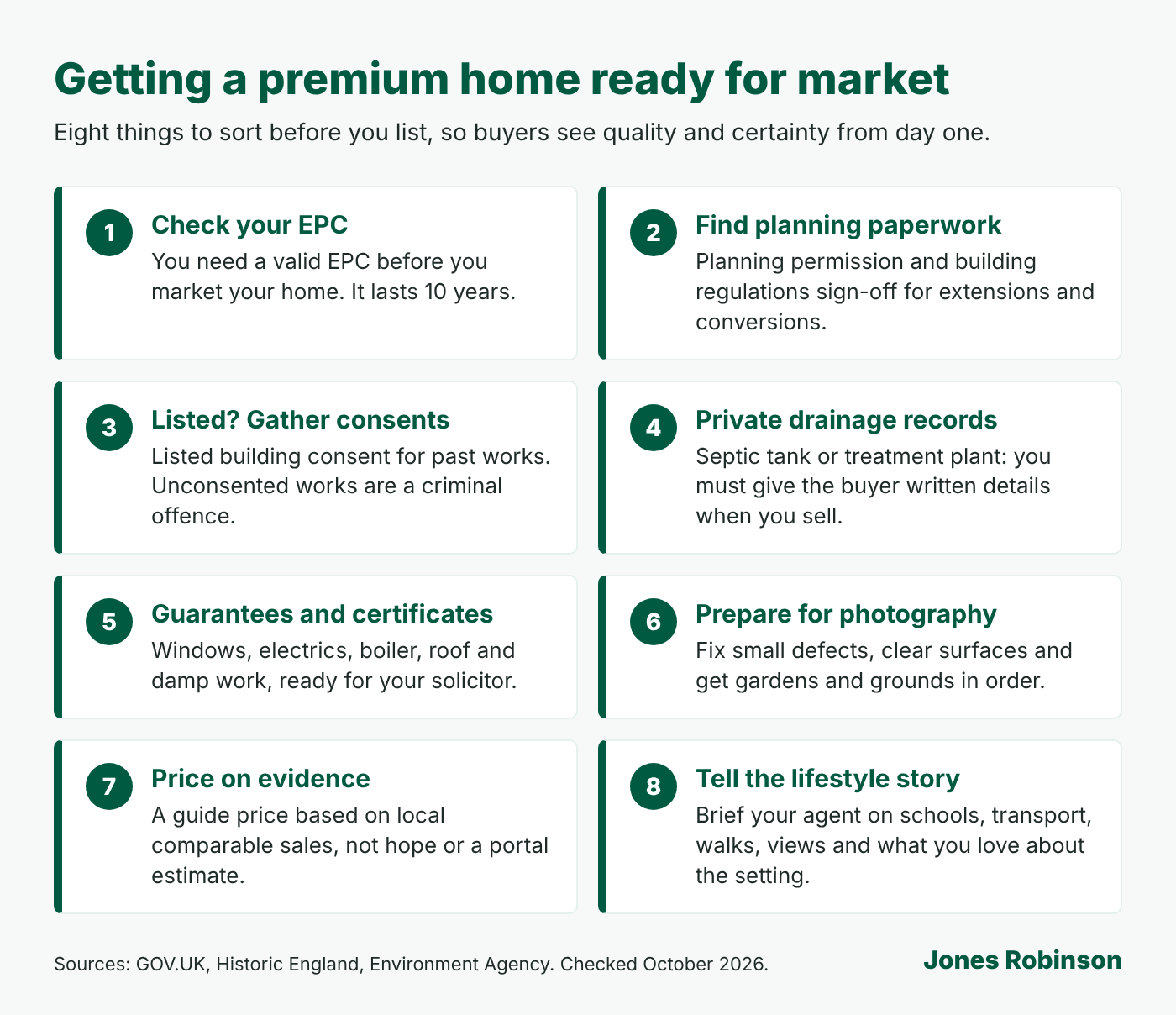
Together, these elements create the conditions for stronger interest, better offers and a more controlled sales process. The checklist below brings the practical steps together.
Premium property FAQs
What makes a property premium?
A premium property combines a strong location, quality and a lifestyle that buyers cannot easily find elsewhere. Price is part of it, but setting, character, space, condition and certainty over paperwork all shape whether buyers see a home as premium.
Can I sell a listed home if past work was done without consent?
Yes, but it needs to be addressed. Works to a listed building without listed building consent are a criminal offence, and buyers' solicitors will ask about past alterations. Speak to your local authority's conservation officer and your solicitor before you market the home so the issue can be resolved or explained properly.
Do I need an EPC to sell an older or listed home?
In most cases, yes. GOV.UK says you must have an EPC before you market a property for sale. The listed building exemption it describes only applies where work to meet minimum energy performance requirements would unacceptably alter the building's character or appearance, so check with your local council's conservation officer before assuming you are exempt.
Is it worth doing work before selling a premium home?
Small repairs, decoration and garden work that improve how the home presents are usually worthwhile. Larger projects are less certain to pay back, so ask your agent for advice before committing.
How do I find out what my premium home is worth?
Book a valuation with a local agent who knows your area. For homes with land, character or an unusual setting, an in-person valuation is far more reliable than an online estimate.
Looking ahead
Premium results are rarely achieved by chance. They are the outcome of careful preparation, clear strategy and informed decision-making.
For homeowners across Newbury, Lambourn, Didcot, Devizes, Marlborough and Pewsey, the opportunity in 2026 is to approach a move with clarity rather than urgency.
Understanding how your property fits within the current market, and how it can be positioned effectively, is the first step.
Jones Robinson supports homeowners with a thoughtful, professional approach to every premium property sale, combining local expertise with high-quality marketing and clear advice throughout the process.
If a move is on the horizon, a conversation now can help shape the right strategy and make sure your property is positioned to achieve the best possible outcome. Book a valuation, or talk it through with your local team in Newbury, Marlborough, Devizes, Pewsey, Lambourn or Didcot.