

In this blog
- What is a party wall agreement?
- What counts as a party wall?
- Which works need a party wall notice?
- How does the party wall process work?
- How much does a party wall agreement cost?
- What happens if you do not serve notice?
- Party walls when buying or selling a home
- FAQs
A party wall agreement is the written outcome of the process set out in the Party Wall etc. Act 1996, which applies when you plan certain building work on or near a wall, boundary or foundation you share with a neighbour. It is either your neighbour's written consent to the work, or a document called a party wall award drawn up by a surveyor if they do not consent.
The Act applies in England and Wales, and it catches more everyday projects than many homeowners realise, including loft conversions, rear extensions and chimney breast removals. This guide explains which works need notice, how the process runs from start to finish, what it typically costs, and why it matters when you come to buy or sell.
What Is a Party Wall Agreement?
"Party wall agreement" is the everyday name for the paperwork that allows notifiable work to go ahead under the Party Wall etc. Act 1996. If your neighbour consents in writing, that consent is the agreement. If they dissent or do not reply, one or two surveyors draw up a party wall award, a legally binding document that sets out what work can be done, how and when.
The Act exists to let building work happen while protecting the neighbour's property. You, as the owner carrying out the work, are known as the building owner. Your neighbour is the adjoining owner. An award normally records the condition of the neighbour's property before work starts, often with photographs, so any damage can be identified later. The building owner is responsible for making good any damage the works cause, or paying compensation if the neighbour asks for it.
The Act is separate from planning permission and building regulations. You may need all three for the same project, and having planning permission does not remove the need to serve party wall notice.
What Counts as a Party Wall?
A party wall is a wall that stands on the land of two or more owners and forms part of a building, or a wall that separates buildings belonging to different owners. The shared wall between two semi-detached or terraced houses is the classic example.
The Act also covers two related structures:
- Party fence wall: a wall that is not part of a building but stands astride the boundary between two properties and separates them, such as a brick garden wall. Wooden fences are not party fence walls.
- Party structure: a floor or other partition separating parts of a building in different ownership, such as the floor between two flats.
That means the Act can apply to flat owners as well as house owners, and it covers much of the housing stock across our area, from Victorian terraces in Newbury and Devizes to semi-detached family homes in Thatcham and Didcot. For fences and hedges, our guide to garden fence law in the UK covers the rules.
Which Works Need a Party Wall Notice?
You need to serve a party wall notice for three types of work: building a new wall on the boundary, carrying out work to an existing party wall or party structure, and excavating close to a neighbour's building. Each has its own minimum notice period, set out in the GOV.UK Party Wall etc. Act 1996 explanatory booklet.
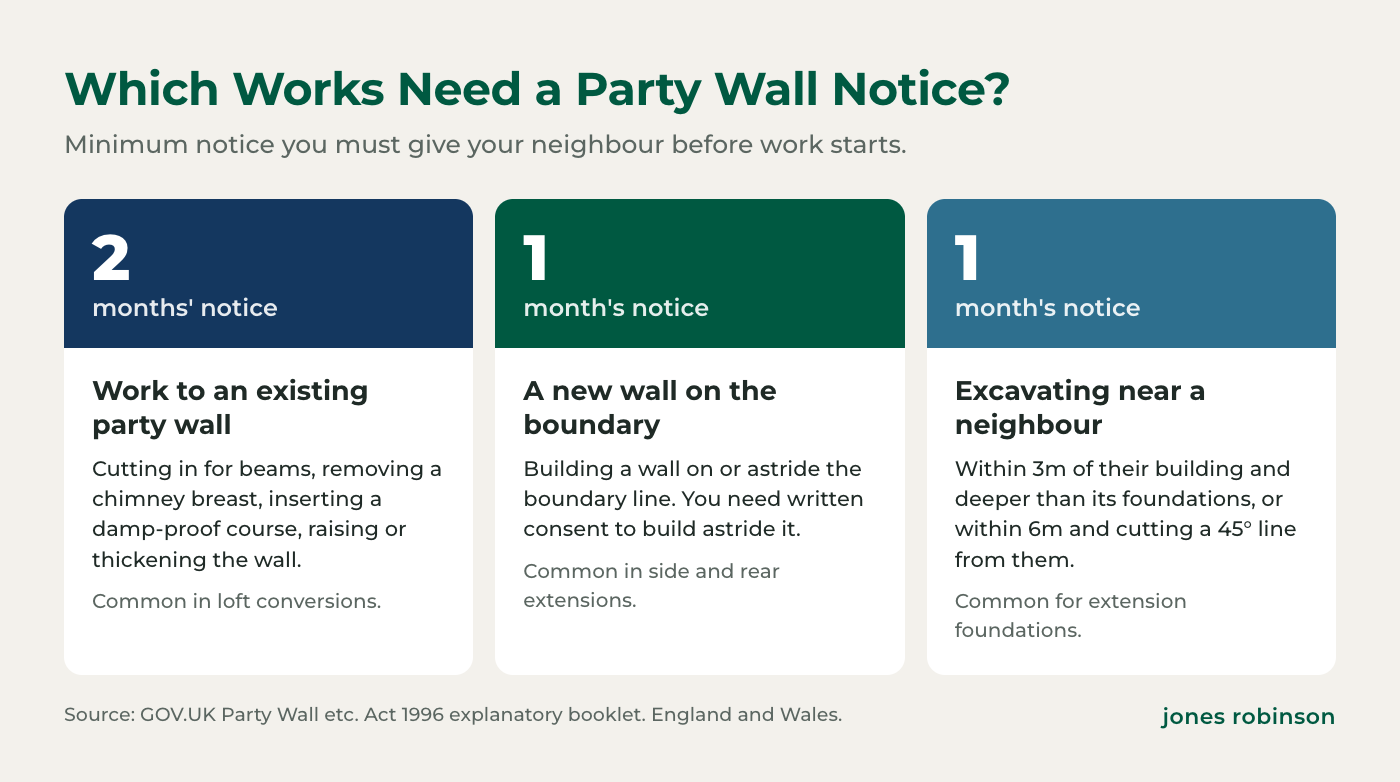
Work to an existing party wall that needs notice includes cutting into it to take the weight of a beam, which is common in loft conversions, removing a chimney breast from it, inserting a damp-proof course, and raising, lowering or thickening the wall.
Excavation needs notice if you dig within 3 metres of a neighbour's building and go deeper than its foundations, or within 6 metres where the excavation would cut a line drawn downwards at 45 degrees from the bottom of their foundations. Foundations for a rear extension often fall into one of these categories.
Minor work does not usually need notice. The government's guidance gives examples such as drilling to fix shelves or wall units, replastering, and adding or replacing electrical sockets.
How Does the Party Wall Process Work?
You serve written notice on each affected neighbour, and they have 14 days to respond. If they consent in writing, work can start once the notice period has passed. If they dissent, or do not respond to notice about work to a party wall or excavation, a dispute is treated as having arisen and surveyors resolve it by preparing a party wall award.
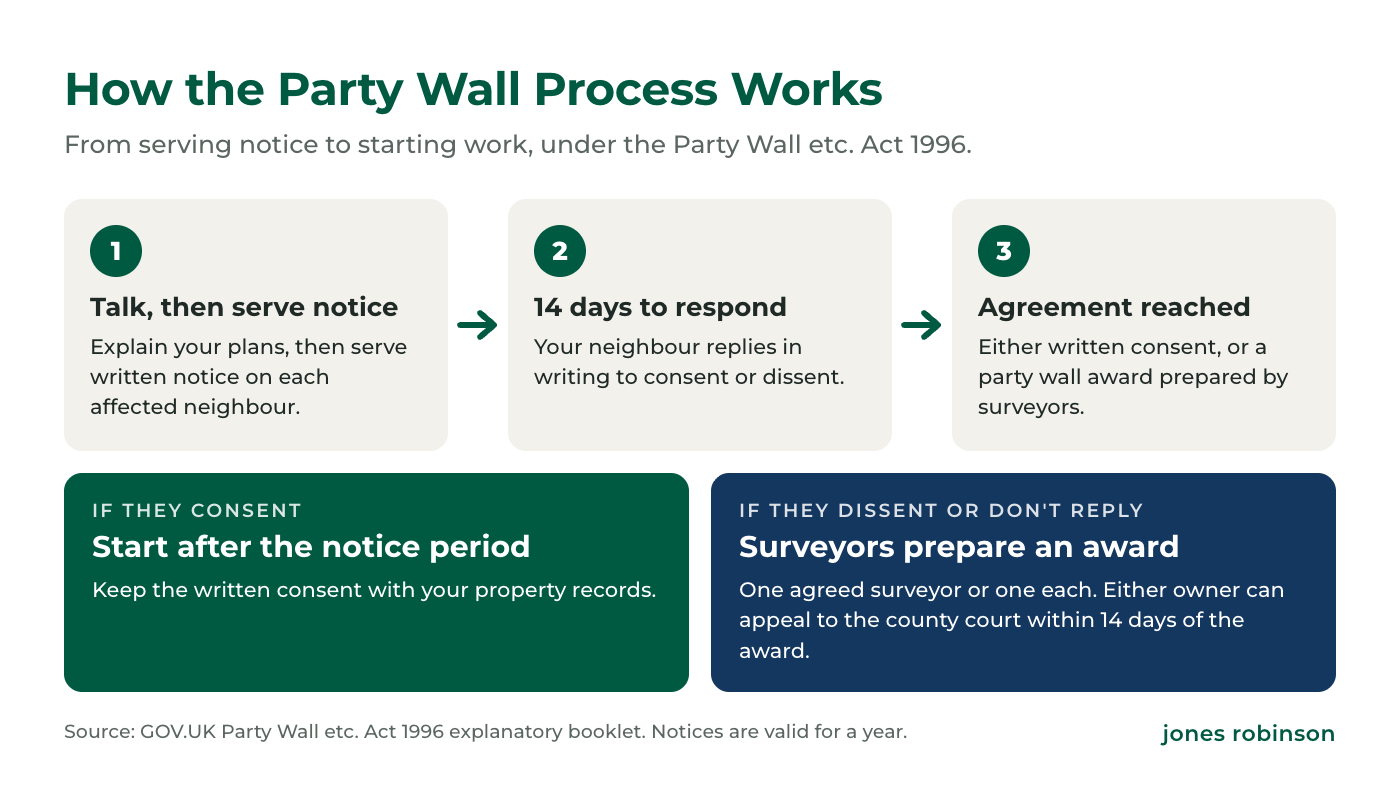
When a dispute arises, the owners can appoint one agreed surveyor to act for both of them, or each owner can appoint their own surveyor. With two surveyors, they select a third surveyor who steps in only if they cannot agree. If a neighbour refuses to appoint a surveyor, you can ask them in writing to do so, and if they still have not appointed one within 10 days, you can appoint a surveyor on their behalf.
The finished award is binding on both owners. Either owner can appeal to the county court within 14 days of the award being served on them. A few practical points help the process run smoothly:
- Talk to your neighbours before you serve notice. A conversation about the plans, timings and working hours often leads to consent rather than a dispute.
- Serve notice early. The notice is only valid for a year, so do not serve it too far ahead either.
- Keep copies of every notice, reply and award. You will need them when you sell.
How Much Does a Party Wall Agreement Cost?
If your neighbour consents in writing, the only cost may be preparing and serving the notice. If surveyors are needed, the HomeOwners Alliance puts the average cost of a party wall agreement at around £1,000 with one agreed surveyor, with a typical range of £900 to £2,700, and says costs can double when each owner appoints their own surveyor (HomeOwners Alliance, March 2026).
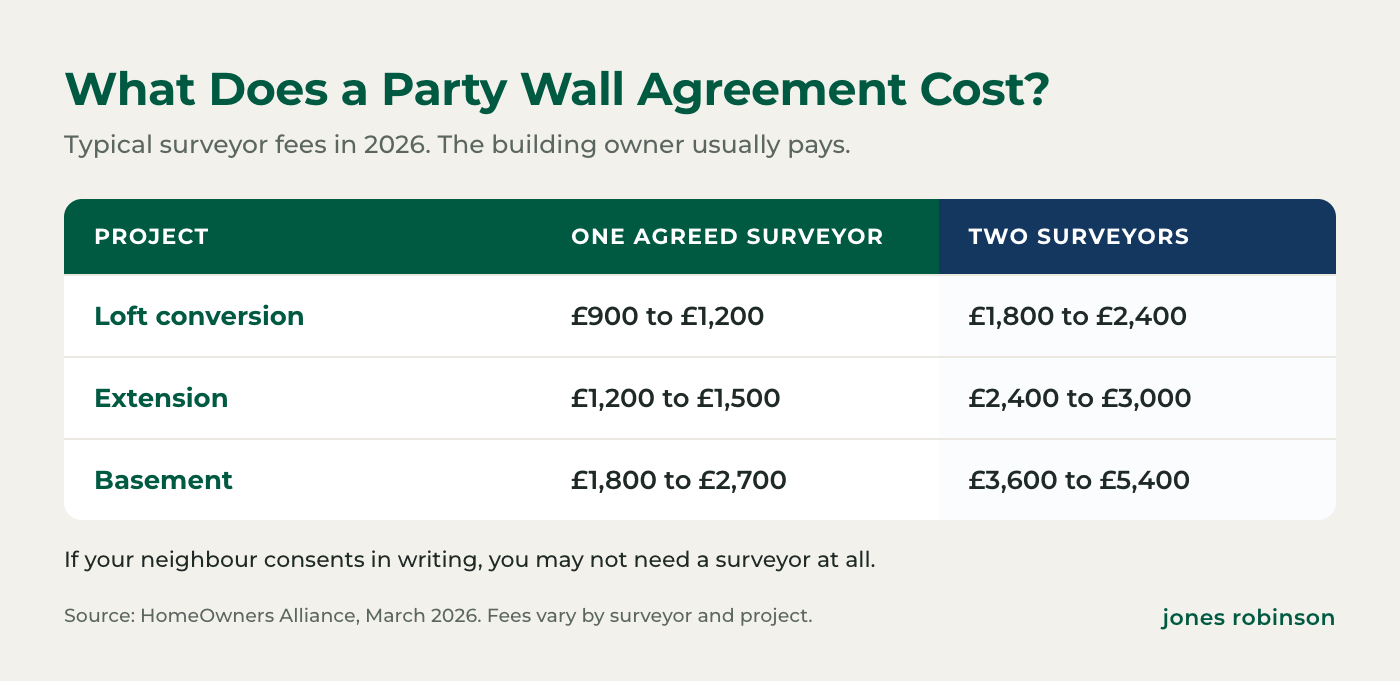
The building owner usually pays all the surveyor fees, including the neighbour's surveyor, where the work is solely for the building owner's benefit. Costs can be shared where the work repairs a defect that benefits both properties. Build these fees into your project budget from the start, alongside planning and building control fees.
What Happens If You Do Not Serve Notice?
Starting notifiable work without serving notice puts you outside the protection of the Act. Your neighbour can seek a court injunction to stop the work, and you have no award to show the condition of their property before work began, which makes damage claims harder to defend.
It can also cause problems later. When you sell, the buyer's conveyancer may ask whether any work was carried out that needed party wall notice, and missing paperwork can lead to questions, delays or requests for indemnity insurance.
Party Walls When Buying or Selling a Home
When you buy a house that has had a loft conversion or extension, ask your conveyancer to check for party wall notices and any award alongside the planning permission and building control completion certificate. A survey will also pick up signs of movement or poor workmanship around shared walls; our guide to Level 2 vs Level 3 surveys explains which to choose.
When you sell, gather the notices, consents and awards for any past work before you go on the market. Having them ready helps your conveyancer answer enquiries quickly and keeps the sale moving. If you are weighing up whether an extension or loft conversion is worth it before selling, our guides to ways to add value to your home and home improvements that do not add value are a good starting point.
FAQs
Do I need a party wall agreement for a loft conversion?
Usually, yes, if you have a party wall. Most loft conversions in semi-detached and terraced houses involve cutting into the party wall to support new beams, which needs two months' notice.
Do I need a party wall agreement for a single-storey extension?
Often. If the foundations are within 3 or 6 metres of your neighbour's building and meet the depth tests, or if you build on or up to the boundary line, you need to serve notice.
Can my neighbour stop me building?
A neighbour cannot use the Act to stop work you are entitled to do. If they dissent, surveyors settle how and when the work is carried out through the award. They can, however, take action if you start without serving notice.
Who pays for the party wall surveyor?
The building owner usually pays the fees for both surveyors where the work is only for their benefit.
How long does a party wall agreement last?
A party wall notice is valid for a year, so work needs to start within that time. An award applies to the work it describes and stays with the properties, which is why sellers should keep a copy.
Do party wall rules apply to flats?
Yes. The floor between two flats in different ownership is a party structure, so some works to it need notice. Flat owners should also check their lease, which may require the freeholder's consent; our guide to freehold vs leasehold explains why.
Planning Work Before a Move?
Our local teams in Newbury, Didcot, Marlborough, Devizes, Pewsey and Lambourn can tell you how buyers in your area value extensions and loft conversions, and what paperwork they will expect to see. Book a Valuation to find out what your home is worth today, or find out more about selling with Jones Robinson.