

In this blog
- What is gazumping?
- What is gazundering?
- Are gazumping and gazundering legal?
- What must estate agents do with new offers?
- How can buyers avoid being gazumped?
- How can sellers avoid being gazundered?
- Will the rules change?
- FAQs
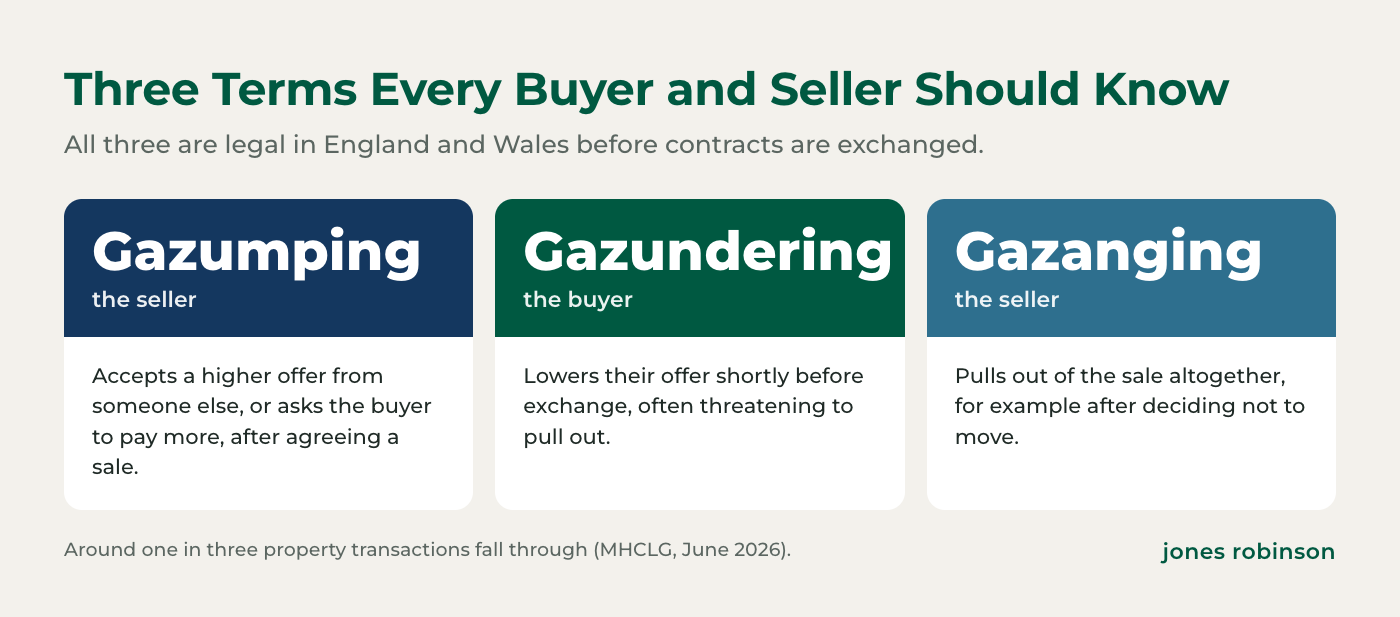
Gazumping is when a seller accepts an offer from one buyer, then accepts a higher offer from someone else before contracts are exchanged. Gazundering is the reverse: a buyer lowers their offer shortly before exchange, often threatening to pull out unless the seller agrees. Both are legal in England and Wales, because a property sale is not binding until contracts are exchanged.
Both can be expensive and stressful for the person on the receiving end, and they are part of a wider problem of sales falling through. The UK Government estimates that around one in three transactions fall through, costing consumers around £400 million a year (MHCLG, June 2026). This guide explains how gazumping and gazundering happen, what the rules say, and the practical steps buyers and sellers can take to protect themselves.
What Is Gazumping?
Gazumping happens when a seller has accepted your offer, but before contracts are exchanged they accept a higher offer from another buyer, or ask you to increase yours to match it. It is most common when demand is strong and several buyers are chasing the same kind of home.
Being gazumped can cost a buyer money as well as time. By the point a seller changes their mind, the buyer may already have paid for a mortgage application, a survey and legal work. None of that is refundable if the purchase does not go ahead.
There is a related term, gazanging, which describes a seller pulling out of a sale altogether, for example because they have decided not to move after all.
What Is Gazundering?
Gazundering happens when a buyer reduces their offer late in the process, usually just before exchange of contracts, and makes it clear they will withdraw if the seller does not accept. It is more common in slower markets, when buyers feel they have the upper hand and sellers are keen to keep their chain together.
A price change is not always gazundering. If a survey uncovers a defect that was not known when the offer was made, it is reasonable for a buyer to renegotiate with evidence such as a builder's quote. Gazundering usually describes a reduction made without a genuine new reason, timed to put maximum pressure on the seller.
Are Gazumping and Gazundering Legal?
Yes, both are legal in England and Wales. A contract to sell land must be made in writing and signed by both parties, and in a house sale this happens at exchange of contracts (Law of Property (Miscellaneous Provisions) Act 1989). Before exchange, an accepted offer is not binding on either side.
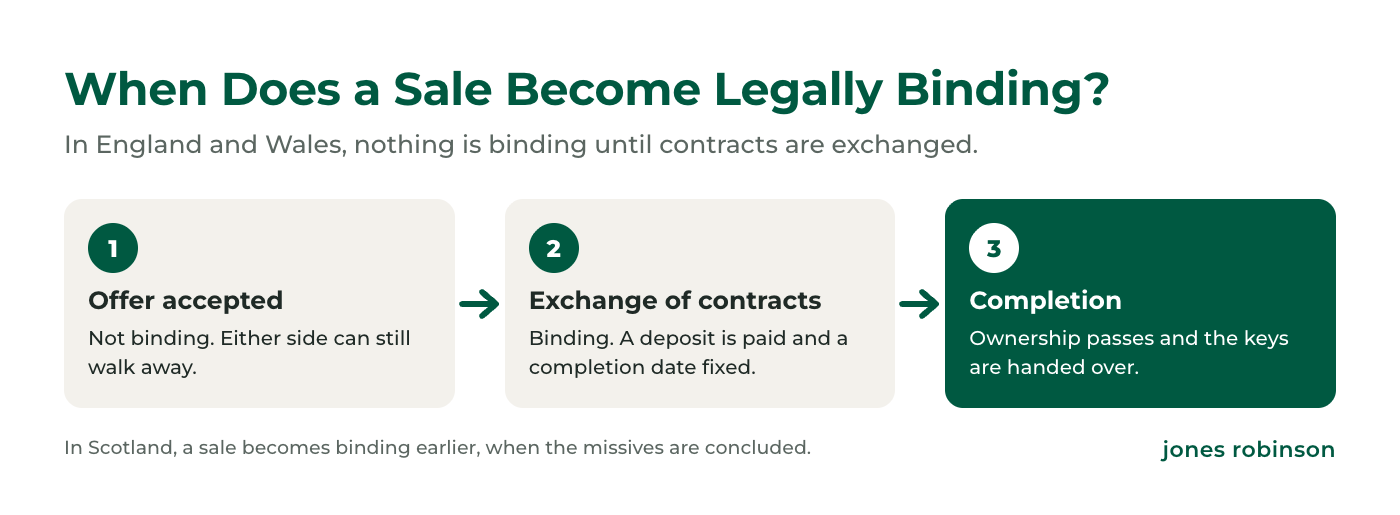
Scotland works differently. Offers are made through solicitors, and a sale becomes binding once the formal letters between them, known as missives, are concluded. Gazumping is much rarer there as a result. Our guides to Sold STC and exchange of contracts explain the stages in England in more detail.
What Must Estate Agents Do With New Offers?
Estate agents must pass every offer to the seller promptly and in writing, even after an offer has been accepted, unless the seller has said in writing that they do not want to receive offers of that kind. This is a legal requirement under the Estate Agents (Undesirable Practices) (No. 2) Order 1991.
The Property Ombudsman Code of Practice, which Jones Robinson follows, adds further rules. Agents must confirm offers in writing, and once an offer has been accepted they must take the seller's instructions on whether to keep marketing the property. If marketing continues, the agent must tell the buyer in writing, and the marketing must make clear that an offer has been accepted (The Property Ombudsman).
The decision about which offer to accept always sits with the seller. The agent's job is to make sure the seller has every offer and enough information about each buyer's position to decide.
How Can Buyers Avoid Being Gazumped?
The best protection is to be the buyer a seller does not want to lose. Sellers value certainty as much as price, so a buyer who is organised and moving quickly is much harder to replace.
- Be ready before you offer: have a mortgage agreed in principle and a conveyancer lined up. Our guide on how to make an offer on a house covers what to include.
- Ask for the property to come off the market: make it a condition of your offer that viewings stop once it is accepted.
- Move quickly: instruct your conveyancer, submit your mortgage application and book your survey straight away.
- Stay in touch: keep in regular contact with the agent so you hear early if anything changes.
- Consider a lock-out agreement: the seller agrees not to deal with other buyers for a fixed period while you complete your checks. It does not force the seller to sell, and it needs to be drafted by a solicitor.
Some buyers and sellers now use reservation agreements, where both sides pay a deposit that they lose if they pull out without a good reason. These are voluntary and still uncommon, so take legal advice before signing one.
How Can Sellers Avoid Being Gazundered?
Sellers can reduce the risk of gazundering by pricing realistically, being upfront about the property, and checking the buyer's position before accepting an offer.
- Price it right from the start: an accurate valuation reduces the chance of a buyer or their lender deciding the price is too high later.
- Share information early: disclose known issues, and have your paperwork ready, including any building regulations sign-off and party wall awards for past work.
- Check the buyer's position: ask the agent to confirm how the buyer is funding the purchase and whether they have anything to sell.
- Keep the sale moving: instruct your conveyancer as soon as you accept an offer, so there are fewer late surprises.
If a buyer does try to lower their offer, ask for the reason in writing, and for evidence if it relates to the survey. You do not have to accept, and your agent can tell you how strong the interest from other buyers was.
Will the Rules Change?
Possibly, but not yet. In its Home Buying and Selling Reform Roadmap, published in June 2026, the government said it will encourage the voluntary use of reservation agreements now. It also plans to legislate, when parliamentary time allows, to require sales packs before a home is listed, and later binding conditional contracts, which would make agreed sales much harder to walk away from.
Until any new law is passed and in force, the current position stands: an accepted offer can be withdrawn by either side until contracts are exchanged.
FAQs
Is gazumping illegal in the UK?
No. Gazumping is legal in England and Wales because an accepted offer is not binding until contracts are exchanged. It is rare in Scotland because the process there works differently.
Can I get my money back if I am gazumped?
Usually not. Survey, mortgage and legal fees are not normally recoverable from the seller. Some insurers offer home buyer protection policies that cover these costs if a sale falls through.
Should a seller accept a higher offer after agreeing a sale?
That is the seller's decision. Many sellers stay with their original buyer if that buyer is proceeding well, because starting again can cost time and put a chain at risk.
Is gazundering illegal?
No. A buyer can change or withdraw their offer at any point before exchange of contracts.
Can an estate agent keep marketing a property after an offer is accepted?
Yes, if the seller instructs them to. Under The Property Ombudsman Code, the agent must tell the buyer in writing and make clear in the marketing that an offer has been accepted.
How can I tell if an offer is genuine?
Ask the agent how the buyer is funding the purchase, whether they have a mortgage agreed in principle, and whether they have a property to sell. A good agent checks this before putting an offer forward.
Buying or Selling With Jones Robinson
Our teams in Newbury, Didcot, Marlborough, Devizes, Pewsey and Lambourn verify every buyer's position and keep every party informed, with a Dedicated Sales Progressor on each sale. Book a Valuation if you are selling, or browse properties for sale and find out more about buying with us.