

Updated October 2026: we have refreshed this guide with current Energy Saving Trust estimates, corrected the light bulb dates and added the latest Boiler Upgrade Scheme grant amounts.
In January 2022, Jones Robinson committed to achieving net-zero carbon emissions by 2030 or sooner, whilst helping our clients reduce their emissions too.
We partnered with Carbon Footprint Ltd to calculate the carbon footprint of our business so that we could put new policies, processes and behaviours in place to achieve our pledge. By September 2022 we had achieved Net Zero status for our Scope 1 and 2 emissions. We are also committed to supporting our clients in their efforts to become more sustainable and environmentally friendly.
So what are the best ways to reduce your carbon footprint at home? Heating is the big one: according to the Energy Saving Trust, around 18% of the UK’s CO2 emissions come from heating our homes. The changes that cut the most carbon are switching to low carbon heating, improving insulation and taking control of your heating, but everyday habits such as shorter showers, LED bulbs and switching things off all help and cost little or nothing.
In this blog
- Which changes make the biggest difference?
- Our top tips
- Bigger upgrades and the Boiler Upgrade Scheme
- Frequently asked questions
Make the changes you’ll be able to sustain
We are aware that everyone’s circumstances are different. For some, options such as installing solar panels or heat pumps aren’t feasible or realistic. The best way to commit to change is to make sure that change is going to be manageable and something you can commit to. Much like New Year’s resolutions, it’s often the bigger, more dramatic changes that people decide to let slip. By setting energy-efficient goals that are achievable, you are more likely to see them through.
Which changes make the biggest difference?
It helps to know where the biggest wins are before you start. The Energy Saving Trust has estimated how much CO2 a typical home in Great Britain could save each year from some of the most common improvements. The gap between a full heating upgrade and a simple bulb swap is large, which is why it is worth looking at your heating and insulation first if you are able to.
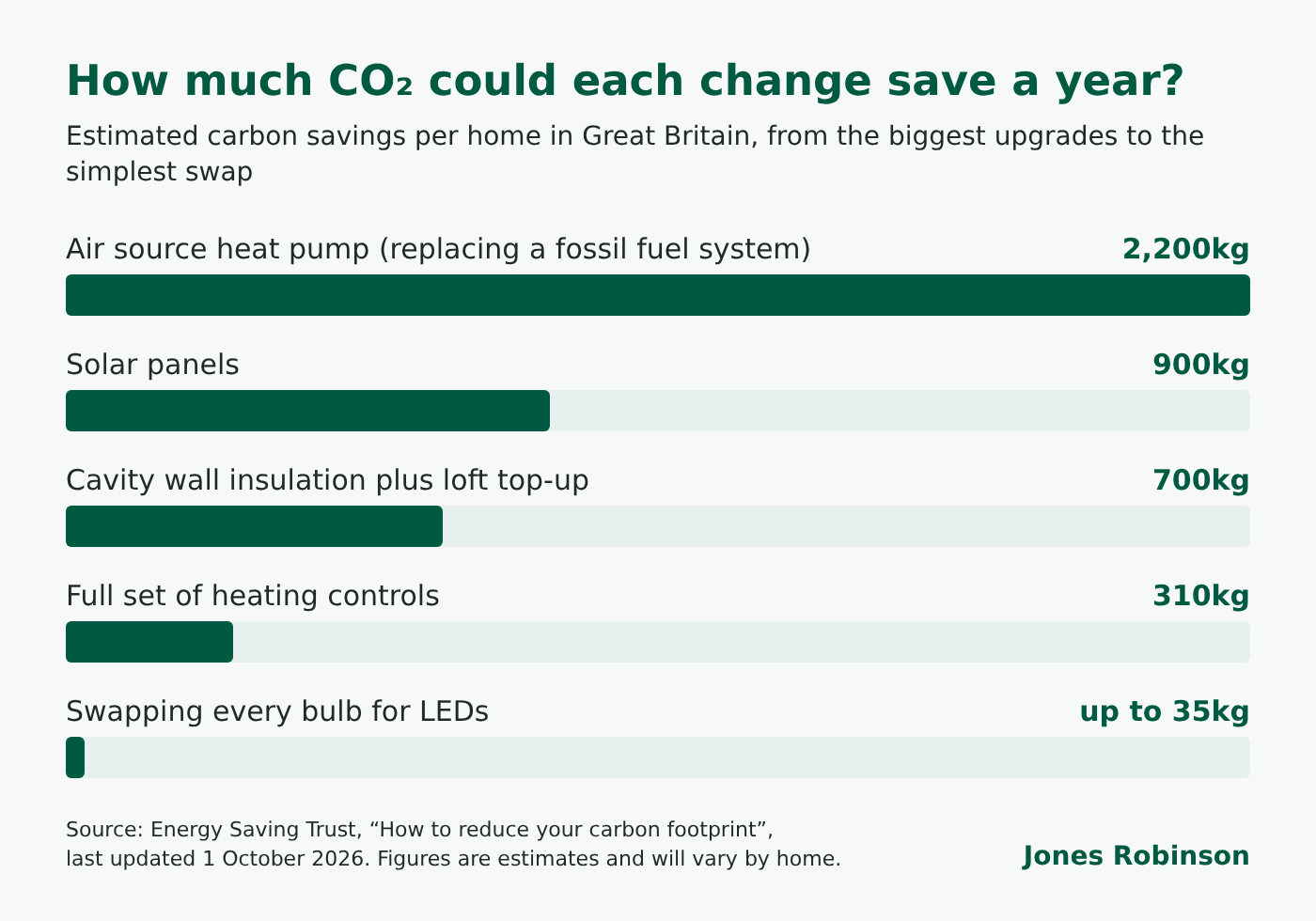
| Change | Estimated CO2 saving a year (Great Britain) |
|---|---|
| Installing an air source heat pump | 2,200kg |
| Installing solar panels | 900kg |
| Cavity wall insulation plus topping up loft insulation | 700kg |
| A full set of heating controls (programmer, room thermostat and thermostatic radiator valves) | 310kg |
| Replacing every bulb in your home with LEDs | Up to 35kg |
Source: Energy Saving Trust, How to reduce your carbon footprint (last updated 1 October 2026). These are estimates and the saving in your own home will depend on its size, construction and current heating system.
Our top tips!

With this in mind, we thought it would be worthwhile to outline 5 simple and practical tips for reducing your carbon emissions within your property:
Assess your current situation with an EPC
Anyone selling, renting or buying a home will be very familiar with an Energy Performance Certificate (EPC). In short, an EPC rating is a review of a property’s energy efficiency. They’re most commonly used by those looking to rent or buy a property as a way of finding out how much their energy bills are likely to be should they decide to buy or rent that property. EPCs are carried out by accredited assessors who survey the home before producing a report, which then appears on the property listing. The rating runs on a colour-coded scale from A to G, with A being the most efficient with the cheapest fuel bills. Once issued, an EPC is valid for 10 years.
If you are not sure whether your home already has one, you can search the government’s find an energy certificate service and download any valid EPC for free. Homeowners in England and Wales can also use the Find ways to save energy in your home tool on GOV.UK, which suggests improvements along with an estimated cost and bill saving for each.
Once you have an EPC the advice within it can be used to inform how you can make your home more energy-efficient. The recommendations section is most useful for those already in a property looking to reduce their carbon footprint. It lists suggested improvements, usually starting with the easiest and quickest to carry out, along with an indication of the cost of each and the potential savings from making these changes to your property.
Use less water
Processing and delivering water to a home uses a lot of energy, and heating it at home uses more. Using less water, and especially less hot water, can therefore lower both your carbon footprint and your bills. Simple ways to do this include keeping a jug of water in the fridge so you aren’t running the tap every time you want a drink, turning the shower on when you are ready to get in rather than letting it run, and measuring the water you need before putting a pan on to boil. Many of us also leave the tap running while filling the kettle, cooking or, most commonly, brushing our teeth. Turning it off during these everyday tasks can make a real difference.
The Energy Saving Trust estimates that, in Great Britain:
- keeping your shower to four minutes could save around £45 a year on energy bills
- only boiling the water you need in the kettle could save around £10 a year
- fitting an aerator to your kitchen tap could save around £20 a year
- swapping one bath a week for a four-minute shower could save around £10 a year
Use a low-flow showerhead
If you want to take being water-efficient even further, a low-flow showerhead is designed to reduce the amount of water wasted when showering, by restricting the volume of water that flows through it. They can be very cost-effective and easy to install. Check that the showerhead you choose is compatible with your type of shower (for example a combi boiler, mixer, electric or power shower) before you buy.
Change your lightbulbs
The UK government ended the sale of most halogen light bulbs from September 2021, and the sale of most fluorescent bulbs followed from September 2023. The alternative, LED bulbs, use up to 80% less power than halogen bulbs and last five times longer, according to the government. Most people have already replaced their light bulbs with LEDs, but it is still worth checking any older fittings, lamps and outdoor lights to make sure you are being as energy efficient as possible. The Energy Saving Trust estimates that replacing all the bulbs in your home with LEDs could reduce your carbon dioxide emissions by up to 35kg a year in Great Britain.
Once you’ve changed the bulbs…turn them off more!

Similar to running a tap when cleaning our teeth, many of us will leave a room and leave the light on without really thinking about it. Or, when working from home, we switch on the light in the morning for a video call, or because it isn’t light yet, and don’t turn it off for the rest of the day. Being more conscious of this and switching a light off when you leave a room can reduce your carbon footprint. The Energy Saving Trust puts the saving at around £7 a year in Great Britain: small on its own, but it costs nothing and adds up alongside the other habits in this guide.
Finally, a few more quick tips!
- Unplugging electrical devices or switching them off at the wall when they aren’t in use, rather than leaving them on standby
- Turning the heating down
- Adjusting the timings of your heating, ideally with a programmer, room thermostat and thermostatic radiator valves
- Fit insulation to the walls and loft to reduce the need for heating (the Energy Saving Trust recommends at least 270mm of loft insulation)
- Use locally sourced food for cooking
- Draught proof windows and doors to reduce draughts and the need for heating, while keeping enough ventilation to avoid condensation and damp
Here is what some of these everyday changes could be worth, according to the Energy Saving Trust:
| Quick change | Estimated bill saving a year (Great Britain) |
|---|---|
| Professional draught proofing of windows and doors | Around £55 |
| Drying clothes on a line or rack instead of a tumble dryer | Around £50 |
| Switching appliances off standby | Around £45 |
| Topping up the insulation on a hot water cylinder | Around £45 |
| Washing at 30°C and doing one fewer wash a week | Around £26 |
| Turning lights off when you leave a room | Around £7 |
Source: Energy Saving Trust, Quick tips to save energy at home (last updated 6 October 2026). These are estimates; your own savings will depend on your home, how you use energy and current energy prices.
For more ideas, see our guides to ways to make your property more eco-friendly and keeping your home warm this winter.
Bigger upgrades and the Boiler Upgrade Scheme
If you are planning work on your home anyway, or your boiler is nearing the end of its life, it is worth looking at low carbon heating. As the table above shows, installing an air source heat pump is the biggest single saving on the Energy Saving Trust’s list. Our guide to heat pumps as a sustainable heating solution explains how they work.
In England and Wales, the government’s Boiler Upgrade Scheme offers one grant per property towards the cost of replacing fossil fuel heating. At the time of writing, GOV.UK lists:
| System | Boiler Upgrade Scheme grant |
|---|---|
| Air source heat pump (air-to-water) | £7,500 |
| Ground source heat pump (including water source) | £7,500 |
| Biomass boiler | £5,000 |
| Air-to-air heat pump | £2,500 |
Source: GOV.UK, Apply for the Boiler Upgrade Scheme: what you can get (checked 21 October 2026).
Until March 2027, an extra £1,500 is available towards an air source or ground source heat pump if your home is heated by oil or LPG and has no mains gas connection. That may be relevant to many village homes off the gas grid in the Lambourn Valley, the Vale of Pewsey and rural West Berkshire and Wiltshire. Hybrid systems (for example a gas boiler combined with a heat pump) are not eligible, and your MCS certified installer applies for the grant on your behalf, with the grant taken off the price you pay. Check the latest eligibility rules on GOV.UK before committing, and see our article on funding to make your home more energy efficient for background on other schemes.
Improvements like these can also raise your EPC rating, which buyers and tenants can see on every property listing. If you are thinking of selling after making upgrades, a free property valuation will show you where your home sits in the local market.
Frequently asked questions
What are the best ways to reduce your carbon footprint at home?
The biggest reductions come from how you heat your home: switching from a gas or oil boiler to a heat pump, improving wall and loft insulation, and fitting proper heating controls. Smaller, low-cost steps include shorter showers, LED bulbs, switching appliances off standby and draught proofing.
What are 5 easy ways to reduce your carbon footprint at home?
Check your EPC for recommended improvements, use less hot water, fit a low-flow showerhead, swap any remaining old bulbs for LEDs and switch lights off when you leave a room. None of these needs major building work.
Can I get a grant for a heat pump?
Homeowners in England and Wales can apply through an installer for a Boiler Upgrade Scheme grant of £7,500 towards an air source or ground source heat pump, with an extra £1,500 until March 2027 for eligible off-gas homes heated by oil or LPG. Check GOV.UK for the current rules.
How do I find my home’s EPC?
Search for your address on the GOV.UK find an energy certificate service. Any valid EPC can be viewed and downloaded free of charge, and it remains valid for 10 years from when it was issued.
About Jones Robinson
We are independent estate and letting agents with six branches across West Berkshire, South Oxfordshire and Wiltshire, and we know the local property market well.
We will be able to advise you where it is best to advertise your property, the best times to sell or rent a house and how to add value to your home, including the energy efficiency improvements that matter to today’s buyers and tenants.
We are always open and honest about the sales and rental process, whether this is your first house sale or your 10th! This will ensure that you know exactly what to expect. We are also always at the end of the phone or email should you have any questions or queries.
As local estate agents in Newbury, Didcot, Lambourn & Hungerford, Marlborough, Pewsey and Devizes and the surrounding areas, we are best placed to help you sell your property or let it as a landlord. We can even help you in finding your next home. To find out what your home is worth, book a valuation with your local branch.