

With the growing demand for eco-friendly and energy-efficient homes, heat pumps have gained significant attention as an alternative to traditional heating systems. Whether you're a homeowner looking to reduce energy bills or a homebuyer searching for sustainable features, understanding how heat pumps work and their benefits is essential.
At Jones Robinson, we recognise the importance of modern, energy-efficient homes. As heat pumps become more popular, we want to help you understand how this technology could affect your property value and future energy costs.
In this blog
- What is a heat pump?
- Benefits of heat pumps for homeowners
- Are heat pumps right for your home?
- How much does a heat pump cost to install and run?
- Do you need planning permission for an air source heat pump?
- How heat pumps impact property value
- Frequently asked questions
What is a Heat Pump?
A heat pump is an energy-efficient heating system that transfers heat from the air, ground or water into your home. Unlike traditional gas boilers that generate heat by burning fossil fuels, heat pumps use electricity to move heat that already exists, making them a cleaner and more sustainable option. Some types can also cool your home in summer.
There are three main types of heat pumps:
- Air Source Heat Pumps (ASHPs): Extract heat from the air outside. The most common type, an air-to-water heat pump, heats water for your radiators or underfloor heating and your hot water cylinder. An air-to-air heat pump instead blows warm air into rooms and does not usually provide hot water for taps and showers.
- Ground Source Heat Pumps (GSHPs): Use pipes buried underground to absorb heat from the earth.
- Water Source Heat Pumps: Draw heat from a nearby water source, such as a lake or river.
According to the Energy Saving Trust, an air source heat pump’s outdoor unit needs less space than two wheelie bins side by side (about 1.5 metres wide), and the hot water cylinder can usually fit in a cupboard of around 80cm by 80cm.
Benefits of Heat Pumps for Homeowners
- Energy Efficiency: Because they move heat rather than create it, heat pumps are, in the Energy Saving Trust’s words, more than three times more efficient than a gas or oil boiler. Whether that means lower bills depends on what you are replacing and your electricity tariff (see running costs below).
- Lower Carbon Emissions: Since heat pumps don’t rely on burning fossil fuels, they produce far fewer carbon emissions. The Energy Saving Trust estimates that installing an air source heat pump could cut a household’s carbon footprint in Great Britain by around 2,200kg of CO2 a year, the biggest single saving on its list of home improvements.
- Year-Round Comfort: In addition to providing heating in the winter, air-to-air heat pumps can provide cooling in warm weather, so one system can help keep your home comfortable throughout the year. The more common air-to-water heat pumps are generally used for heating and hot water rather than cooling.
- Government Incentives: The UK government offers incentives like the Boiler Upgrade Scheme (BUS) to encourage homeowners in England and Wales to switch to low carbon heating. As of October 2026 the grant is £7,500 towards an air source or ground source heat pump, taken off the price you pay for installation.
Are Heat Pumps Right for Your Home?
While heat pumps offer many benefits, they aren’t suitable for every property. For example, older homes with poor insulation may need additional energy efficiency improvements to get the most from a heat pump. Additionally, heat pumps often have higher upfront installation costs than conventional boilers, although grants help.
Heat pumps are not only for new builds, though. The government-funded Electrification of Heat demonstration project, run by Energy Systems Catapult, installed 742 heat pumps across a broad range of housing types and found they could be installed in every property type it tested.
If you’re considering installing a heat pump, it’s important to evaluate factors such as:
- Insulation Quality: Proper insulation ensures that the heat pump can work efficiently. Improving loft insulation and draught proofing first reduces how much heat your home loses.
- Outdoor Space: Ground source heat pumps require sufficient outdoor space for underground piping. An air source heat pump needs a spot against a wall or on the ground with room around it for air to flow.
- Radiators: Some homes need larger radiators for a heat pump to keep rooms warm, and the Energy Saving Trust lists radiator upgrades as one of the factors that affect installation cost.
- Local Climate: Heat pumps work in cold weather, but the system needs to be sized correctly for your home. Ask an MCS certified installer to assess your home, including how much heat it loses, before recommending a unit.
The government’s free Check if a heat pump could be suitable for you tool asks about your current heating and the number of bedrooms, then compares possible cost and carbon savings. If you are also looking at other improvements, our guide to reducing your carbon footprint at home shows which changes make the biggest difference.

How much does a heat pump cost to install and run?
The Energy Saving Trust puts the typical cost of installing an air source heat pump at around £12,000, before any grant. The final price depends on the size of the system, the size of your home and whether radiators need upgrading.
In England and Wales, the Boiler Upgrade Scheme offers one grant per property towards replacing an existing oil, gas, LPG or electric heating system. Your MCS certified installer applies on your behalf through Ofgem and the grant is taken off the price you pay. Property owners, including landlords and owners of second homes, are eligible, but social housing and most new builds are excluded, and there is no insulation requirement.
| System | Boiler Upgrade Scheme grant |
|---|---|
| Air source heat pump (air-to-water) | £7,500 |
| Ground source heat pump (including water source) | £7,500 |
| Biomass boiler | £5,000 |
| Air-to-air heat pump | £2,500 |
Source: GOV.UK, Apply for the Boiler Upgrade Scheme: what you can get (checked 21 October 2026).
Until March 2027, an extra £1,500 is available towards an air source or ground source heat pump if your home is heated by oil or LPG and has no mains gas connection. That could be worth looking into for village homes off the gas grid in the Lambourn Valley, the Vale of Pewsey and rural West Berkshire and Wiltshire. Hybrid systems, such as a gas boiler working alongside a heat pump, are not eligible.
What about running costs? The Energy Saving Trust notes that electricity costs nearly four times as much as gas per unit, so the answer depends on what you are replacing and your tariff:
| Your situation | What to expect on running costs |
|---|---|
| Replacing an old, G-rated gas boiler | Savings are likely with a well-designed heat pump system |
| Replacing a new, efficient gas boiler on a standard tariff | Bills are unlikely to fall straight away and may be slightly higher |
| Using a heat pump time-of-use tariff | Can cost less to run than a gas boiler |
| Disconnecting from mains gas altogether | Saves the gas standing charge on top |
Source: Energy Saving Trust, Air source heat pumps (last updated 20 October 2026) and Are heat pumps worth it? (last updated 12 December 2025). Your own costs will depend on your home, how you use your heating and current energy prices.
Do you need planning permission for an air source heat pump?
In England, most houses can have an air source heat pump fitted without applying for planning permission, under “permitted development” rights. These rules were relaxed on 29 May 2025: the requirement to keep the unit at least 1 metre from your boundary was removed, the maximum size of the outdoor unit for houses went up from 0.6 to 1.5 cubic metres, and detached houses can now have two units rather than one.
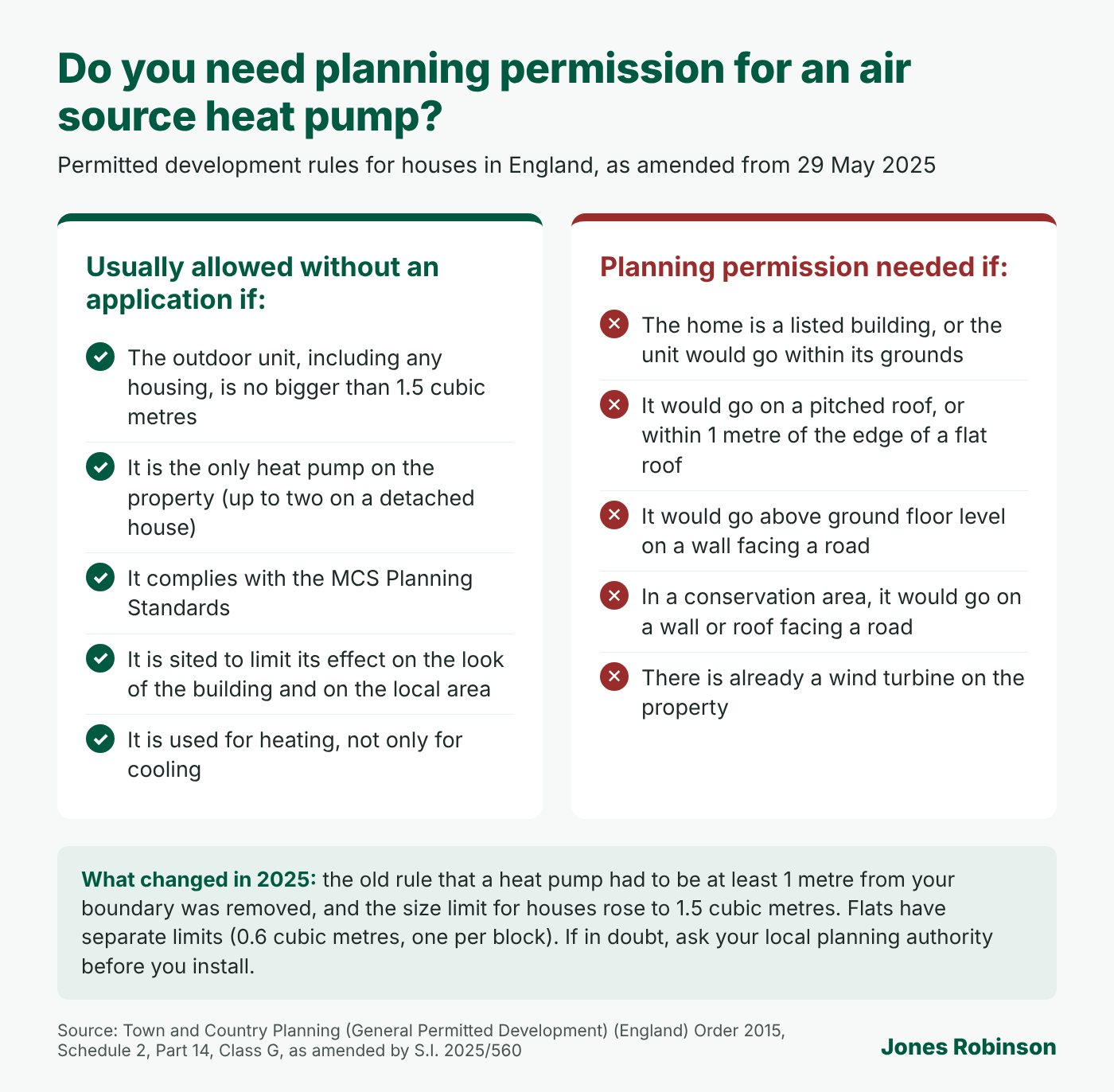
Permitted development does not apply to listed buildings, so if you own a listed home you will need to apply for planning permission, and listed building consent may also be needed. Our guide to buying a Grade II listed property explains more. If your home is in a conservation area, there are extra limits on units on a wall or roof facing a road. If in doubt, check with your local planning authority, such as West Berkshire Council or Wiltshire Council, before you go ahead. Wales has its own planning rules.
Source: The Town and Country Planning (General Permitted Development) (England) Order 2015, Schedule 2, Part 14, Class G, as amended by S.I. 2025/560.
How Heat Pumps Impact Property Value
Energy-efficient homes are increasingly attractive to buyers, and a well-installed heat pump can add to your property’s appeal. Lower carbon emissions and the prospect of manageable running costs are real selling points for buyers who prioritise sustainability. A home’s heating system and estimated energy costs are shown on its Energy Performance Certificate, which sellers must make available to buyers, so it is worth understanding why a good EPC rating matters when you sell.
That said, a heat pump will not automatically add more to your sale price than it cost to install. Keep your MCS certificate, warranty and servicing records ready for buyers and their conveyancer (the Energy Saving Trust recommends an annual service, which warranties often require).
At Jones Robinson, we’ve noticed an increasing number of buyers asking about eco-friendly features. If you’re thinking about selling your home, upgrading to a heat pump could make your property stand out and attract environmentally conscious buyers. Our team can help you assess the potential value heat pumps could add to your home and guide you through the selling process with these features in mind. Landlords can use the Boiler Upgrade Scheme too, and our landlord services team can help you plan upgrades to a rental property. For more ideas, see our guide to ways to make your property more eco-friendly.
Frequently asked questions
Are heat pumps worth it in the UK?
For many homes, yes, especially if you are replacing an old boiler, heating with oil or LPG, or can use a heat pump tariff. A £7,500 Boiler Upgrade Scheme grant against a typical installation cost of around £12,000 leaves around £4,500, although quotes vary. If you have a new, efficient gas boiler, bills may not fall straight away.
Can I get a grant for a heat pump?
Homeowners and landlords in England and Wales can get a Boiler Upgrade Scheme grant of £7,500 towards an air source or ground source heat pump, or £2,500 for an air-to-air heat pump. Until March 2027 there is an extra £1,500 for eligible off-gas homes heated by oil or LPG. Your installer applies for you. Check GOV.UK for the current rules.
Do I need planning permission for an air source heat pump?
Usually not for a house in England. Since 29 May 2025, permitted development rules allow an outdoor unit of up to 1.5 cubic metres, with no minimum distance from your boundary, and up to two units on a detached house. Listed buildings, pitched roofs and units facing a road in a conservation area still need permission. See the planning permission section above.
Will a heat pump work in an older home?
Often, yes. A government-funded trial found heat pumps could be installed in every type of home it tested. Older homes may need extra insulation or larger radiators first, so ask an MCS certified installer to assess yours.
Talk to your local Jones Robinson branch
Whether you are weighing up a heat pump before you sell, or buying a home that already has one, our local teams can help. To find out what your home is worth, book a property valuation or contact your nearest branch in Newbury, Didcot, Lambourn & Hungerford, Marlborough, Pewsey or Devizes.