

In this blog
- What is Build to Rent?
- Why Build to Rent is important for home buyers
- Key features of Build to Rent properties
- Financial considerations for home buyers
- Build to Rent investment: how it works and who invests
- Legal and contractual considerations
- How the Renters' Rights Act affects Build to Rent
- Pros and cons of Build to Rent
- How to find Build to Rent properties
- Future trends in Build to Rent
- FAQs
Introduction
The UK housing market has evolved significantly in recent years, with Build to Rent (BTR) emerging as a popular option for renters seeking high-quality living spaces. Build to Rent properties are purpose-built developments designed exclusively for the rental market, offering long-term homes, professional management, and premium amenities.
Understanding Build to Rent is useful for home buyers considering flexible living arrangements or a stepping stone toward homeownership, and for anyone weighing up Build to Rent as an investment. In this guide, we’ll explore what Build to Rent entails, how it differs from traditional rental models, how the Renters' Rights Act has changed it, and why it could be the right choice for you.
What Is Build to Rent?
Definition and Key Features
Build to Rent (BTR) are properties constructed specifically for the rental market rather than for sale. These developments are professionally managed by property companies or developers, offering a streamlined rental experience.
In planning terms, the National Planning Policy Framework glossary describes Build to Rent as purpose-built housing that is typically 100% rented out. It can be flats or houses, can form part of a wider multi-tenure development on the same site, and is typically professionally managed stock in single ownership and management control.
Key Features of Build to Rent:
- Long-Term Renting: BTR is designed for people who want to stay put. In England, private tenancies are now rolling (periodic) under the Renters' Rights Act rather than fixed terms of one to three years.
- Managed Services: On-site management teams handle maintenance, repairs, and tenant support.
- Premium Amenities: Modern facilities like gyms, lounges, and communal gardens enhance the living experience.
History and Growth in the UK
The Build to Rent sector in the UK began gaining traction in the early 2010s as housing demand outpaced supply. Key growth milestones include government-backed initiatives encouraging BTR development and significant investment from property firms. Today, cities like London, Manchester, and Birmingham lead the market, with more BTR communities emerging nationwide.
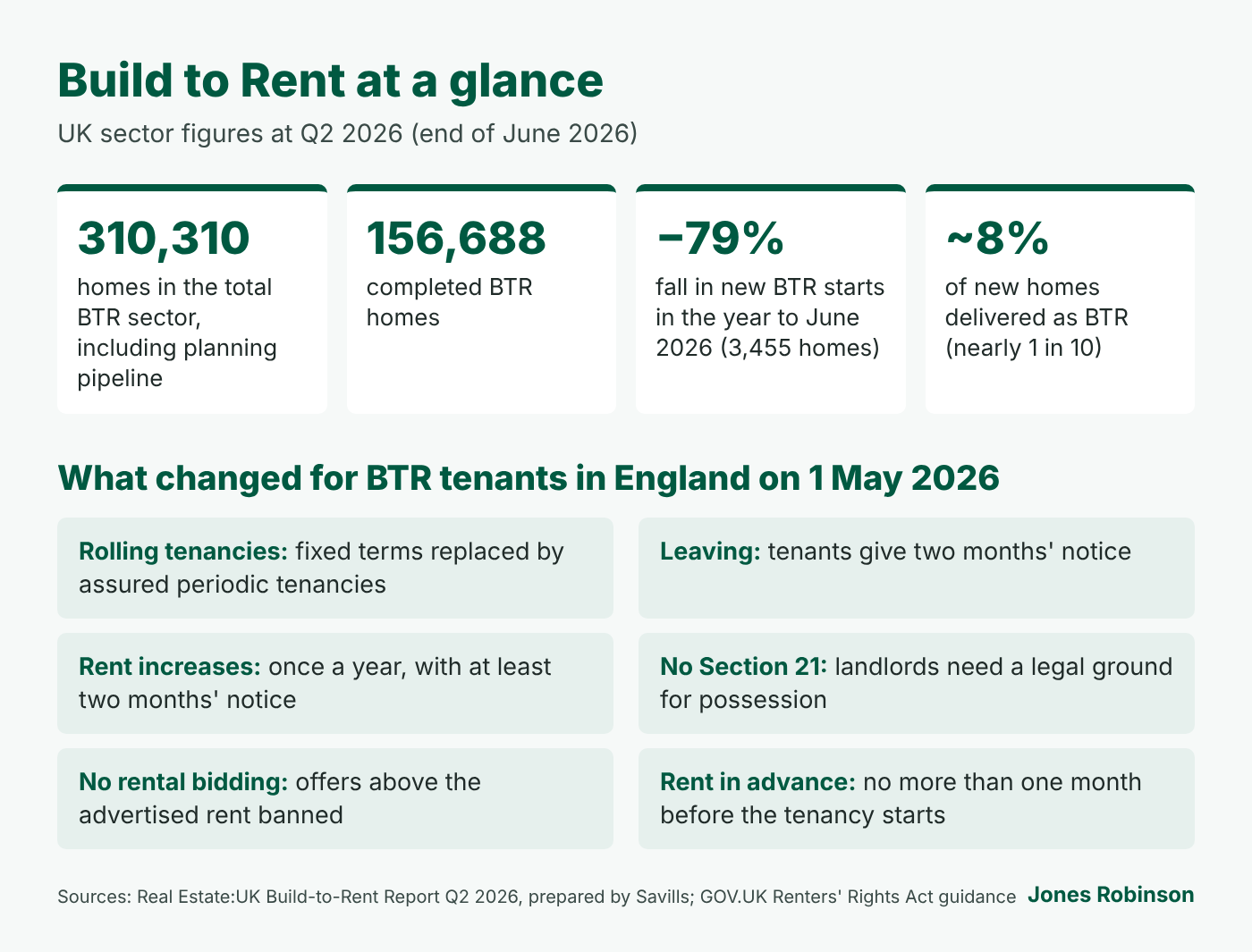
Build to Rent in Numbers (Q2 2026)
The latest quarterly figures, prepared by Savills for Real Estate:UK (formerly the British Property Federation), show the sector at the end of June 2026:
| Measure | Figure |
|---|---|
| Total UK BTR sector (completed, under construction and in planning) | 310,310 homes |
| Completed BTR homes | 156,688 homes |
| New BTR starts on site, year to June 2026 | 3,455 homes, down 79% on the previous year |
| BTR homes under construction | 50,362 homes, down 21% compared with Q2 2025 |
| BTR homes in planning | 103,260 homes |
| Share of new homes delivered as BTR | Around 8% (nearly 1 in 10) |
| BTR investment in Q2 2026 | £2.2 billion, the strongest Q2 on record |
| BTR investment in 2025 | £5.3 billion, a record year |
Source: Real Estate:UK Build-to-Rent Report Q2 2026 (published 3 August 2026) and accompanying release; Savills UK Build to Rent Market Update Q2 2026; Savills Q4 2025 update.
How Build to Rent Works
Build to Rent developments follow a unique operational model:
- Planning and Development: Developers acquire land and design rental-focused housing.
- Construction: Projects are built with renters' needs in mind, emphasising community living and modern conveniences.
- Management: Dedicated teams manage the entire property, from tenancy agreements to maintenance services.
Unlike the traditional buy-to-let model, where individual landlords rent out homes, BTR properties are owned by a single investor or operator and run by professional management teams, which aims to give a consistent standard across the whole development.
Looking for your next rental home? Browse our properties to rent across West Berkshire, South Oxfordshire and Wiltshire, and let our lettings team help you find a home that suits your lifestyle.
Why Build to Rent Is Important for Home Buyers
Access to Housing for First-Time Buyers
For first-time buyers, Build to Rent offers a valuable stepping stone toward homeownership. While saving for a deposit, tenants can enjoy high-quality homes with modern amenities that might otherwise be out of reach. BTR properties often provide a taste of homeownership without the immediate financial commitment of purchasing a house. If you are weighing up the two, our guide to renting vs buying a home sets out the pros and cons.
Flexible Living Arrangements
Build to Rent developments cater to tenants looking for flexibility. Home buyers in transition, such as those relocating for work or uncertain about long-term plans, can benefit from a rolling tenancy that they can end with two months' notice. This makes BTR ideal for individuals who need stable, well-maintained homes without long-term purchase obligations.
Reduced Maintenance Hassles
One major advantage of Build to Rent is professional property management. From routine maintenance to urgent repairs, tenants can expect a dedicated team to deal with problems. This hassle-free living experience appeals to home buyers who prefer to avoid the responsibilities typically associated with homeownership.
Key Features of Build to Rent Properties
Amenities and Services
Build to Rent properties are designed with tenant convenience and lifestyle in mind. Common amenities include:
- On-Site Maintenance: Quick response teams handle repairs and maintenance.
- Fitness and Wellness Facilities: Gyms, swimming pools, and yoga studios for a healthier lifestyle.
- Social and Communal Spaces: Residents can enjoy lounges, coworking spaces, and rooftop terraces.
- Concierge Services: 24/7 assistance for deliveries, bookings, and tenant support.
Security and Safety
Safety is a top priority in Build to Rent communities. Common security features include:
- 24/7 Surveillance: CCTV monitoring ensures a secure environment.
- Controlled Access: Key fob entry and secure lobby areas limit unauthorised access.
- On-Site Security Teams: Staff are available around the clock in many developments.
Lease Flexibility
Tenancy terms in England changed on 1 May 2026, when the Renters' Rights Act replaced most assured shorthold tenancies with assured periodic (rolling) tenancies. For Build to Rent tenants this means:
- No Fixed End Date: Your tenancy continues until you end it or the landlord obtains possession on a legal ground.
- No Renewals to Negotiate: The tenancy rolls on, and rent can only be increased once a year through the formal process.
- Leaving Early: No break clause is needed. You give two months' written notice, ending at the end of a rent period, unless your landlord agrees in writing to less.
Searching for a hassle-free renting experience? Visit our tenants page to learn more about our tenant services and how our lettings team can support you.
Financial Considerations for Home Buyers
Costs and Fees
Renting a Build to Rent property involves several costs beyond the monthly rent:
- Deposits: Capped at five weeks' rent where the annual rent is under £50,000 (six weeks where it is between £50,000 and £100,000), and held securely in a government-approved tenancy deposit scheme. A holding deposit to reserve a home is capped at one week's rent.
- Rent in Advance: Since 1 May 2026, you cannot be asked for rent before the tenancy agreement is signed, and no more than one month's rent between signing and moving in.
- Monthly Rent: Covers the living space and often includes amenities like gyms or coworking areas.
- Bills and Extras: In England, the Tenant Fees Act 2019 limits charges to rent, deposits and a short list of permitted payments, such as utilities where your agreement says so. Amenities are paid for through the rent, so check what it includes.
Comparing BTR Costs vs. Buying
Choosing between renting a Build to Rent home and purchasing a property involves weighing upfront costs and long-term financial goals:
| Factor | Build to Rent | Buying a Home |
|---|---|---|
| Upfront Costs | Deposit (capped at five weeks' rent in most cases) plus up to one month’s rent in advance | Deposit, legal fees, survey and any stamp duty |
| Monthly Payments | Rent, plus any bills and council tax not included in the rent | Mortgage, insurance, maintenance costs |
| Maintenance Expenses | Landlord's responsibility, funded through the rent | Paid by homeowner |
| Flexibility | Rolling tenancy; leave with two months' notice | Less flexible due to ownership |
Thinking about buying instead? Our buying a home guide and mortgage advice can help you work out what you could afford.
Financing Options
While Build to Rent properties are typically for rent only, some schemes may include pathways to ownership:
- Rent-to-Own Schemes: Rare in the BTR market but may appear in specific developments.
- Shared Equity Options: In certain cases, tenants may have the chance to purchase shares in their rental property, though this is uncommon.
Build to Rent Investment: How It Works and Who Invests
Build to Rent investment means owning a whole rental scheme rather than a single home. Returns come from net rental income across all the homes, after management and running costs, plus any change in the value of the development. Because one owner holds the entire scheme, BTR is mainly a market for large investors.
Who Invests in Build to Rent?
The main investors are pension funds, insurers, property companies and overseas investors. Savills reports that North American capital accounted for 60% of UK BTR investment in the first half of 2026, with domestic investors at 35%.
Can Individuals Invest in Build to Rent?
Usually not directly. Because BTR schemes stay in single ownership, you generally cannot buy one home in a scheme as a buy-to-let. Private investors tend to get exposure indirectly, through a pension or shares and funds in property companies that own rental homes. Values and income can fall as well as rise, and this is not financial advice: speak to an FCA-authorised adviser before investing.
Build to Rent vs Buy-to-Let
| Factor | Build to Rent | Buy-to-Let |
|---|---|---|
| Owner | One institutional owner of the whole scheme | Individual landlord or small company, often with one or a few homes |
| How you invest | Large funds directly; individuals usually only indirectly | Buy a property, often with a buy-to-let mortgage |
| Management | Professional team, often on site | Self-managed or through a letting agent |
For individual landlords, BTR has raised tenant expectations around repairs and communication, and a well-run buy-to-let with full property management can match that. Thinking of letting a property yourself? Read our guide on how to become a landlord in the UK.
Legal and Contractual Considerations
Lease Agreements
Before renting a Build to Rent property, understanding the tenancy agreement is essential. Key terms to review include:
- Tenancy Type: Most private tenancies in England are now assured periodic tenancies with no fixed end date.
- Written Terms: Your landlord must give you written information about the terms of your tenancy, usually in the tenancy agreement. Read what the rent includes and any rules on pets, parking and communal areas.
- Notice Period: You give two months' notice. Your landlord needs a legal ground for possession and must give the notice set for it (for example, four months to sell, and not in the first 12 months).
Tenant Rights and Obligations
Build to Rent tenants are protected by UK rental laws. Important rights and obligations include:
- Right to a Safe Home: Landlords must ensure properties are safe, well-maintained, and free of hazards.
- Protection of Deposits: Deposits must be secured in a government-approved tenancy deposit scheme.
- Fair Rent Increases: Rent can only be increased once a year, using a section 13 notice that gives at least two months' notice. If you think the new rent is above market rate, you can challenge it at the First-tier Tribunal.
- Tenant Responsibilities: Tenants must pay rent on time, report maintenance issues, and respect communal property rules.
Getting ready to move into your new home? Visit our tenant move-in page for a step-by-step guide on what to expect when you move into a home let through Jones Robinson.
How the Renters' Rights Act Affects Build to Rent
Build to Rent operators are private landlords, so their tenancies follow the same rules as any other private let. Alongside the tenancy changes above, the Renters' Rights Act brought in these rules in England from 1 May 2026:
- Section 21 abolished: Landlords need a legally valid ground for possession to end a tenancy.
- No rental bidding: Landlords and agents must publish an asking rent and cannot accept offers above it.
- No rent review clauses: Rent can only rise once a year through the statutory section 13 process.
- No discrimination: It is illegal to refuse tenants because they have children or receive benefits.
- Pets: Landlords must consider a tenant's request to keep a pet and give valid reasons for any refusal.
Landlord and property registration rolls out regionally from 15 December 2026, followed by a private rented sector ombudsman, Awaab's Law and the Decent Homes Standard. These changes apply in England; housing law is devolved, so Wales and Scotland have their own rules.
For BTR, the Act narrows the gap with a standard private let. Longer tenancies used to be one of BTR's main selling points; now every private tenant in England has open-ended security, so BTR competes more on service, amenities and management quality. Read more in our guide to the Renters' Rights Act now it is in force.
Pros and Cons of Build to Rent
Advantages
- Professional Management:
Tenants benefit from on-site management teams offering prompt maintenance and support. - High-Quality Amenities:
BTR properties often feature gyms, lounges, coworking spaces, and secure parking, enhancing the living experience. - Flexible Tenancies:
Rolling tenancies let you stay long term or leave with two months' notice, catering to various lifestyle needs. - Community Living:
Social events and communal spaces foster a sense of community among residents. - Security and Safety:
Features like 24/7 CCTV, key fob access, and on-site security ensure tenant safety.
Drawbacks
- Higher Rental Costs:
Premium amenities and services often come with higher monthly rents compared to traditional rental properties. - Limited Homeownership Pathways:
Unlike shared ownership schemes, BTR properties are rarely available for purchase. - Bills on Top:
Utilities, broadband and council tax may be payable on top of the rent unless the agreement includes them, which can increase overall living costs. - Less Personalisation:
Tenants may face restrictions on decorating or making structural changes.
How to Find Build to Rent Properties
Online Search Tips
Finding your ideal Build to Rent property is easier when you know where to look. Use these tips to streamline your search:
- Visit Trusted Property Portals: Rightmove and Zoopla list rental homes from agents and operators, and many BTR operators also let directly through their own websites.
- Filter by Features: Search for homes with essential amenities such as gyms, concierge services, and parking.
- Create Alerts: Set notifications for new listings that match your preferences and budget.
- Check Reviews: Look for tenant feedback to learn about property management and living conditions.
- Compare with Local Rents: Check what similar homes rent for nearby. Our guide to average rents across West Berkshire by town is a useful benchmark.
Work with Jones Robinson
Whether you choose a Build to Rent home or a privately let property, our lettings team can help you find the right rental home. Here’s how we can support you:
- Local Market Expertise: Our branches know the rental markets in West Berkshire, South Oxfordshire and Wiltshire, and can help you compare what is available.
- Personalised Viewings: We arrange viewings of homes that meet your needs.
- Clear Terms: We explain the tenancy terms, what the rent includes and your rights under the new rules.
- Application Support: We guide you through the rental application process, making it simple and hassle-free.
Future Trends in Build to Rent
Expansion of BTR in the UK
Demand for high-quality rental homes remains strong, but the sector faces a mixed outlook. Key trends include:
- Regional and Suburban Expansion: While major cities like London and Manchester dominate the market, BTR is expanding into suburban areas, with single family housing taking 59% of BTR investment in 2025.
- Increased Investment: A record £5.3 billion went into UK BTR in 2025 and £2.2 billion in Q2 2026 alone, but the industry reports capital moving towards established, completed schemes rather than funding new ones.
- Slower New Development: Starts on site fell 79% in the year to June 2026 (84% outside London), and completions have exceeded starts for ten consecutive quarters, so fewer new BTR homes are in the pipeline.
- Policy Uncertainty: The industry says speculation about rent controls is weighing on investment, although the government has said it does not support rent controls.
Technological Advancements in Property Management
Technology is reshaping how Build to Rent properties are managed and experienced:
- Smart Home Integration: Features like app-controlled lighting, heating, and security systems are becoming more common.
- Online Leasing Platforms: Tenants can apply, sign tenancy agreements, and pay rent through digital platforms.
- Data-Driven Maintenance: Predictive maintenance systems reduce service delays by identifying issues before they occur.
- Virtual Tours: Prospective tenants can explore properties remotely through virtual tours.
Looking for expert property advice? Visit our branches page to find your nearest Jones Robinson office. Our experienced team is ready to help with renting, letting and all your property needs.
FAQs
1. What Is the Difference Between Build to Rent and Buy-to-Let?
Build to Rent properties are purpose-built developments owned and managed by developers or institutions, offering professional services and long-term rental options. In contrast, Buy-to-Let involves individual landlords renting out privately owned properties.
2. Is Build to Rent More Expensive Than Traditional Renting?
Rents can be higher, as they cover amenities like gyms, lounges and concierge services plus on-site management. Whether that is good value depends on how much you use the extras, so compare with similar homes nearby.
3. Can I Buy a Build to Rent Property?
Typically, Build to Rent properties are owned by developers or investment firms and are not available for purchase. However, some developments may offer rent-to-own schemes, though these are uncommon.
4. Do Build to Rent Tenancies Have Long-Term Leases?
BTR is designed for long-term renting, but in England fixed terms were replaced by rolling tenancies on 1 May 2026. You can stay until you give two months' notice, and the landlord needs a legal ground to end the tenancy.
5. Are Build to Rent Properties Fully Furnished?
It varies by development. Many Build to Rent homes are offered furnished, while others are unfurnished or offer a choice, so check the listing or ask the operator.
6. Can I Invest in Build to Rent?
Not usually directly, as schemes are owned by large investors such as pension funds and property companies. Individuals tend to invest indirectly, through pensions or property company shares and funds. This is not financial advice.
7. Does the Renters' Rights Act Apply to Build to Rent?
Yes. BTR landlords are private landlords, so in England their tenancies follow the Act, including rolling tenancies and one rent increase a year.
Build to Rent is transforming the UK housing market by offering professionally managed, high-quality rental homes with modern amenities. For home buyers seeking flexibility, security, and a hassle-free living experience, Build to Rent can be a good alternative to traditional renting or a stepping stone to homeownership.
Renting or Letting in Berkshire, Oxfordshire and Wiltshire
Whether you are looking for your next rental home or you are a landlord wondering how to compete with professionally managed rentals, Jones Robinson can help. Browse our homes to rent, find out about our landlord services, or speak to your local team in Newbury, Didcot, Marlborough or Devizes.
Explore the latest industry news, property tips, and expert advice on our blog. Stay up-to-date with our in-depth guides and market updates to make informed property decisions.
Related Articles:
Renting vs Buying a Home: Exploring the Pros and Cons
The Renters' Rights Act Five Months On
What Tenants Are Looking For in 2026
What Does Tenant in Situ Mean?