

In this blog
- What is premium property management?
- Do landlords need property management services in 2026?
- How does the Renters’ Rights Act affect property management?
- What service standards should a premium manager meet?
- What does a property management service include?
- Is luxury property management worth it for higher-value homes?
- Premium property management FAQs
The lettings market in 2026 looks very different from just a few years ago. Demand for rental property remains strong, but expectations have shifted, and so have the risks. For landlords, owning a property is no longer just about generating income. It is about staying compliant, securing the right tenants, and protecting long-term value.
That is why more landlords are turning to premium property management. This approach offers a more structured and professional way to manage a property, helping to protect your assets, improve tenant quality, and deliver more consistent results over time.
Updated October 2026: the Renters’ Rights Act’s main changes for private landlords in England took effect on 1 May 2026. We have updated this article to reflect the rules now in place and those still to come.
What premium property management really means today
Traditional property management was once focused on collecting rent and arranging repairs. While these elements remain important, they now represent only part of the service.
Premium property management takes a broader and more strategic view. It involves managing the entire lifecycle of a property, from legal compliance and tenant sourcing through to ongoing maintenance and performance monitoring. The focus is no longer simply on managing issues as they arise, but on preventing them and improving outcomes over time.
If you are new to the subject, our guide to what property management is and what a property manager does covers the basics, fees and the main legal checks. This article focuses on the standard of service you should expect from a premium manager in 2026.
The shift towards professional property management
More landlords across the UK are moving towards structured property management services as the lettings landscape becomes increasingly complex. The Renters’ Rights Act 2025 has played a significant role in this shift.
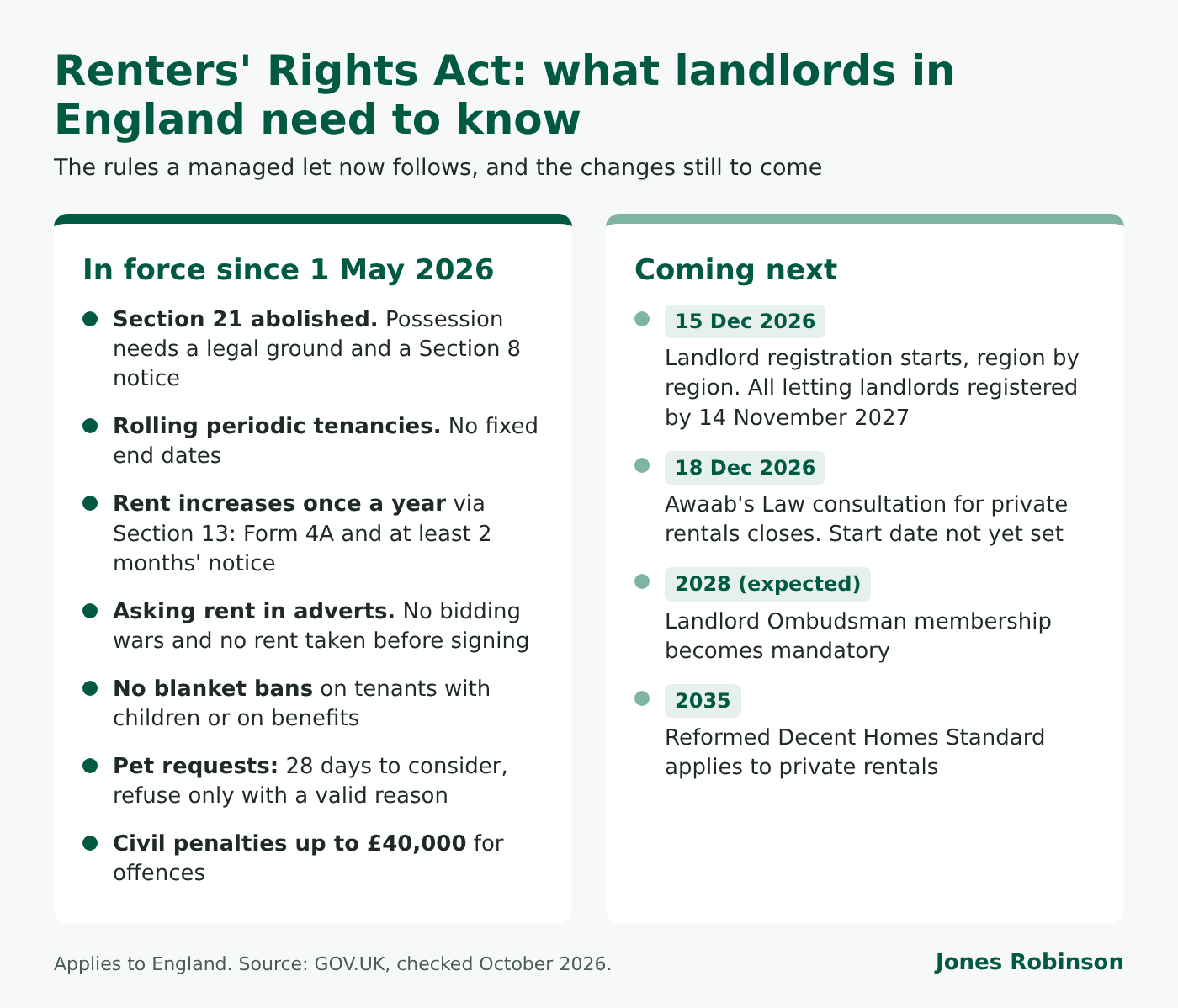
Since 1 May 2026, Section 21 ‘no fault’ evictions have been abolished in England. Tenancies now roll on with no fixed end date, rent can only be increased once a year, and landlords who need the property back must serve a Section 8 notice on a legal ground. The government’s overview for landlords explains each change.
These changes make self-management more time-consuming and, in some cases, riskier. Getting a notice, a rent increase or a deposit wrong can now delay possession or lead to a penalty.
As a result, professional management is becoming the most reliable way to ensure a property is handled correctly and remains compliant. For a fuller picture of how the first months have played out, read what the Renters’ Rights Act means for landlords five months on.
Why compliance is now central to property management
Compliance is now at the centre of effective property management. Landlords must keep up with evolving legislation, meet tenant rights obligations, and ensure all safety and legal requirements are fulfilled.
Even a small oversight can lead to delays, disputes, or financial penalties. Since 1 May 2026, councils can impose civil penalties of up to £40,000 for the most serious offences, up from £30,000, and a court will not normally grant possession if the tenant’s deposit was not properly protected. This is where experienced property management services provide reassurance. By maintaining a clear structure and up-to-date knowledge, they help ensure that every property meets current regulations and adapts as rules change.
More change is on the way. The government’s landlord registration service launches on 15 December 2026, and Landlord Ombudsman membership is expected to become mandatory in 2028. A premium manager should be preparing landlords for both now, not waiting for the deadline.
What a premium manager should handle under the Renters’ Rights Act
The new rules have changed what ‘good’ looks like. When you compare property managers, these are the standards worth asking about. Each one reflects a legal requirement that now applies to lettings in England.
| Area | What the rules now require | What a premium manager should do |
|---|---|---|
| Marketing and offers | Adverts must show an asking rent. No bidding, no offers accepted above it, no rent taken before the tenancy is signed | Set the asking rent from local evidence at the start, so the property lets at the right level first time |
| Choosing tenants | No refusing people because they have children or receive benefits | Reference every applicant on individual affordability, with Right to Rent checks, and record how decisions were made |
| Pet requests | Tenants can ask to keep a pet. Landlords have an initial 28 days to consider it and need a valid reason to refuse | Respond within the timeframe, in writing, and advise you on reasonable conditions |
| Rent reviews | Once a year via Section 13, using Form 4A with at least 2 months’ notice. Tenants can challenge an increase above market rent | Review the rent annually against local comparables and serve the correct notice on time |
| Deposits | Protect in a government-approved scheme and give the prescribed information. Without this, possession is normally blocked | Protect every deposit promptly and keep proof on file for the life of the tenancy |
| Possession | Section 8 notice with a legal ground. Selling or moving in: not in the first 12 months, usually 4 months’ notice. Arrears ground at 3 months owed | Keep rent records, inspection reports and correspondence that would stand up as evidence if needed |
| Registration | Rolling out from 15 December 2026, with all letting landlords registered by 14 November 2027 | Tell you when your area is called forward and make sure your property details are ready |
Source: GOV.UK, Renters’ Rights Act: an overview for landlords, implementation roadmap and landlord registration announcement (9 September 2026). Rules apply to England.
The routine safety checks still apply too: an annual gas safety check, an electrical inspection at least every five years, a valid EPC, smoke alarms on every storey and carbon monoxide alarms where required.
Protecting your property as a long-term asset
A rental property should always be viewed as a long-term investment rather than a short-term income source. Effective management plays a key role in protecting that investment.
Regular inspections, preventative maintenance, and consistent oversight help to maintain the condition of the property. Over time, this protects both rental income and capital value. Poorly managed property assets often result in higher costs and reduced returns in the long run.
Standards are also rising. The government is consulting until 18 December 2026 on extending Awaab’s Law, which sets legal deadlines for fixing hazards such as damp and mould, to private rentals, and a reformed Decent Homes Standard will apply to privately rented homes from 2035. Regular inspections that pick up problems early put landlords in a far stronger position for both.
The role of tenant quality in premium property management
Tenant quality has a direct impact on the performance of a property. A well-managed property is far more likely to attract reliable tenants who stay longer and take better care of the home.
Professional property management includes thorough referencing and careful tenant selection. This reduces risk and creates a more stable rental experience. With fixed terms gone and Section 21 no longer available, choosing the right tenant at the start matters more than ever; our guide to choosing the right tenant under the Renters’ Rights Act explains how referencing works now. In the context of luxury property management, tenant quality becomes even more important, as expectations are higher and standards must be maintained consistently.
What makes luxury property management different
Luxury property management operates to a higher standard than traditional services. A luxury property requires more attention, more care, and a more tailored approach.
Tenants expect a high level of service, and the property itself must reflect that. This includes maintaining presentation, responding quickly to issues, and ensuring every aspect of the experience feels seamless. This level of management requires expertise and attention to detail. For the tenant’s side of the picture, see what tenants expect from premium rentals in 2026.
Managing a luxury property in today’s market
Letting a luxury property involves more than simply listing it on the market. It requires careful positioning, targeted marketing, and a clear understanding of the tenant profile.
Maintaining the condition of the property is equally important. Without the right management, even a well-located property can underperform. This is why many landlords rely on specialist support to ensure their property is presented and managed to the highest standard.
The value of luxury property management services
Specialist luxury property management services are designed to meet the expectations of high-value properties and tenants. These services focus on quality at every stage, from marketing and tenant sourcing through to ongoing care.
By taking a proactive approach, these services ensure that the property is managed in a way that reflects its value. This helps to protect both income and long-term performance.
How premium property management improves rental performance
There is a strong connection between property management and rental performance. A well-managed property is more likely to achieve the right rental value, attract strong tenants, and avoid unnecessary void periods.
Over time, premium property management helps to create a more stable and predictable income stream. It also reduces the likelihood of costly issues arising, which can impact overall returns.
Pricing has become more important under the new rules. Because rental bidding is banned, the rent you advertise is effectively the most you can achieve, and tenants can challenge an annual increase above market rent, so each review needs local evidence behind it.
Saving time and reducing stress through professional management
Managing a property involves a wide range of responsibilities, from tenant communication to maintenance and compliance checks. These demands can quickly become time-consuming.
Professional property management services take on these responsibilities, allowing landlords to step back from day-to-day tasks. This ensures that everything is handled properly while reducing the pressure on the landlord.
The importance of local expertise in property management
Local knowledge plays a crucial role in effective property management. Understanding the local market helps to set the right rental price, attract suitable tenants, and respond quickly to changes in demand.
Strong local expertise ensures that each property is positioned correctly and performs well within its specific area. Rents and tenant demand differ noticeably between a flat in Newbury town centre, a family home in Didcot and a country house near Marlborough or in the Vale of Pewsey. If you let in our area, our guide to average rents across West Berkshire by town is a useful starting point.
What to expect from a premium property management service
A high-quality property management service should provide clarity, consistency, and confidence. Landlords should receive clear communication, transparent reporting, and a reliable point of contact.
In practice, that should include:
- A named, dedicated property manager as your single point of contact
- Monthly rental statements and clear records of income and costs
- Regular property visits with written and photographic reports
- A way for tenants to report repairs at any time, with work overseen through to completion
- An annual rent review, with the correct Section 13 notice served on your behalf
- Compliance management throughout the tenancy, from safety certificates to deposit protection
- A managed end of tenancy, including the deposit return and any dilapidations
More importantly, landlords should feel assured that their property is being managed with care and professionalism. This level of service is what defines premium property management. At Jones Robinson, these are all part of our Full Management service; our article on choosing between rent collection and full management explains which level suits different landlords.
Why more landlords are choosing a premium approach in 2026
The lettings market is becoming more complex, and the expectations placed on landlords continue to increase. Regulation is tighter, and tenant expectations are higher than ever before.
As a result, more landlords are choosing premium property management to protect their property and improve long-term outcomes. This shift reflects a growing focus on quality, consistency, and risk management.
Choosing the right property management partner
Not all property management services offer the same level of support. Choosing the right partner can have a significant impact on how your property performs.
A strong partner will understand your goals, provide practical advice, and deliver a consistent standard of management. In a changing market, this level of support is increasingly important. Before you sign, it is worth asking:
- Are you members of a professional body such as ARLA Propertymark, a redress scheme and a client money protection scheme?
- How have your processes changed since 1 May 2026, for rent reviews, pet requests and possession?
- Who will be my day-to-day contact, and how often will the property be visited?
- How will you help me register when landlord registration reaches my area?
- What is included in the fee, and what costs extra?
Our list of top questions landlords should ask a new lettings agent goes into more detail.
Premium property management FAQs
Is premium property management worth it?
For many landlords, yes, particularly those with higher-value homes, several properties, or who live some distance away. Weigh the fee against what it replaces: your own time, the cost of empty months between tenants, and the risk of a compliance mistake now that penalties and possession rules are stricter.
Can a managing agent still end a tenancy for me?
Yes, but only with a legal reason. Since 1 May 2026, Section 21 cannot be used in England. Your agent would serve a Section 8 notice on a valid ground, such as rent arrears or selling the property after the first 12 months, and apply to court if the tenant does not leave.
Do I need to register as a landlord?
Yes. Registration opens on 15 December 2026, starting in the West Midlands and then rolling out region by region, with three months to sign up once your area is called forward. All landlords actively letting must be registered by 14 November 2027, and failing to register can lead to a fine.
A better way to manage your property
The lettings market will continue to evolve, and landlords who take a proactive approach will be better placed to succeed.
With the right management in place, a property can remain compliant, perform consistently, and retain its long-term value. For landlords looking to protect their investment and achieve better results, premium property management offers a clear and reliable path forward.
Our property management team looks after more than 1,000 properties across Newbury, Marlborough, Devizes, Didcot and Lambourn, and we are licensed members of ARLA Propertymark. To find out what your property could let for, book a rental valuation, read more about our property management service, or speak to the team at your nearest branch in Newbury, Marlborough, Devizes or Didcot.