

In this blog
- What defines a premium rental property in today's market?
- What do tenants expect from rental homes in 2026?
- What is the rental market like in autumn 2026?
- Why do presentation and condition matter more than ever when letting a property?
- How do compliance and professional management influence tenant choice?
- How has the Renters' Rights Act changed what tenants expect?
- How can landlords position their property to attract the right tenants?
- How do premium rentals deliver stronger long-term results?
- How should you approach your rental in 2026?
- FAQs
The lettings market in 2026 remains strong, but it is also becoming more structured and more deliberate. Demand continues to outpace supply across much of West Berkshire, South Oxfordshire and Wiltshire, yet tenant expectations have evolved.
For landlords, this means that achieving a strong result is no longer just about setting the right rent. It is about how a property is presented, managed and positioned from the outset.
Premium rentals are not defined by price alone. They are defined by the experience they offer and the confidence they give to tenants. Understanding what tenants expect today can help landlords attract the right people and secure more reliable, long-term outcomes.
Updated October 2026: this guide now reflects the Renters' Rights Act 2025, which changed the rules for private landlords in England on 1 May 2026, and the latest rental market data.
What defines a premium rental property in today's market
A premium rental property is not necessarily the most expensive home available. Instead, it is one that feels well maintained, easy to live in and clearly managed.
Across areas such as Newbury and Didcot, this often means practical layouts, good connectivity and a clean, modern feel. In Marlborough, Devizes and the surrounding villages, character homes can also achieve premium results when they are presented clearly and maintained to a high standard.
Tenants are not simply comparing rent levels. They are comparing how straightforward each property feels. Homes that are ready to move into, with no uncertainty around condition or management, tend to stand out.
In this context, a premium rental is one that offers clarity, consistency and ease of living.
What do tenants expect from rental homes in 2026
Tenant expectations have become more defined. Most tenants now approach a move with a clear idea of what they are looking for, and they are less willing to compromise on the basics.
In 2026, tenants typically expect:
- A clean and well-maintained property
- Clear and accurate information before viewing, including the asking rent
- A straightforward and transparent process
- Confidence that any issues will be handled properly
Many tenants are planning for longer stays, particularly professionals and families. This means they are thinking not just about the property itself, but about how it will work over time.
Where these expectations are met, tenants are more likely to act quickly and commit with confidence. For a closer look at the features, layouts and running costs renters weigh up, see our guide to what tenants are looking for in 2026.
What is the rental market like in autumn 2026?
The national data supports what lettings teams are seeing locally: plenty of tenants, not enough good homes to let.
- Tenant demand is still rising. In the RICS UK Residential Market Survey for September 2026, a net balance of +23% of surveyors reported rising tenant demand, while more surveyors reported falling than rising landlord instructions.
- Rents are expected to keep climbing. A net balance of +37% of RICS respondents expect rents to rise over the next three months.
- Rents are rising more slowly in the South East. ONS figures show the average private rent in England was £1,466 a month in September 2026, up 4.0% on a year earlier. Annual rent inflation in the South East was 3.5%, joint lowest of the English regions with London.
Source: RICS UK Residential Market Survey, September 2026; ONS Price Index of Private Rents, September 2026 (published 21 October 2026).
Strong demand does not mean any property will let well. With South East rent growth running below the England average and tenants able to compare homes easily online, the best-presented, best-managed homes are the ones that let quickly and keep their tenants. For town-by-town figures, see our breakdown of average rents across West Berkshire in 2026.
Why presentation and condition matter more than ever when letting a property
First impressions continue to play a significant role in the lettings market. Most tenants will form an initial view of a property online, before deciding whether to arrange a viewing.
Well-presented homes tend to:
- Attract more enquiries
- Let more quickly
- Appeal to more reliable tenants
Presentation is not about making a property look different. It is about showing it clearly and ensuring that it reflects the standard tenants expect.
Condition is equally important. Minor maintenance issues, signs of wear or unclear presentation can create hesitation. Tenants may question how well the property will be managed, even if the issues are small.
Energy efficiency is part of condition too. Tenants increasingly look at running costs, and a stronger EPC rating can make a home easier to let. Our article on why a good EPC rating is a selling point explains more.
Addressing these points before marketing begins helps a property feel straightforward and ready to move into.
How compliance and professional management influence tenant choice
The lettings market is becoming more regulated, and this is changing how tenants make decisions.
Increasingly, tenants value:
- Professionally managed properties
- Clear communication
- Prompt and reliable maintenance
This is partly driven by wider changes in legislation, but also by expectations around service. Tenants want to feel that their home will be looked after properly throughout the tenancy.
A premium let starts with the legal basics in place before the first viewing. In England, that includes an annual gas safety check, an electrical safety report (EICR) at least every five years, an EPC rating of E or above, a smoke alarm on every storey and a carbon monoxide alarm in any room with a fixed combustion appliance (gas cookers excluded), Right to Rent checks on every adult tenant, and protecting the deposit in a government-approved scheme within 30 days. Our guide to becoming a landlord in the UK covers each requirement in detail.
For landlords, this shift creates an opportunity. A well-managed property not only reduces risk but also makes the home more attractive to prospective tenants.
Professional management supports:
- Better tenant relationships
- Faster resolution of issues
- Greater overall confidence in the tenancy
This can have a direct impact on both demand and retention. If you are weighing up how much support you need, our article on what landlords should expect from premium property management sets out what a good service looks like.
How has the Renters' Rights Act changed what tenants expect?
Since 1 May 2026, the Renters' Rights Act 2025 has turned several things tenants used to hope for into legal rights. A premium let now means meeting these rules smoothly, not just meeting them.
| What changed on 1 May 2026 | How landlords can deliver |
|---|---|
| Section 21 abolished; tenancies are assured periodic (rolling, with no fixed end date) | Tenants can leave with 2 months' notice, so keeping good tenants depends on the home and the service around it |
| Every advert must state an asking rent; landlords cannot encourage bidding or accept offers above it | Set the right rent from day one, based on local evidence |
| No rent before the tenancy agreement is signed, then a maximum of 1 month's rent in advance | Explain move-in costs clearly at the offer stage |
| Rent can rise only once a year, using the Section 13 process (Form 4A, at least 2 months' notice) | Plan annual reviews and keep rent in line with the market |
| Tenants can ask to keep a pet; landlords have an initial 28 days to consider the request and need a valid reason to refuse | Decide your approach to pets before marketing |
| No discrimination against tenants with children or on benefits | Assess every applicant on affordability and referencing |
| Coming next: landlord registration from 15 December 2026, region by region, with all letting landlords registered by 14 November 2027 | Keep certificates and tenancy records organised and up to date |
Source: GOV.UK, Renters' Rights Act: an overview for landlords, overview for tenants, implementation roadmap and landlord registration announcement (9 September 2026).
For a fuller local picture, read what landlords in Berkshire and Wiltshire need to know now the Renters' Rights Act is in force.
How landlords can position their property to attract the right tenants
Attracting the right tenant is about more than generating interest. It is about ensuring that the property is matched with someone whose needs and expectations align with it.
This starts with clear positioning:
- Pricing that reflects the local market and property standard
- Marketing that highlights the most relevant features
- A clear understanding of the likely tenant profile
Pricing matters more now that bidding is banned. If the asking rent is set too high, you cannot rely on competing offers to find the true level, and the home may sit empty while it is re-advertised. A local rental valuation gives you an evidence-based starting point.
For example, a well-located home in Didcot may appeal to professional tenants commuting to Oxford or London. A family home in Marlborough may attract tenants focused on schools and long-term living. Rural properties around Pewsey and Lambourn often appeal to those seeking space and lifestyle.
By focusing on the right audience, landlords can attract more suitable tenants and reduce unnecessary turnover. Careful referencing is the other half of the job: see what makes a good tenant.
How premium rentals deliver stronger long-term results
A premium approach to lettings is not just about achieving a higher rent. It is about creating stability and consistency over time.
Properties that are well presented, clearly managed and appropriately positioned tend to:
- Let more quickly
- Attract more reliable tenants
- Experience fewer void periods
- Maintain better condition over time
Longer tenancies are often a key outcome. When tenants feel confident in both the property and its management, they are more likely to stay. With every tenancy now periodic, a tenant who is unhappy can give two months' notice at any point, so the quality of the home and the service around it has a direct effect on how long income lasts.
This reduces disruption, lowers costs and provides a more predictable income stream.
How to approach your rental in 2026
For landlords, the focus in 2026 is on preparation and clarity.
This includes:
- Ensuring the property is well maintained and ready to let
- Understanding current tenant expectations
- Staying up to date with compliance requirements, including landlord registration when it reaches your region
- Using professional marketing and management where appropriate
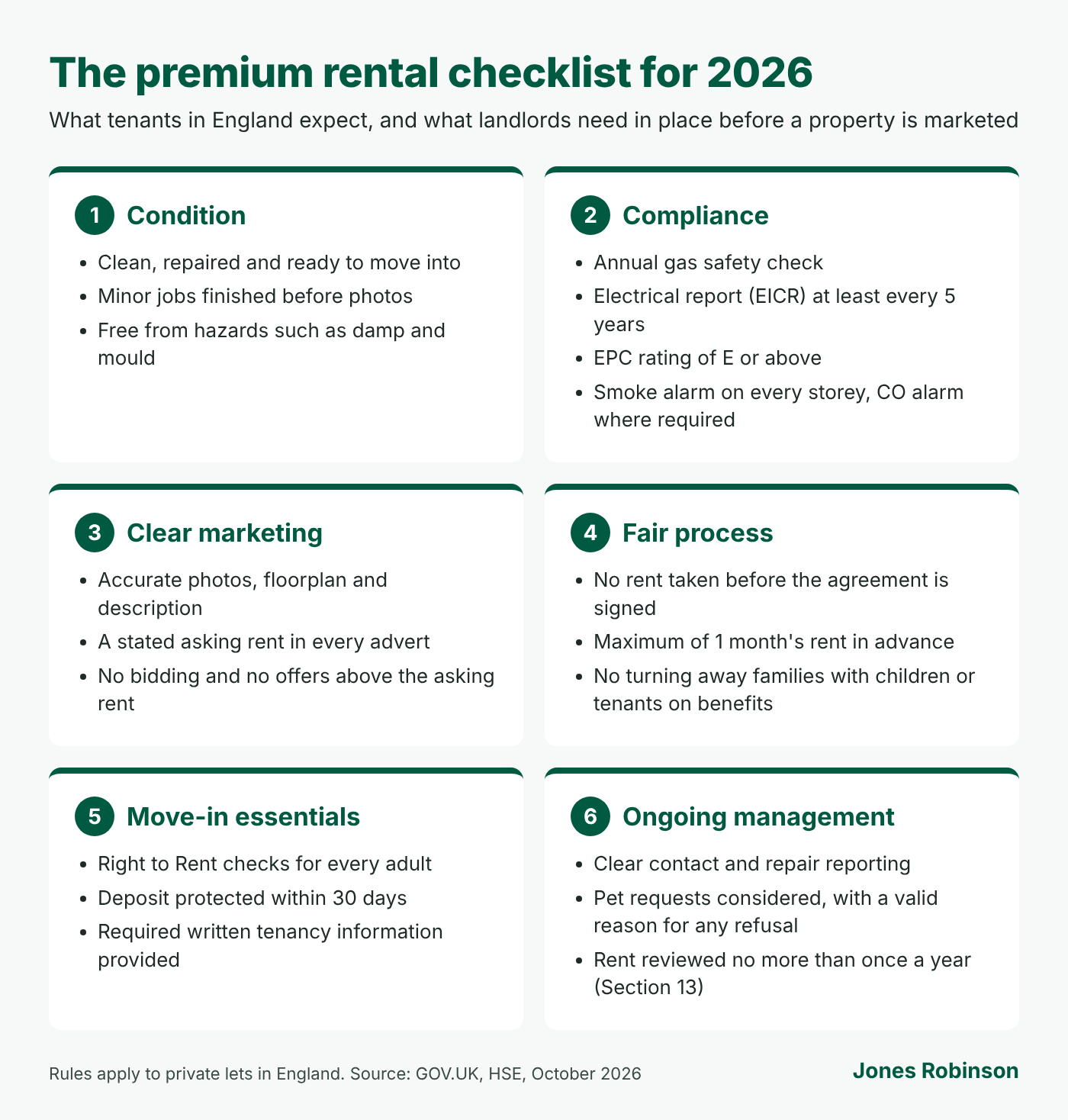
Taking a structured approach from the outset helps avoid delays and supports stronger results.
FAQs
What makes a rental property premium?
A premium rental is one that is well maintained, accurately marketed, fully compliant and clearly managed. It does not have to be the most expensive home on the market. Tenants pay for confidence that the property is ready to live in and that problems will be dealt with properly.
Can landlords still accept offers above the asking rent?
No. Since 1 May 2026, landlords in England must state an asking rent and cannot encourage bidding or accept offers above the advertised rent. That makes getting the asking rent right at the start more important.
How much rent can a landlord ask for upfront?
No rent can be taken before the tenancy agreement is signed. After signing, a landlord can ask for a maximum of one month's rent in advance, alongside a deposit capped at five weeks' rent where the annual rent is under £50,000.
Do I have to accept pets in a premium rental?
Not automatically, but you must consider a tenant's request to keep a pet and give a valid reason if you refuse. The government says landlords have an initial 28 days to consider a request, so it helps to decide your approach before you market the property.
Is it worth using a letting agent for a premium rental?
It depends on how much time you have and how confident you are with the rules. A full management service handles marketing, referencing, compliance, repairs and the Renters' Rights Act processes. Our comparison of rent collection or full management can help you choose.
Looking ahead
The lettings market continues to offer strong opportunities, but it is becoming more professional and more expectation-led.
Landlords who adapt to these changes are likely to see the greatest benefit. By focusing on presentation, management and positioning, it is possible to attract better tenants and achieve more consistent outcomes.
Jones Robinson supports landlords across Newbury, Lambourn, Didcot, Devizes, Marlborough and Pewsey with a clear, professional approach to lettings and property management. From preparing your property for the market to ensuring full compliance throughout the tenancy, the focus is on protecting your investment and delivering long-term value.
If you are considering letting your property, a conversation with your local team can provide clarity on current demand, achievable rental values and the best approach for your circumstances.