

In this blog
- How is the Renters' Rights Act working in practice?
- Can landlords still evict tenants after Section 21?
- How much notice do landlords have to give now?
- What it means for ending a tenancy now
- What do landlords need to do differently under the Renters' Rights Act?
- What is still to come
- How long does it take to evict a tenant now?
- Is buy-to-let still worth it in 2026?
When the Renters' Rights Act came into force on 1 May 2026, the coverage was loud and, in places, alarming. Five months on, the picture is clearer, calmer and more useful than the headlines suggested. The law hasn't made letting unworkable. But it has changed where a landlord's attention needs to go, and the first few months have shown exactly how.
Here's what we've learned since May, and what it means for the way you let from here. If you want a full rundown of every change that took effect on 1 May, our guide to what landlords in Berkshire and Wiltshire need to know now the Renters' Rights Act is in force covers it in detail.
How is the Renters' Rights Act working in practice?
The honest answer is that for most landlords, day-to-day letting feels much as it did. A good tenant in a well-run property doesn't notice the legislation, and neither does their landlord. Rent comes in, the property is looked after, the tenancy continues.
The exception is ending a tenancy. That's the one area where the new rules change things significantly, and where landlords have hit unexpected hurdles.
The surprise most landlords didn't see coming
With Section 21 gone, every possession claim now needs a specific legal ground, served through a Section 8 notice on Form 3A, and in most cases it goes through the courts. On paper, that was expected. In practice, two things have surprised people.
The first is time. Even a clear-cut case takes longer than many landlords assume, because the notice period and the court process now run back to back with no shortcut. Ministry of Justice figures for April to June 2026 show landlord possession claims up 6% on the same quarter of 2025, and a median of 27.1 weeks from a landlord's court claim to repossession by county court bailiffs. That clock only starts once the notice period has run out. Those figures cover all landlord claims, social and private, across England and Wales, and the quarter includes only two months under the new rules. The Ministry of Justice says it is not yet clear whether the Act is behind the changes, so treat them as a guide rather than a forecast. Regaining a property is rarely quick anymore.
The second is a detail many landlords miss. To win possession on the main rent-arrears ground (Ground 8), the tenant has to owe at least three months' rent (13 weeks' if rent is paid weekly or fortnightly) both on the day you served notice and on the day of the hearing. So, a tenant who pays enough off beforehand can defeat the claim on that ground. Arrears that exist only because a Universal Credit housing payment has not yet arrived are also ignored in the calculation. It's caught out landlords who assumed that arrears alone would be enough. The discretionary arrears grounds (Grounds 10 and 11) remain available, but the court then decides whether it is reasonable to order possession.
How much notice do landlords have to give now?
The notice period depends on the ground you rely on. These are the grounds landlords use most often, with the minimum notice now set out in the Housing Act 1988.
| Reason for possession | Ground | Minimum notice | Worth knowing |
|---|---|---|---|
| You or a family member want to move in | Ground 1 (mandatory) | 4 months | Cannot take effect in the first 12 months of the tenancy |
| You want to sell | Ground 1A (mandatory) | 4 months | Cannot take effect in the first 12 months of the tenancy |
| Serious rent arrears | Ground 8 (mandatory) | 4 weeks | At least 3 months' rent owed at notice and at the hearing |
| Some rent owed, or persistent late payment | Grounds 10 and 11 (discretionary) | 4 weeks | The court decides whether possession is reasonable |
| Anti-social behaviour | Ground 14 (discretionary), Ground 7A (mandatory, for specified serious cases) | None: you can apply to court as soon as notice is served | Ground 7A covers cases such as relevant convictions and closure orders |
Source: Housing Act 1988, section 8 and Schedule 2, as amended by the Renters' Rights Act 2025; GOV.UK: Renters' Rights Act overview for landlords. Rules shown are for England.
Once the notice period ends, the full process looks like this:
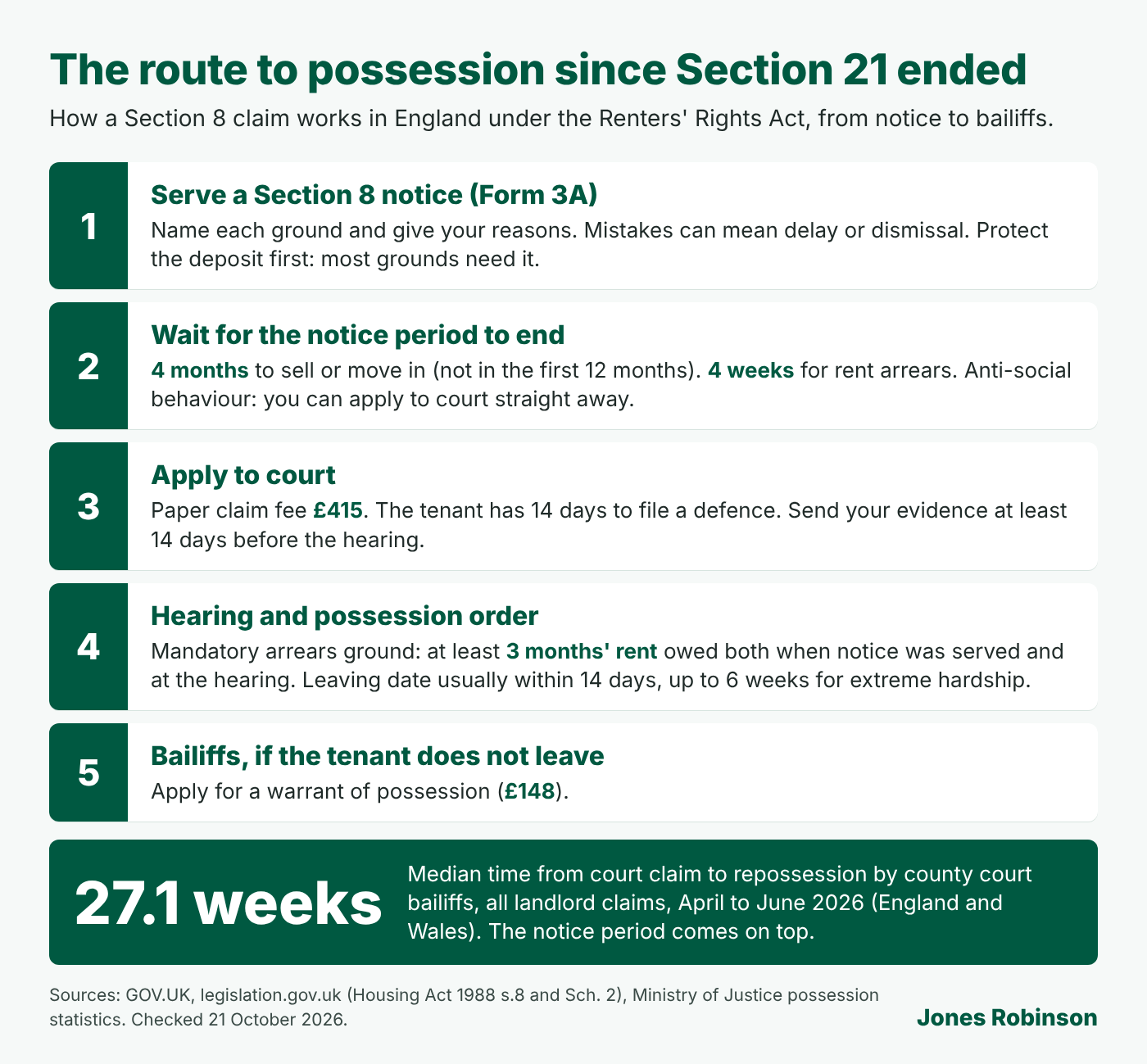
Sources: GOV.UK: repossessing your privately rented property after 1 May 2026; Ministry of Justice: mortgage and landlord possession statistics, April to June 2026.
What it means for ending a tenancy now
The practical takeaway isn't that ending a tenancy has become impossible. It hasn't. There are still clear, workable grounds for genuine arrears, for anti-social behaviour, and for a landlord who needs to sell or move back in. The grounds work.
What's changed is that the margin for error has shrunk. A possession case now stands or falls on evidence and process: the right ground, the right notice, served correctly, backed by proper records and full compliance. GOV.UK is clear that an incomplete or inaccurate notice can see a claim delayed or dismissed, and for most grounds the court will also want to see that the tenant's deposit was protected and the prescribed information given. The landlords finding the new system difficult are usually the ones whose paperwork or compliance wasn't in order to begin with. The ones finding it manageable had their house in order already.
What this means for the way you let from here
Five months in, the clearest lesson is that the whole weight of letting has shifted to the front of the tenancy, to who you let in, and how well the let is set up and run from day one.
Three things matter more than they used to. Choosing the right tenant, because a difficult one is now slow and costly to move on, which makes careful referencing and genuine affordability checks your best protection (our guide to choosing the right tenant under the Renters' Rights Act goes into this). Keeping proper records and full compliance throughout, because that's what a possession case now depends on. And looking after good tenants so they stay, because a settled, long-term tenant sidesteps the whole question of possession, and avoids the hidden cost of tenant turnover. Our tenancies run to an average of 3 years and 3 months, and that matters more now than it ever has.
If you manage your own property, these are the checks worth making now:
- Information Sheet: tenants with an existing written tenancy should have received the government's Renters' Rights Act Information Sheet by 31 May 2026. Make sure you can show when and how it was given.
- Deposit: confirm the deposit is protected in a government-approved scheme and the prescribed information was served, as most possession grounds depend on it.
- Rent reviews: rent can now only be increased once a year using the Section 13 process (Form 4A) with at least two months' notice. A tenant who challenges an increase at the First-tier Tribunal does not pay the higher rent until it decides.
- Records: keep a dated rent ledger, safety certificates and a written log of arrears conversations or complaints. This is the evidence a judge will look at.
- New lets: advertise an asking rent and do not accept offers above it, take no rent before the tenancy agreement is signed, and do not refuse tenants because they have children or receive benefits.
None of this is cause for alarm. It's simply a shift in where the care needs to go, from being able to end a tenancy easily, to setting it up so you rarely need to.
What is still to come
The first phase is in force, but more is on the way. The new landlord registration service launches on 15 December 2026, starting in the West Midlands and rolling out across England over 12 months, with every landlord actively letting required to register by 14 November 2027. Landlord Ombudsman membership is expected to become mandatory in 2028, and the reformed Decent Homes Standard will apply to private rented homes from 2035.
Sources: GOV.UK: stronger protections and greater confidence for renters (9 September 2026); GOV.UK: Renters' Rights Act implementation roadmap; GOV.UK: Decent Homes Standard government response (28 January 2026).
Where this leaves landlords
For a landlord who lets well, the Renters' Rights Act is far less daunting in practice than it looked on paper. It rewards careful, compliant letting and makes casual letting harder. If your tenant is well chosen, your compliance is sound, and your records are kept, you're in a stronger position than the headlines would have you believe.
It does, though, take more attention than it used to, which is why more landlords are choosing to have their properties professionally managed: to keep the compliance, the records and the tenant relationship in expert hands, and to let with confidence rather than worry. Some also add rent and legal protection, which covers rent and supports legal representation if a property has to be recovered.
Frequently asked questions
How long does it take to evict a tenant now?
It depends on the ground. Add the notice period (four weeks for arrears, four months for selling or moving in, none for anti-social behaviour) to the court process. Ministry of Justice figures put the median time from a landlord's court claim to repossession by bailiffs at 27.1 weeks in April to June 2026. A defended case can take longer, and an error in the notice can see the claim delayed or dismissed.
Is buy-to-let still worth it in 2026?
That depends on your own figures and circumstances, and we cannot give financial advice. The cost side has changed: the higher rates of stamp duty for additional homes are 5 percentage points above the standard rates, mortgage interest relief for individual landlords is limited to a basic-rate tax credit, and Making Tax Digital for Income Tax applies from 6 April 2026 to landlords with qualifying income over £50,000 (£30,000 from April 2027). The new rules favour well-run tenancies with well-chosen tenants. Our guide on how to become a landlord in the UK sets out the full list of requirements, and a lettings valuation will tell you what your property could achieve.
How we help
At Jones Robinson, our lettings and management service is built around exactly what the new rules reward: careful tenant selection, compliance kept in order as standard, proper records, and tenants looked after so they stay. It's letting that feels like an investment, not a second job.
If you'd like an honest view of where your property stands five months into the new rules, book a management review with our lettings team. We'll tell you plainly what's in good shape and what's worth sorting, with no pressure either way. You can also contact your nearest Jones Robinson branch in Newbury, Didcot, Marlborough, Devizes, Pewsey or Lambourn.