
If you have an elderly parent who needs to move into a care home, you may be wondering what will happen to their house and whether you will have to sell it to pay for their care. This is a common and stressful situation that many families face, especially in the UK where care costs are high and rising.
In this post, we will explain some of the factors that determine whether you have to sell your parents house to pay for care, and some of the options and alternatives that may be available to you. We will also share how we, as an estate agent, can help you through the process of selling your parents home if that is the best or only option for you. The rules below are the ones that apply in England, which covers all of our branches. Wales, Scotland and Northern Ireland have their own systems and figures.
In this blog
- What is the means test for care fees?
- What is the 12-week property disregard?
- Do I have to sell my parents house to pay for care?
- What happened to the cap on care costs?
- Can I sell my parent's house on their behalf?
- How can we help you sell your parents house?
- Frequently asked questions
| Care home funding in England, 2026/27 | What it means for your parent |
|---|---|
| Over £23,250 in capital (upper limit) | Pays the full cost of the care home |
| £14,250 to £23,250 | Pays from their income, plus £1 a week for every £250 of capital between the two limits |
| Under £14,250 (lower limit) | Capital is ignored, but they still contribute from their income, keeping at least £31.80 a week for personal expenses |
| 12-week property disregard | If other savings are under £23,250, the home is not counted for the first 12 weeks of a permanent care home stay |
| Deferred payment agreement | The council pays the fees and recovers the money later from the home, so it does not have to be sold in your parent's lifetime |
Source: DHSC social care charging circular for 2026 to 2027 and the Care and support statutory guidance.
What is the means test for care fees?
The first thing you need to know is that the amount of care fees that your parent has to pay depends on their income, savings and assets, including their property. This is assessed by a means test (called a financial assessment) conducted by the local authority where your parent lives or plans to move into care.
The means test has different rules depending on whether your parent receives care at home or in a residential care home. If they receive care at home, their property is not included in the means test and they only have to pay for care from their other income and savings. The same applies if a care home stay is only temporary and they intend to return home. However, if they move into a care home permanently, their property will usually be included in the means test, unless one of the following people has lived in it as their main home since before your parent went into care:
- Their husband, wife, civil partner or partner (unless they are estranged)
- An estranged or divorced partner who is a lone parent
- A relative aged 60 or over
- A relative who is incapacitated, for example because of a disability
- Your parent's own child aged under 18
Councils can also choose to ignore the home in other cases, for example where a relative who gave up their own home to become your parent's carer still lives there. They do not have to, so if this applies to your family it is worth asking.
If none of these apply, then your parent's property will be counted as an asset and its value will be added to their other savings and investments. The council uses the current market value, minus 10% for the costs of selling and minus any mortgage or loan secured on it. If the home is jointly owned, only your parent's share is counted. The council will then calculate how much your parent has to pay for their care based on these thresholds, which have been kept at the same level for 2026/27:
- If your parent has more than £23,250 in assets, they will have to pay for their full care costs
- If your parent has between £14,250 and £23,250 in assets, they will pay what they can afford from their income, plus a contribution from their capital of £1 a week for every £250 between the two limits. For example, £18,250 in savings adds £16 a week
- If your parent has less than £14,250 in assets, their capital is ignored, but they will still pay towards their care from their income, such as their State Pension. They must be left with at least £31.80 a week (the Personal Expenses Allowance for 2026/27)
For most homeowners, the house alone takes them well above £23,250, which is why the question of selling comes up so often.
What is the 12-week property disregard?
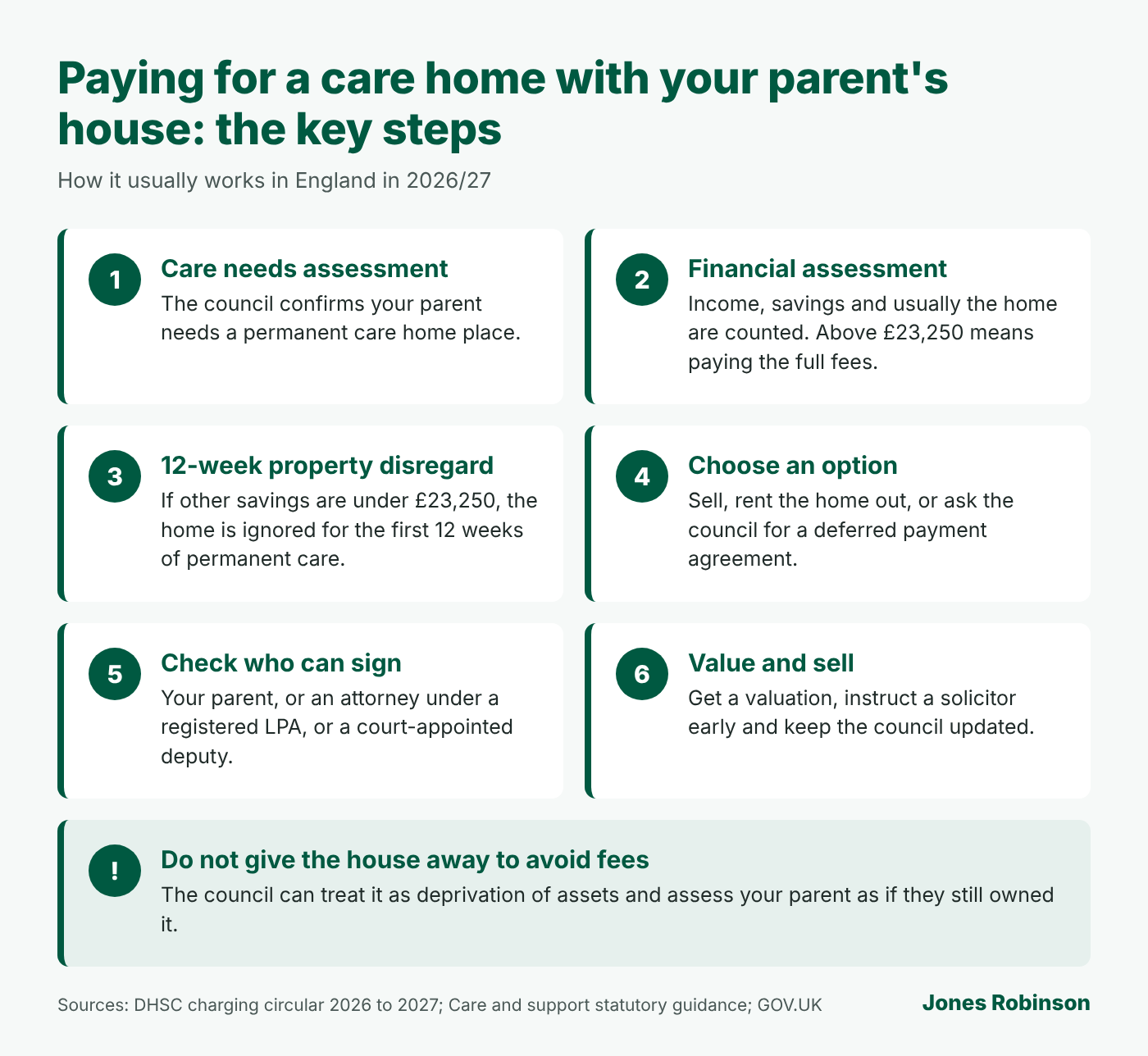
The rules are designed so that nobody is forced to sell their home at a time of crisis. If your parent's savings and other assets, not counting the house, are below £23,250, the council must ignore the value of their home for the first 12 weeks after they move into a care home permanently. The same applies if a relative whose presence was protecting the home dies or moves into a care home unexpectedly.
During those 12 weeks, the council helps with the fees based on your parent's income and other savings. The move into care is often sudden and emotional, so use this breathing space to talk things through with your parent, get the house valued and decide between selling, renting or a deferred payment agreement without feeling rushed.
Do I have to sell my parents house to pay for care?
In most cases, no. Your parent cannot normally be forced to sell their house in their lifetime to pay for care. However, if your parent's property is included in the means test and they have more than £23,250 in assets, they will have to pay for their full care costs and may not be able to afford them without selling their house or using one of the alternatives below.
There are some ways to avoid or delay selling your parents house to pay for care, such as:
- Renting out the property and using the rental income to cover care fees
- Applying for a deferred payment agreement with the local authority, which allows your parent to delay paying for their care until the house is sold or until after they die
- Taking out an equity release plan or a lifetime mortgage on the property, which allows your parent to borrow money against the value of their house and use it to pay for care
- Giving away or transferring the property to someone else, such as a child or relative
However, each of these options has its own advantages and disadvantages, and may not be suitable or available for everyone. For example:
- Renting out the property may incur tax liabilities and maintenance costs, and may affect your parent's eligibility for benefits. The rent also counts as income in the financial assessment. Your parent (or their attorney) becomes a landlord with full legal duties, which have changed considerably under the Renters' Rights Act, so many families use a property management service rather than letting the home themselves
- Applying for a deferred payment agreement may incur interest charges and administration fees, and may reduce your parent's inheritance
- Taking out an equity release plan or a lifetime mortgage may reduce your parent's equity in their house and affect their ability to move or switch providers. It needs regulated financial advice
- Giving away or transferring the property may count as deliberate deprivation of assets, meaning your parent would still have to pay the same level of care fees as if they still owned their house
How a deferred payment agreement works
Under a deferred payment agreement, the council pays the care home fees and secures the debt with a legal charge on your parent's home, rather like a mortgage. The money is repaid when the house is sold or from your parent's estate after they die. The council must offer one if your parent needs a care home place, has £23,250 or less in assets not counting their home, owns a home that is not disregarded, and can give the council a first legal charge on it.
Councils can charge interest, capped at a national maximum rate reset every six months, plus a set-up fee, so ask for both in writing before signing.
Why giving the house away rarely works
If the council decides that avoiding care fees was a significant reason for giving the house away, it can assess your parent as if they still owned it (see the FAQs below). Our guide to gifting property with a deed of gift explains the wider legal and tax points.
Check for NHS funding first
If your parent has complex, long-term health needs, ask whether they qualify for NHS continuing healthcare, which is arranged and funded entirely by the NHS, including in a care home. If it applies, the house is not needed to pay for care at all.
Therefore, it is important to seek professional advice before making any decisions about what to do with your parents house. You should also consult with your parent and respect their wishes as much as possible.
What happened to the cap on care costs?
You may have read about a planned £86,000 lifetime cap on personal care costs, along with a more generous means test. These reforms were postponed and then cancelled by the Chancellor on 29 July 2024, so there is no cap in place. Longer-term reform is being reviewed by an independent commission chaired by Baroness Casey, and is due to report in 2027, but for now the means test above still applies.
Can I sell my parent's house on their behalf?
Only if you have the legal authority to do so. The house belongs to your parent, so if they have mental capacity they make the decision and sign the paperwork themselves, with your help.
- Lasting power of attorney (LPA): a registered property and financial affairs LPA lets the attorney make decisions about money and property, including selling the home. It can be used as soon as it is registered, with your parent's permission. Registration costs £92 per LPA and takes around 8 to 10 weeks if there are no mistakes in the application.
- Deputyship: if your parent has lost mental capacity and there is no LPA, you will need to apply to the Court of Protection to become their property and financial affairs deputy. This takes longer, so allow for it in your plans.
If your parent still has capacity and has not made an LPA, it is worth doing so now, even if a sale is not yet planned. If the house is sold after your parent has died, the executors will deal with the sale instead, and our guide on selling a house before probate is granted explains how that works.
How can we help you sell your parents house?
If you decide that selling your parents house is the best or only option for paying for their care, we can help you through every step of the process. We specialise in supporting families selling houses to pay for care. We understand that this can be a difficult and emotional time for you and your family, and we will do our best to make it as smooth and stress-free as possible.
Here are some of the ways we can help you sell your parents house:
- We can provide you with a free valuation of your parents house based on current market conditions and comparable properties in the area
- We can advise you on how to prepare and present your parents house for sale, such as decluttering, cleaning, repairing and staging
- We can market your parents house to potential buyers through various channels, such as online platforms, social media, local newspapers and our network of contacts
- We can arrange and conduct viewings of your parents house with interested buyers, and handle any queries or negotiations on your behalf
- We can liaise with solicitors, surveyors, mortgage lenders and other parties involved in the sale, and keep you updated on the progress and status of the transaction
- We can support you until the completion of the sale and the transfer of ownership, and help you with any after-sales issues or questions
We have extensive experience and knowledge of the local property market and the legal and financial aspects of selling a house. We also have a friendly and professional team of agents who are dedicated to providing you with the best service and results.
Most families start by finding out what the property is worth, and a free valuation is the quickest way to get that in writing. It is also useful evidence for the council's financial assessment.
What are the benefits of selling your parents house with us?
Selling your parents house with us has many benefits, such as:
- Saving time and hassle: We will take care of the details and tasks involved in selling your parents house, so you don't have to worry about them. You can focus on your parent's care and well-being, and your own personal and professional life.
- Getting the best price: We will use our expertise and resources to market your parents house effectively and attract qualified buyers who are willing to pay a fair price. We will also negotiate on your behalf to secure the best possible deal for you.
- Reducing stress and uncertainty: We will guide you through the whole process of selling your parents house, from start to finish. We will answer any questions you may have along the way, and keep you informed of any developments or changes. We will also help you overcome any challenges or issues that may arise during the sale.
- Achieving peace of mind: We will work closely with your solicitor so that the paperwork and formalities are handled correctly, and that the sale is carried out in line with your parent's wishes and interests.
Sales made to fund care are often time sensitive, so instructing early matters: our conveyancing service can move alongside the offer. Because your parent is not buying another home, there is usually no onward chain on your side, which can help the sale move more quickly.
Frequently asked questions
Can the council force my parent to sell their house?
Not normally. If your parent qualifies for a deferred payment agreement, the council pays the fees and recovers the money later from the house, so it does not have to be sold in their lifetime. If they do not qualify because they have more than £23,250 in other savings, they will pay the fees from those savings first, and can ask for a deferred payment agreement once their other assets fall to £23,250 or below.
Can I carry on living in my parent's house while they are in care?
The house is only ignored automatically if you are aged 60 or over or incapacitated, and it has been your main home since before your parent went into care. Otherwise it is up to the council whether to ignore it (see the means test section above), so raise it before the financial assessment.
Who pays the care fees while the house is on the market?
During the 12-week disregard, the council helps with the fees if your parent's other savings are below £23,250. After that, the home counts towards their capital, so many families use a deferred payment agreement to cover the fees until the sale completes, when the deferred amount is repaid. Councils should aim to have the agreement in place by the end of the 12 weeks, so it is worth raising early.
What happens if my parent signed the house over to me years ago?
There is no set cut-off date. The council will look at whether your parent could reasonably have expected to need care at the time of the gift, and whether avoiding care fees was a significant reason for it. A transfer made when your parent was fit and healthy, with no expectation of needing care, is far less likely to be treated as deprivation of assets.
How to get in touch with us?
If you are interested in selling your parents house with us, or if you want to find out more about our services and how we can help you, please get in touch with us today. You can contact us by phone, email or through our website, or call into your local branch, such as our Newbury office or our Devizes office. We will be happy to hear from you and assist you in any way we can.
We hope that this blog post has given you some useful information and insights on selling your parents house to pay for care. We know that this is not an easy decision or situation to deal with, but we are here to support you and make it easier for you.