

Equity release lets homeowners, usually aged 55 and over, unlock some of the value tied up in their home as tax-free cash without having to sell up and move. For some people it is a sensible way to clear an existing mortgage, help family or fund later life. For others, downsizing or a different type of borrowing will work out better. This guide explains how it works, what it costs and what to weigh up before you speak to an adviser.
Please note: this article is general information, not financial advice. Jones Robinson is an estate agent, not a financial adviser. Equity release is usually a lifetime commitment and will reduce the value of your estate. You will need advice from a specialist equity release adviser before taking out a plan, and independent legal advice from your own solicitor.
In this blog
- What is equity release?
- How does a lifetime mortgage work?
- Lifetime mortgage vs home reversion
- How interest builds up over time
- Can you use equity release to pay off your mortgage?
- What protections are there?
- The pros and cons to weigh up
- Alternatives to equity release
- Equity release FAQs
What is equity release?
Equity release is a way of borrowing against your home, or selling all or part of it, while you carry on living there. There are two main types:
- Lifetime mortgage: a loan secured on your home. You keep ownership, and the loan plus interest is repaid when the last borrower dies or moves permanently into long-term care, usually from the sale of the property.
- Home reversion: you sell all or part of your home to a provider in return for a lump sum or regular payments, and keep the right to live there under a lifetime tenancy.
Lifetime mortgages dominate the market. According to the Equity Release Council's figures for Q2 2026 (April to June 2026), lifetime mortgages account for more than 99% of the market. Total lending in that quarter was £597 million across 13,489 customers, 5,307 of them releasing equity for the first time, and the average new lump sum was £113,779.
Our earlier introduction to lifetime mortgages includes a worked example of how voluntary repayments can reduce the final balance, based on the interest rates available at the time it was written.
How does a lifetime mortgage work?
A lifetime mortgage lets you borrow money against the value of your property while you keep ownership and the right to live in the home. Each lender sets its own minimum age, typically between 50 and 55, and the property must be your main residence.
You can take the money as a single lump sum or as a drawdown facility, where you take an initial amount and keep a reserve to draw on later as you need it. The outstanding loan and the interest that has built up are repaid when you die or move permanently into long-term care. If you are a couple, the loan runs until the last of you dies or moves into care.
Making repayments during your lifetime is optional on most plans. If you pay nothing, the interest is added to the loan each year. It may also be possible to switch your plan later to release more money or secure a lower rate, although early repayment charges can apply, so your adviser will need to check the terms.
If you are concerned about the impact on your inheritance, some lifetime mortgages let you protect a percentage of your home's value as an inheritance for your family, which reduces how much you can borrow.
Lifetime mortgage vs home reversion
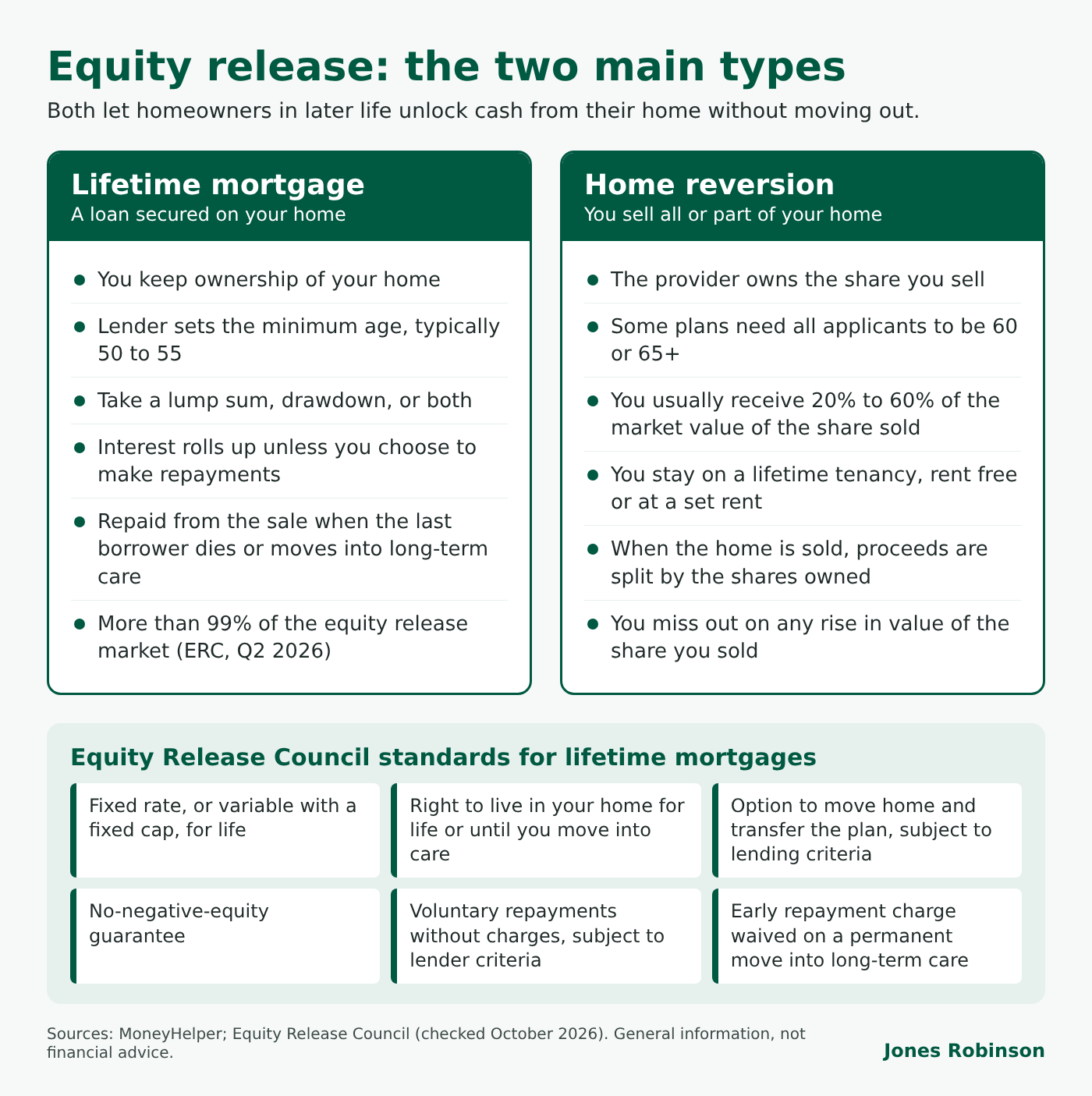
With home reversion, the amount you receive is well below the market value of the share you sell, usually between 20% and 60% according to MoneyHelper, because the provider has to wait until the home is empty to sell. Younger applicants are offered a lower percentage, and some plans require all applicants to be at least 60 or 65 and the home to be mortgage-free. You also miss out on any future rise in value of the share you have sold.
A lifetime mortgage keeps the home in your name, so you benefit from any growth in its value, but interest builds up on the loan (see MoneyHelper's lifetime mortgage guide).
How interest builds up over time
On a lifetime mortgage where you make no repayments, interest is charged on the loan and then on the interest already added. This compounding is the main reason the amount owed can grow faster than people expect. The table below is a simple illustration of a £50,000 loan at a hypothetical fixed rate of 6% a year, with interest added annually and no repayments made. It is not a quote: actual rates, fees and terms vary between lenders and over time.
| Years since release | Amount owed (no repayments) |
|---|---|
| At the start | £50,000 |
| 5 years | £66,911 |
| 10 years | £89,542 |
| 15 years | £119,828 |
| 20 years | £160,357 |
Source: Jones Robinson calculation for illustration only (£50,000 × 1.06 to the power of the number of years). At 6% a year compounded, the debt roughly doubles in 12 years.
This is why your age, how much you take and whether you make voluntary repayments all matter. Drawing smaller amounts, or paying some or all of the interest each month, slows the growth.
Can you use equity release to pay off your mortgage?
Yes. This can appeal, for example, to someone whose interest-only mortgage is reaching the end of its term without a repayment plan in place. In practice, an equity release offer will usually require any existing mortgage on the property to be cleared from the money you release. Whatever is left can be used for other purposes.
Before going down this route, it helps to be clear about a few points:
- The debt does not disappear, it changes shape. You swap monthly mortgage payments for a loan that grows with interest and is repaid from your estate, as MoneyHelper points out.
- How much you can release depends on your age, health and the value of your home. If your remaining mortgage is larger than the amount a lender will offer, equity release alone will not clear it.
- Advisers must look at alternatives. Under the FCA's rules for equity release advice (MCOB 8), the adviser has to consider other ways of raising the money, such as a further advance or replacement mortgage, and how the plan would affect your tax position and means-tested benefits.
- Selling may be the better answer. If you would be happy in a smaller home, downsizing can clear the mortgage without new debt.
What protections are there?
Equity release advice and products are regulated by the Financial Conduct Authority. On top of this, members of the Equity Release Council, the industry's trade body, must offer lifetime mortgages that meet its product standards:
- A fixed interest rate, or a variable rate with a cap fixed for the life of the loan.
- The right to live in your home for life, or until you move permanently into care, provided it remains your main residence and the terms and conditions are kept to.
- The option to move home and transfer the plan, subject to the lender's criteria at the time.
- A no-negative-equity guarantee: provided the home is sold for the best price reasonably obtainable and the terms are met, you or your estate will never owe more than the property is worth after reasonable selling costs.
- The ability to make repayments without charges (subject to lender criteria), and early repayment charges waived on a permanent move into long-term care.
The Council also requires every customer to receive independent legal advice before the plan goes ahead.
The pros and cons to weigh up
Potential benefits: tax-free cash without moving out, no compulsory monthly repayments on most lifetime mortgages, and the flexibility to take a lump sum or draw money down as needed, whether to clear a mortgage or other debts, help family or top up retirement income.
Points to consider carefully
- It reduces the value of your estate and what you can leave to family.
- Cash released can affect your entitlement to means-tested benefits such as Pension Credit, as well as local authority grants and Council Tax reductions.
- Set-up costs, including advice, valuation, legal and arrangement fees, can come to between £1,500 and £3,000, according to MoneyHelper.
- Early repayment charges can apply if you repay the plan early for reasons other than moving into care.
- You must keep the property in good condition, so budget for maintenance and buildings insurance.
It is worth involving your family early, especially if future care costs are a concern. Our guide to selling a parent's house to pay for care covers the practical questions families face.
Alternatives to equity release
Before committing, look at the other options. MoneyHelper and the FCA's advice rules point to alternatives such as:
- Downsizing: selling and buying a smaller or cheaper home frees up cash without new borrowing, and can cut running costs. Our tips for moving into a smaller home and releasing equity and our article on whether to downsize at retirement are good starting points.
- A retirement interest-only mortgage: if you can afford monthly payments, you pay the interest each month and the amount borrowed is usually only repaid when you sell your home, move into long-term care or die.
- A further advance or a new mortgage: borrowing more on your existing mortgage, or replacing it, may suit if you can afford the repayments.
- Grants: depending on what the money is for, a local authority or other grant may be available.
- Savings or investments, or free debt advice if the aim is to clear other borrowing.
If you are weighing up equity release against a move to a smaller home in Newbury, Marlborough, Devizes or the surrounding villages, an up-to-date valuation of your home will give you and your adviser a realistic figure to work from.
Equity release FAQs
What is the minimum age for equity release?
Equity release is generally for homeowners aged 55 and over. Lifetime mortgage providers set their own minimum, typically between 50 and 55, and on a joint plan both applicants must meet it. Some home reversion plans require all applicants to be at least 60 or 65.
Is money from equity release tax-free?
The cash you release is tax-free. However, your adviser must consider how the plan would affect your wider tax position and any means-tested benefits you receive or may claim.
Can I still leave an inheritance?
Yes, but it will usually be smaller. Some lifetime mortgages let you ring-fence a percentage of your home's value for your family, and making voluntary repayments can reduce the amount owed when the plan ends.
Do I need a solicitor?
Yes. The Equity Release Council requires every customer to receive independent legal advice before a plan goes ahead, and your solicitor will explain the terms and your obligations.
Next steps
To make an informed decision, speak to a qualified equity release adviser who can look at your circumstances, explain the options and their costs, and check whether equity release is suitable at all. The Equity Release Council has a directory of member advisers, and you can check that any firm is authorised on the FCA Financial Services Register.
If downsizing turns out to be the better route, Jones Robinson can help. We can give you an up-to-date valuation of your home to share with your adviser, and guide you through selling your home and finding somewhere smaller. Contact your local office, such as our Newbury branch or Didcot branch. If you need a mortgage for your next purchase, our mortgage advice and broker services page explains how Firstxtra Financial Services can help.