

In this blog
- What Is a Probate Valuation?
- Do You Need an Official Valuation for Probate?
- How Do Inheritance Tax Thresholds Affect a Probate Valuation?
- Estate Agent Market Appraisal vs RICS Red Book Valuation
- How Much Does a Probate Valuation Cost?
- Which Inheritance Tax Forms Do Executors Need?
- How Are Jointly Owned Homes Valued for Probate?
- What Happens If You Undervalue a House for Probate?
- What If the House Sells for More or Less Than the Probate Value?
- A Step-by-Step Guide for Executors
- How Jones Robinson Can Help
- Frequently Asked Questions
No, the law does not require a formal valuation for probate. HMRC needs the property's open market value at the date of death, and gov.uk says an estate agent or chartered surveyor can value it. Where Inheritance Tax is payable, or the estate is close to the threshold, a RICS Red Book valuation is the safer choice.
The figure you report matters more than many executors expect. It decides whether Inheritance Tax is due, and it usually becomes the starting point for Capital Gains Tax when the house is eventually sold. Below, we explain which valuation suits which estate and how to get the figure right.
Key Summary
- A probate valuation is the open market value of the property on the date the person died, not a future asking price.
- No law requires a RICS valuation. A written estate agent appraisal is often enough when the estate is clearly below the Inheritance Tax thresholds.
- Where tax is payable, a RICS Red Book valuation gives the strongest evidence if HMRC's Valuation Office questions the figure.
- The nil-rate band is £325,000 and the residence nil-rate band is up to £175,000, both frozen until April 2031 and unchanged by the Budget on 28 October 2026.
- A careless undervaluation can bring a penalty of up to 30% of the extra tax and a larger Capital Gains Tax bill later. Overvaluing means paying more Inheritance Tax than necessary.
- If the house sells for less than its probate value within four years of the death, the people liable for the tax may be able to claim relief on form IHT38.
What Is a Probate Valuation?
A probate valuation is the value of someone's home, and everything else they owned, on the day they died. HMRC's Inheritance Tax Manual sets the test under section 160 of the Inheritance Tax Act 1984: the price the property "might reasonably be expected to fetch if sold in the open market at that time". It assumes a sale on the date of death, with no deduction for selling costs.
Every estate needs this figure, even when no tax is due, because the probate application in England and Wales asks for the estate's gross and net values. In practice, executors have to value the estate before they apply. New to the process? Our guide to what a probate property is covers the basics.
Do You Need an Official Valuation for Probate?
Not always. Gov.uk says "you can get any property or land valued by an estate agent or chartered surveyor", and it does not insist on a formal report. What HMRC does expect is reasonable care. In our view, the right choice comes down to one question: is there likely to be Inheritance Tax to pay?
When an Estate Agent Appraisal Is Usually Enough
If the whole estate is comfortably below the available thresholds, or everything passes to a surviving spouse or civil partner, an appraisal from a local estate agent who knows recent sales is normally proportionate. Ask for a written figure at the date of death, with the comparable sales behind it. Keep it with the estate records.
When a RICS Red Book Valuation Is the Safer Choice
A formal valuation earns its fee when tax is payable, when the estate sits close to a threshold, or when the property is hard to compare. Farmhouses with paddocks, listed buildings, homes in poor condition and houses with land that might have development potential all fall into that last group. HMRC's own guidance expects executors to make sure the valuer considers any development potential, which is a live question for many rural homes in West Berkshire, Wiltshire and South Oxfordshire.
How Do Inheritance Tax Thresholds Affect a Probate Valuation?
The nil-rate band is £325,000, and tax above it is charged at 40%. The residence nil-rate band adds up to £175,000 when a home passes to children or grandchildren, tapering away by £1 for every £2 the estate is worth over £2 million. Both were frozen until April 2031 at Budget 2025. The rates published with the Budget on 28 October 2026 keep both bands, and the 40% rate, unchanged for 2026 to 2027 and 2027 to 2028.
Local prices show why this matters here. ONS figures put the average house price in August 2026 at £402,000 in West Berkshire, £328,000 in Wiltshire and £471,000 in South Oxfordshire (provisional). In all three districts an average home on its own is worth more than the nil-rate band. An accurate figure can therefore decide whether any tax is due at all.
Estate Agent Market Appraisal vs RICS Red Book Valuation
The Red Book is the common name for RICS Valuation, Global Standards, the rules that govern valuation work by members of the Royal Institution of Chartered Surveyors. The current edition has applied since 31 January 2025. RICS members who carry out most valuation work must join its Valuer Registration scheme and agree to be audited by RICS Regulation.
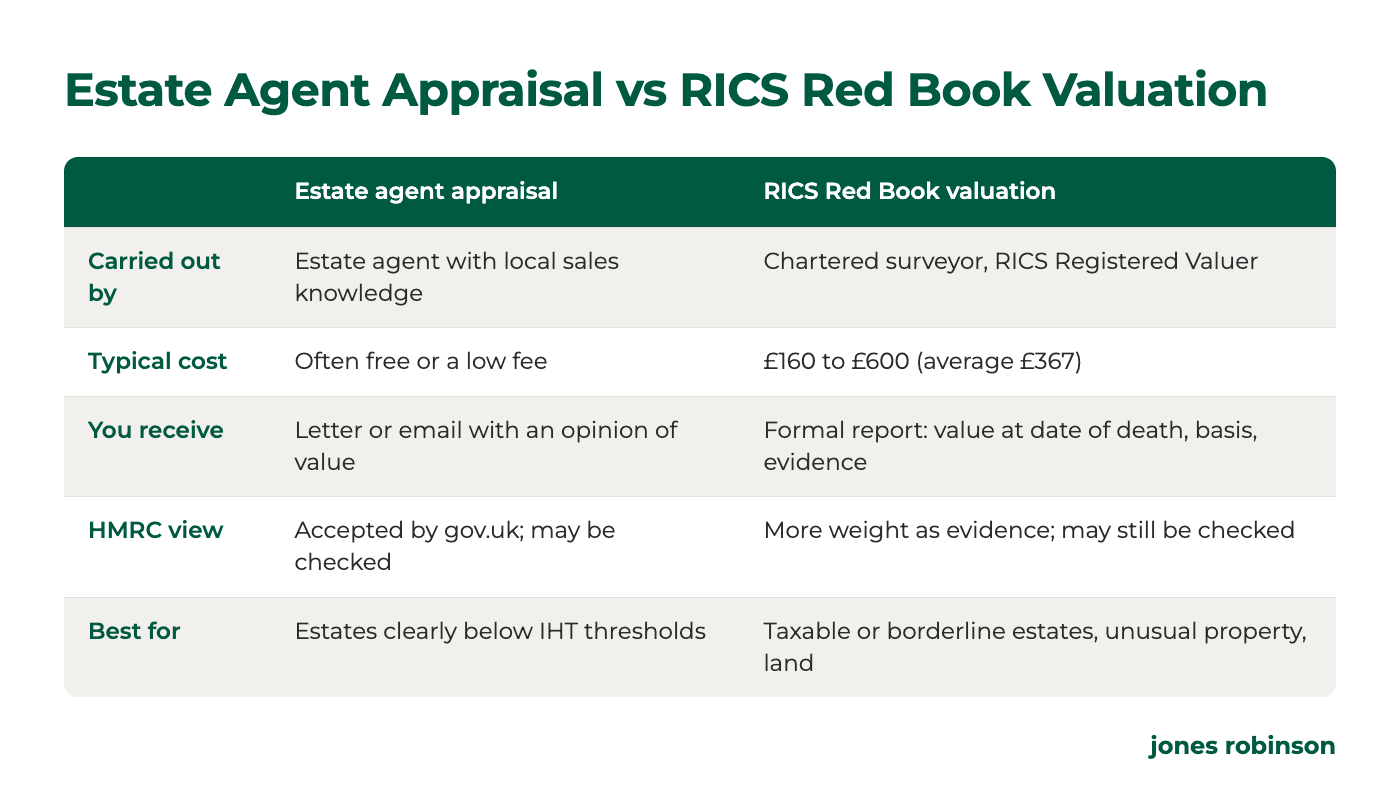
| Factor | Estate agent market appraisal | RICS Red Book valuation |
|---|---|---|
| Who carries it out | An estate agent with local sales knowledge | A chartered surveyor who is a RICS Registered Valuer |
| Typical cost | Often free or a low fee | Around £160 to £600 |
| What you receive | A letter or email with an opinion of value | A formal written report stating the open market value at the date of death, the basis and the evidence |
| HMRC acceptance | Accepted by gov.uk as a valuation source, but may be checked | Carries more weight as evidence, though the Valuation Office can still check it |
| Best for | Estates clearly below the thresholds | Taxable estates, estates near a threshold, unusual property and land |
One caution if you ask an agent: an appraisal for a sale usually gives a marketing price for the months ahead. Make clear that you need the value at the date of death. For what a thorough appraisal looks like, read what a good estate agent valuation should involve.
How Much Does a Probate Valuation Cost?
A RICS probate valuation typically costs around £367, according to user cost data published by Compare My Move in April 2026. Quotes range from about £160 to £600 depending on the size and value of the property. Estate agents often charge little or nothing for a market appraisal.
Weigh the fee against what is at stake. On a taxable estate, a valuation that is £20,000 too high means £8,000 of extra Inheritance Tax at 40%. A few hundred pounds for a figure you can defend is usually money well spent.
Which Inheritance Tax Forms Do Executors Need?
For deaths on or after 1 January 2022, the old IHT205 short form no longer applies. Most estates that owe no tax are now "excepted estates", and the executor enters the estate values in the probate application instead. An estate is usually excepted if it is below the £325,000 threshold, worth £650,000 or less with a spouse's unused threshold transferred, or worth less than £3 million and left entirely to a spouse or civil partner living in the UK, or to a qualifying charity. Large lifetime gifts, trusts or foreign assets can take an estate outside these rules, so check gov.uk's full list.
If tax is due, or full details are needed for another reason, you complete form IHT400 with schedule IHT405 for houses and land, enclosing a copy of any professional valuation. The IHT400 must be sent within 12 months of the death and before you apply for probate. Tax must be paid by the end of the sixth month after the death to avoid interest, and HMRC then sends a code you need for the probate application, usually within 20 working days. If the estate is short of cash for the bill, our guide on how to pay Inheritance Tax when you have no money sets out the options.
How Are Jointly Owned Homes Valued for Probate?
Only the share that belonged to the person who died goes into the estate. Where a married couple or civil partners owned the home as joint tenants, gov.uk's estimating guidance divides the value by two. Where joint tenants were friends or siblings, you divide the value by the number of owners and then take 10% off the deceased's share.
Tenants in common are treated differently, because their share does not pass automatically to the other owners. You value the share they actually held. The title register will show which applies, and our article on tenants in common vs joint tenants sets out the difference.
What Happens If You Undervalue a House for Probate?
HMRC checks. Its IHT400 notes say it will usually ask the Valuation Office for an opinion of the property's value. The Valuation Office Agency became part of HMRC on 1 April 2026 and now operates as the Valuation Office. If it cannot accept your figure, it will try to agree a value with you, and any extra tax carries interest.
Penalties depend on behaviour. HMRC will not charge a penalty if you took reasonable care, even if the figure later proves wrong. A careless inaccuracy can lead to a penalty of up to 30% of the extra tax, up to 70% if deliberate and up to 100% if deliberate and concealed. The clearest evidence of reasonable care is a written valuation from a qualified professional who was properly instructed.
Why a Low Figure Can Cost Beneficiaries Later
Where Inheritance Tax is payable and HMRC has agreed the value, section 274 of the Taxation of Chargeable Gains Act 1992 makes that figure the market value at death for Capital Gains Tax. It becomes the beneficiaries' base cost. Set it too low and a later sale shows a bigger gain, so a saving on one tax can come back as a bill on another. Where no Inheritance Tax is due, HMRC's Capital Gains Manual says the value is usually not "ascertained" in that way, so it can be looked at afresh if Capital Gains Tax arises on a sale. The same page warns that values in tax-free estates are sometimes inflated for a Capital Gains Tax advantage, so a generous figure is no safer.
What If the House Sells for More or Less Than the Probate Value?
Schedule IHT405 asks whether a property has been sold, or will be sold, within 12 months of the death, and whether you want to use the sale price as the value at death. A genuine open market sale soon after the death is strong evidence of value. HMRC's guidance also asks executors to reflect any marketing information that casts doubt on an earlier figure. You can put a property on the market before the grant, as our guide to selling a house before probate is granted explains, although if the person who died owned it alone, the sale cannot complete until the grant arrives.
If the house sells for less than the probate value within four years of the death, the people liable for the tax may be able to claim loss on sale relief using form IHT38. A loss smaller than £1,000 or 5% of the value at death (whichever is lower) does not qualify, and a sale to a beneficiary or their relative may be excluded. If the house sells for more, the gain above the probate value may be liable to Capital Gains Tax.
A Step-by-Step Guide for Executors
- Record the date of death: every valuation is pinned to it.
- Check how the home was owned: the title register shows whether it was in sole or joint names, and on what basis.
- Estimate the whole estate: add savings, investments, possessions and gifts made in the last seven years, then check whether the estate is excepted.
- Choose the valuation: an agent appraisal for a clearly non-taxable estate, or a RICS Red Book valuation if tax is payable or the property is unusual.
- Instruct the valuer properly: ask for the open market value at the date of death, and share anything relevant, such as its condition or planning history.
- Report the figure: on the probate application for an excepted estate, or on IHT400 and IHT405 with a copy of the valuation.
- Keep records and update HMRC: if better evidence emerges, such as a sale price, tell HMRC the correct figure.
Every estate is different, so take advice from a probate solicitor or tax adviser on your own circumstances.
How Jones Robinson Can Help
Jones Robinson was established in 1998 and has six offices across West Berkshire, Central Wiltshire and South Oxfordshire. Our valuers provide market appraisals based on local sales evidence, from Didcot and Newbury to the villages around Pewsey and Lambourn. The team also includes Jonathan Shortt, a Chartered Surveyor and RICS Registered Valuer (MRICS). Not sure which valuation the estate needs? Ask us, and we will talk it through before you commit to anything.
When the time comes to sell, our probate property sales service helps executors through the sale itself, with a Dedicated Sales Progressor on every sale. You are also welcome to call into your nearest Jones Robinson branch.
Frequently Asked Questions
Can I Use an Online Estimate for a Probate Valuation?
Online estimates from property portals are a useful sense check, but nobody has inspected the property. For anything beyond a clearly non-taxable estate, get a written valuation from someone who has seen the house.
How Many Valuations Do I Need for Probate?
There is no rule. One well-evidenced written valuation at the date of death is better than an average of several loose opinions.
How Do I Value House Contents for Probate?
Gov.uk suggests working out what items would sell for, for example by checking online marketplaces. Household goods can be estimated, but a professional valuation is worth considering for anything worth over £1,500, such as jewellery or art.
Can I Value the House Myself?
You can, and for a small excepted estate a careful estimate based on recent comparable sales may be reasonable. The figure remains your responsibility as executor, so keep a note of your evidence.
What If I Am Buying a Probate Property?
Buyers face different questions, mostly about timing. Our guide to buying a house in probate covers what to expect.
If you are an executor and would like a clear, evidence-based figure for a property in our area, Book a Valuation with Jones Robinson and we will explain your options.