

In this blog
- What Must Every Letting Agent Have by Law?
- Which Professional Memberships and Qualifications Matter?
- What Has the Renters' Rights Act Changed for Letting Agents?
- How Well Does the Agent Know Local Rents?
- How Will the Agent Find and Look After Your Tenants?
- Fees, Contracts and the Small Print
- How Do You Check a Letting Agent's Reputation?
- Questions to Ask a Letting Agent, and What a Good Answer Sounds Like
- How Jones Robinson Can Help
- Frequently Asked Questions
To choose a letting agent in West Berkshire or Wiltshire, first check the legal basics: redress scheme membership, Client Money Protection and a published fee list that includes VAT. Then compare the people and the service: MARLA-qualified staff, local rent evidence, careful tenant referencing, a named property manager and a firm grasp of the Renters' Rights Act.
The choice matters more now than it did two years ago. Since 1 May 2026, section 21 has gone and most private tenancies in England roll on with no fixed end date, so an agent's paperwork and judgement feed straight into your income and your risk. A search for the best letting agents in Newbury, Marlborough or Devizes will give you a long list. This guide, with a table of questions to take to each appointment, will help you shorten it.
Key Summary
- By law, every letting agent in England must belong to a government-approved redress scheme and, if it holds your money, a Client Money Protection (CMP) scheme.
- Agents must publish a full fee list, including VAT, that names their redress and CMP schemes.
- Letting agents in England still need no legal qualification, so ARLA Propertymark membership and MARLA-qualified staff are among the clearest signs of competence.
- Under the Renters' Rights Act 2025, agents must advertise one fixed rent, cannot accept offers above it and can usually take no more than one month's rent before the tenancy starts.
- The new Register Your Rental Property service opens for West Berkshire and South Oxfordshire landlords on 15 March 2027 and for Wiltshire on 15 August 2027.
- Average private rents in September 2026 were £1,355 a month in West Berkshire, £1,091 in Wiltshire and £1,418 in South Oxfordshire (ONS).
What Must Every Letting Agent Have by Law?
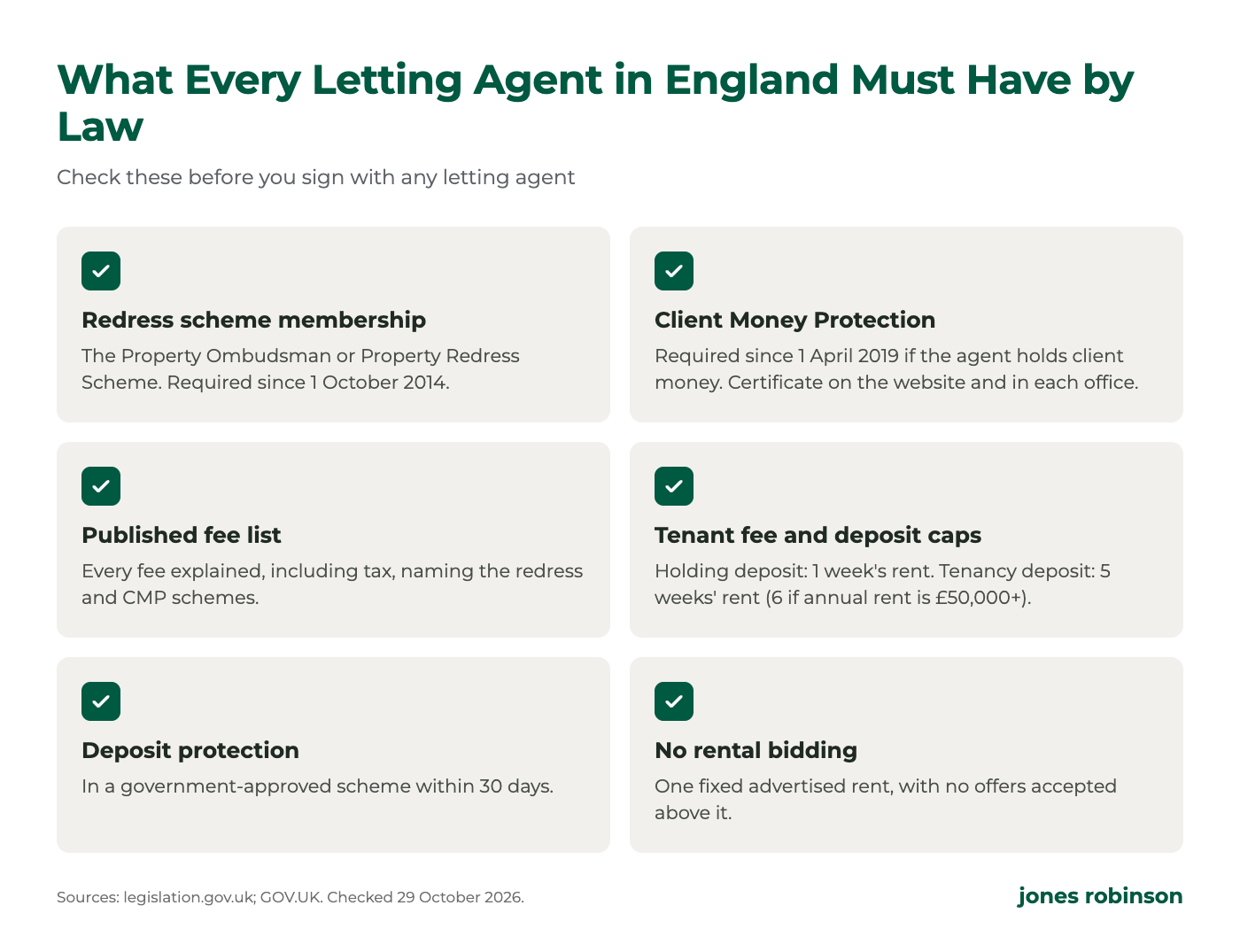
These requirements apply to every letting agent and property manager in England. You can check them all in about ten minutes, and an agent that falls short on any one of them should come off your list.
Redress Scheme Membership
Since 1 October 2014, anyone carrying out lettings or property management work in England must belong to a government-approved redress scheme under the Redress Schemes for Lettings Agency Work and Property Management Work Order 2014. The two schemes are The Property Ombudsman and the Property Redress Scheme. If the agent cannot resolve your complaint, the scheme can make an independent decision. Councils can fine an agent up to £5,000 for not belonging.
Client Money Protection
Any agent that holds client money, such as rent or deposits, has had to belong to an approved CMP scheme since 1 April 2019 under the Client Money Protection Schemes for Property Agents Regulations 2019. The agent must display its CMP certificate in each office and publish a copy on its website. Not belonging can cost the agent a fine of up to £30,000. As Propertymark explains, CMP means you can claim back money lost if a member agent goes into liquidation.
A Published Fee List
Section 83 of the Consumer Rights Act 2015 requires agents to display their fees in each office and publish them on their website. Each fee must be described clearly enough for you to understand what it covers, and the amount must include tax. The list must also name the agent's redress and CMP schemes.
Tenant Fees, Deposits and Right to Rent
The Tenant Fees Act 2019 bans most charges to tenants. According to GOV.UK, a holding deposit is capped at one week's rent and a tenancy deposit at five weeks' rent (six weeks where annual rent is £50,000 or more), and no more than one month's rent can usually be taken in advance before the tenancy starts. The deposit must be protected in one of the three government-approved schemes within 30 days. Every adult tenant also needs a Right to Rent check before moving in.
| Legal Must-Have | Legislation | How to Check |
|---|---|---|
| Redress scheme membership | Redress Schemes Order 2014 | Named on the fee list; confirm on the scheme's register |
| Client Money Protection | CMP Regulations 2019 | Certificate on the website and in the office |
| Published fees, including VAT | Consumer Rights Act 2015, s83 | Every charge explained on the website |
| No banned tenant fees | Tenant Fees Act 2019 | Tenant fee schedule lists only permitted payments |
| Deposit protection within 30 days | Housing Act 2004 | Ask which scheme the agent uses |
| No rental bidding | Renters' Rights Act 2025 | Adverts show one fixed rent, never a range or "offers over" |
Which Professional Memberships and Qualifications Matter?
Anyone can still set up as a letting agent in England without a qualification. That is set to change. At the Labour Party Conference in September 2026, the government announced that property agents will need a licence to practise and appropriate qualifications, overseen by an independent regulator, as reported by Propertymark. No start date or qualification level has been set yet.
Until then, voluntary standards are your best guide. ARLA Propertymark member firms follow a code of practice and undertake CPD, and Propertymark inspects its member agencies. For individuals, look at the letters after the name: under Propertymark's membership grades, MARLA requires a Level 3 lettings qualification and at least a year's experience. Ask what the person who will actually manage your property holds, not just the firm.
What Has the Renters' Rights Act Changed for Letting Agents?
From 1 May 2026, existing assured shorthold tenancies became assured periodic tenancies and new fixed terms can no longer be created, as the government's landlord guidance confirms. Section 21 has gone. To regain possession you now need a valid ground under section 8 and the correct notice for that ground, which can be as long as four months. Dated inspection reports and correctly served notices are the evidence a court will look at, so an agent's record-keeping is part of your protection.
The day-to-day rules have tightened too. Adverts must show one specific rent, and agents cannot ask for or accept offers above it. A first breach of the rental bidding rules can bring a fine of up to £7,000. Rent can rise once a year, but not in the first year, through the form 4A section 13 process with at least two months' notice, and tenants can ask the First-tier Tribunal to decide whether the new rent matches the open market. A tenant's request to keep a pet needs a written response within 28 days.
Our update on the Renters' Rights Act five months on covers how these rules are working in practice. Because the detail turns on each tenancy, take advice from a solicitor on your own circumstances.
What Is Coming Next
The government's Register Your Rental Property service opens region by region from 15 December 2026, at £65 per property per year. West Berkshire and South Oxfordshire fall in the South East, where registration runs from 15 March to 14 June 2027. Wiltshire is in the South West, the final region, with a window of 15 August to 14 November 2027. The landlord must start the registration, though an agent can upload certain information for you if you agree, so ask each agent how it plans to help.
A new private rented sector Landlord Ombudsman will follow. The government's implementation roadmap pointed to landlords joining in 2028, but no launch date has been confirmed.
How Well Does the Agent Know Local Rents?
Rents in our area have risen faster than the England average over the past year. The latest Office for National Statistics data, published on 21 October 2026, puts the England average at £1,466 a month, up 4.0%. All three of our districts grew by more than 5%.
| Area | Average Monthly Rent (Sept 2026) | Annual Change | Three-Bedroom Average |
|---|---|---|---|
| West Berkshire | £1,355 | +6.2% | £1,532 |
| Wiltshire | £1,091 | +5.8% | £1,231 |
| South Oxfordshire | £1,418 | +5.2% | £1,634 |
Sources: ONS local housing data for West Berkshire, Wiltshire and South Oxfordshire; England figure from ONS Private Rent and House Prices, October 2026.
District averages hide a wide spread. A flat near Newbury station and a four-bedroom house outside Marlborough sit in different markets, so a good agent backs its rent figure with recent comparable lets rather than an average. That evidence carries more weight now that tenants can challenge an increase at tribunal. Our guide to average rents across West Berkshire by town breaks the figures down further.
How Will the Agent Find and Look After Your Tenants?
The legal minimums are the same for every agent. The real differences show up in the service, usually a year or two into a tenancy.
Tenant Referencing
Expect credit checks, income and affordability checks, employment confirmation and a previous landlord reference, plus Right to Rent checks and a guarantor where needed. The same process should apply to every applicant. Refusing renters because they have children or receive benefits is now unlawful, so decisions must rest on affordability and history.
A Named Property Manager
Ask who will look after your property day to day and how many properties they manage. A named manager who knows the building and the tenant will spot problems earlier than a shared inbox. Ask, too, who covers when that person is on leave.
Inspections, Reporting and Communication
Find out how often the property is visited and whether reports include dated photographs. Good records protect you at the end of a tenancy and in any possession claim. Check when rent reaches your account and whether an online portal holds your statements and documents, which matters most to landlords living overseas and those with larger portfolios.
Maintenance and Contractors
Ask whether contractors are vetted and insured, and whether there is an out-of-hours service for emergencies. Rural properties on oil heating or private drainage need trades who know those systems.
Compliance Tracking
Gas safety records, electrical inspection reports, the EPC and smoke and carbon monoxide alarms all carry legal requirements, and the certificates have renewal dates. A managing agent should track every date and send you the paperwork without being chased.
Fees, Contracts and the Small Print
Fees depend on the level of service. Most agents offer a tenant-find service, rent collection and full management, and our guide on rent collection or full management explains which suits which landlord. A headline percentage means little until you know what it includes.
Before you sign, read the terms of business for these points:
- VAT: whether quoted fees include it (the published list must).
- Extras: charges for inventories, check-outs, court attendance or arranging works.
- Notice to end the agreement: how long it is, and whether any fee continues if the tenant the agent introduced stays on after you leave.
- Spending authority: the limit on repairs the agent can approve without asking you.
- Client money: confirmation that rent and deposits are held in a separate client account.
Ask whether the agent offers rent and legal protection, and what it covers. With section 21 gone, it pays to understand whether you have cover for legal costs if a possession claim is contested.
How Do You Check a Letting Agent's Reputation?
Start with independent review platforms such as Trustpilot and Google. Read the recent reviews rather than relying on the score, and look for comments from landlords, not just from sellers. How an agent replies to criticism tells you a lot about how it handles problems.
Then check the claims. Confirm membership on the redress scheme's register and find the CMP certificate on the website. It is also fair to ask to speak to a current landlord client, and a well-run agent should be happy to arrange it.
Questions to Ask a Letting Agent, and What a Good Answer Sounds Like
Take this table to each appointment. Our article on the top questions landlords should ask a new lettings agent goes into several of them in more depth.
| Question | What a Good Answer Sounds Like |
|---|---|
| Which redress and CMP schemes do you belong to? | Names both straight away and points you to the certificate on the website. |
| How did you arrive at this rent? | Shows recent comparable lets nearby and explains the adjustments. |
| Who will manage my property, and what qualifications do they hold? | Names the person, their MARLA or other qualification and their caseload. |
| How do you reference tenants? | Credit, affordability, employment, previous landlord and Right to Rent, applied the same way to every applicant. |
| How do you handle rent increases now? | Annual review with market evidence, served on form 4A with at least two months' notice. |
| What happens if a tenant falls into arrears? | A clear escalation process, dated records and knowledge of the section 8 grounds. |
| How will you help with the new property register? | Explains the South East or South West dates and what information it can upload for you. |
| What does your full fee list include, with VAT? | A written schedule with every charge explained and nothing left to discover later. |
How Jones Robinson Can Help
We are an ARLA Propertymark licensed member, client money is protected through Propertymark CMP and we are registered with The Property Ombudsman. Our specialist management team looks after over 1,000 properties across the Newbury, Marlborough, Devizes, Didcot and Lambourn areas, and Anna Hill, our Director of Property Management, is MARLA qualified.
Landlords can choose rent collection or full management, and our landlord services cover everything from a first let to an established portfolio. We are rated 4.9 out of 5 on Trustpilot from 584 reviews, and we will gladly answer every question in the table above.
Frequently Asked Questions
How Can I Check a Letting Agent Has Client Money Protection?
Look for the CMP certificate on the agent's website or in its offices, where it must be displayed. If you cannot find it, ask for a copy, which the agent must provide free of charge.
What Does MARLA Mean?
MARLA is the Member grade of ARLA Propertymark. Holders have a Level 3 lettings qualification and at least one year's experience in the industry.
How Much Do Letting Agents Charge?
It depends on the service you choose, from tenant-find only to full management. Every agent must publish its fees including VAT, so compare those lists side by side and check what each fee actually covers.
Can My Letting Agent Register My Property on the New Database for Me?
Not entirely. The landlord must start the registration, but with your agreement an agent can then upload certain information on your behalf. You remain responsible for the information provided.
Can I Change Letting Agent If I Already Have a Tenant?
Yes. Check your current agent's notice period and any clause about fees continuing for an existing tenant, and make sure the deposit stays protected throughout the handover.
Is It Better to Let Your Property Through an Agent?
For most first-time landlords, yes, given how much the rules changed in 2026. Our advice for first-time landlords explains the steps either way.
If you would like to talk through how we would look after your property, find out more about our Property Management service or speak to your nearest Jones Robinson office.