

Updated October 2026: this article was first published in February 2026, before the Renters' Rights Act came into force. We have updated it to reflect the rules that have applied to private lets in England since 1 May 2026, and added the latest local rent figures.
In this blog
- What are tenants looking for in 2026?
- What condition do tenants expect a rental property to be in?
- What features do tenants want in a rental property in 2026?
- How do tenants decide if a rental property offers good value?
- What do tenants expect from landlords and letting agents?
- How do rental regulations affect what tenants expect in 2026?
- How can I attract good tenants to my rental property?
- Frequently asked questions
- How can I prepare my rental property for tenants in 2026?
As February arrives, many landlords begin to take stock of the year ahead. Decisions around when to let, how to present a property and what tenants are expecting all come into sharper focus as the spring market approaches.
Tenant priorities in 2026 are shaped less by short-term trends and more by practicality, value and confidence. Across West Berkshire, South Oxfordshire and Wiltshire, tenants are still active, but they are more selective. Homes that feel well managed, straightforward and fairly priced tend to attract stronger interest and longer-term commitments.
For landlords in Newbury, Lambourn, Didcot, Devizes, Marlborough and Pewsey, understanding what tenants are looking for this year is an important part of protecting income, reducing voids and securing stable tenancies.
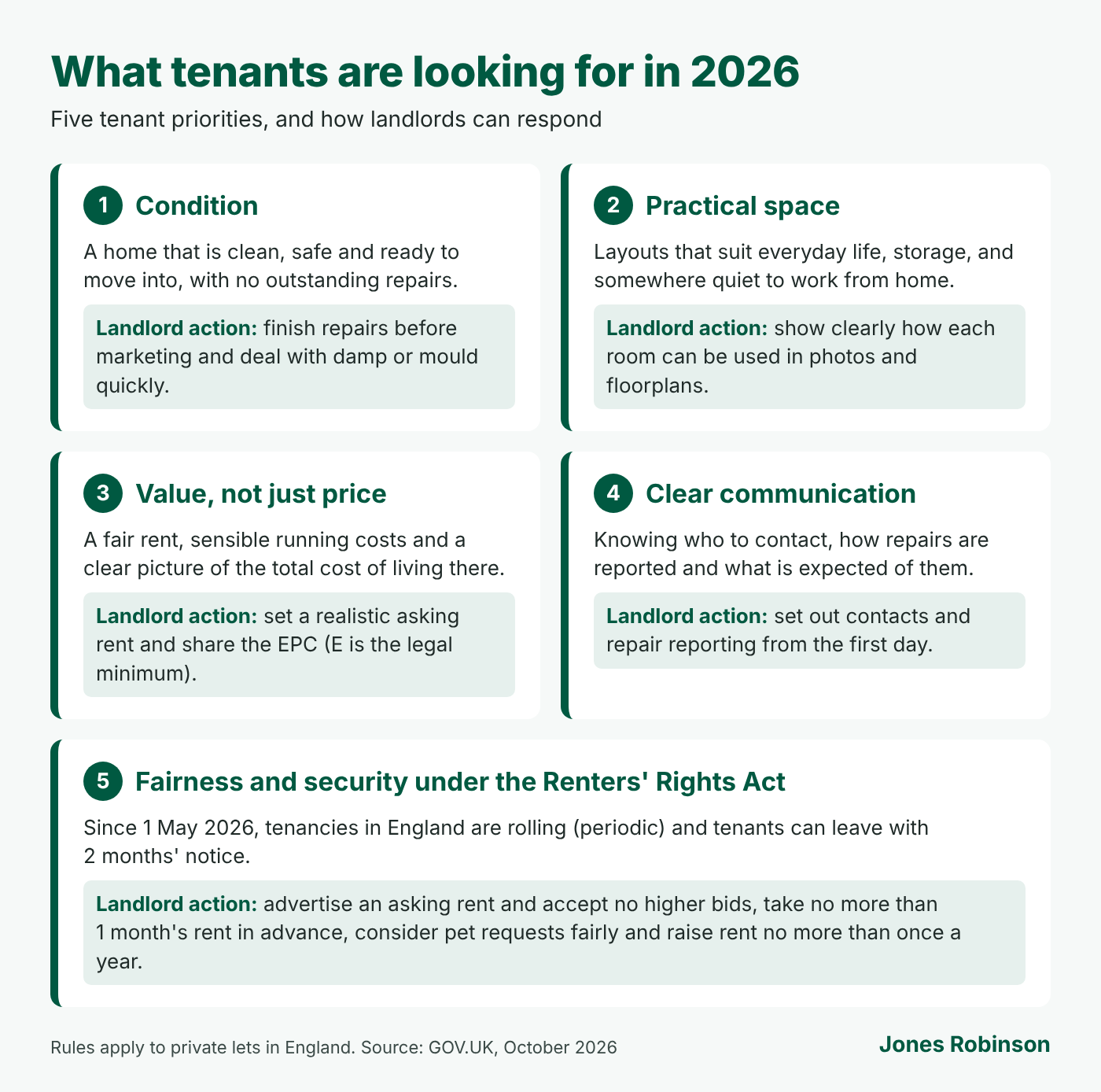
In short, tenants in 2026 are looking for:
- Good condition: a clean, safe, well-maintained home that is ready to move into.
- Practical space: layouts and storage that suit everyday life, and room to work from home.
- Value, not just price: a fair rent, sensible running costs and no surprises.
- Clear communication: knowing who to contact and how repairs will be handled.
- Fairness and security: a landlord who follows the Renters' Rights Act rules that have applied since 1 May 2026.
Quality And Condition Matter More Than Ever
Tenants in 2026 expect homes to be clean, safe and well maintained. This does not mean properties need to be newly refurbished, but it does mean that condition plays a clear role in decision-making.
Tenants respond more positively to homes that feel cared for and ready to live in. Issues such as tired décor, unresolved maintenance or unclear responsibility can quickly create hesitation. Professional and family tenants, in particular, want reassurance that a property will be easy to settle into from day one.
In towns such as Newbury, Didcot and Devizes, where tenant choice can be broader, presentation helps a property stand out. In villages around Lambourn and Pewsey, where supply is often limited, condition still matters because it influences how long a tenant is willing to commit.
For landlords, focusing on maintenance and presentation is about protecting long-term value rather than chasing cosmetic perfection.
Safety is the baseline rather than a selling point. A rental home needs an annual gas safety check, an electrical safety report (EICR) at least every five years, working smoke alarms and, where required, carbon monoxide alarms, all in place before a tenant moves in. Our guide to landlord requirements in the UK covers each of these in detail. Damp and mould are also under closer scrutiny: the government is consulting until 18 December 2026 on how Awaab's Law will apply to private rentals, which will introduce legal deadlines for fixing serious hazards such as severe damp and mould. No start date has been set, but tenants already expect damp and leaks to be dealt with promptly.
Practicality and Everyday Living
Modern tenants are thinking carefully about how a home will support daily life. Layout, storage and usability all feature prominently in viewings and enquiries.
Working from home remains common, particularly among professional tenants in Didcot and Newbury. As a result, properties that offer flexible space, quiet rooms or clear separation between living and working areas are often more appealing.
Family tenants tend to focus on flow and functionality. Space that works well for everyday routines, rather than simply looking good on paper, can influence how quickly a decision is made. In Marlborough and Devizes, where longer-term family lets are common, this practicality often outweighs short-term trends.
In rural areas around Lambourn and Pewsey, tenants are often looking for homes that feel comfortable and manageable, with sensible layouts that suit village life and longer stays.
Pets are now part of this conversation too. Since 1 May 2026, a tenant can ask to keep a pet, and a landlord must consider the request and can only refuse with a valid reason. Under the government's implementation roadmap, landlords have an initial 28 days to consider a request. Homes with practical flooring, a secure garden or easy access to green space can appeal to households who want to bring a pet with them.
Value, Not Just Price
Affordability remains an important consideration, but tenants in 2026 are increasingly assessing value rather than focusing solely on headline rent.
Running costs, energy efficiency and transparency all play a role. Tenants want to understand what living in a property will cost overall and are more confident committing when expectations are clear from the outset.
Energy efficiency feeds directly into those running costs. A privately rented home in England must have an EPC rating of at least E before it can be let, unless a valid exemption is registered, and landlords can be fined up to £5,000 per property for breaching the rules (GOV.UK). The government has consulted on raising the standard to EPC C by 2030, but this is not yet law. A better rating also gives tenants a lower-bills message, which is why a good EPC rating is a selling point as well as a legal requirement.
Homes that feel fairly priced, well maintained and professionally managed are often perceived as better value, even if they are not the cheapest option. This is particularly relevant for professional tenants in areas such as Didcot and Newbury, and for families seeking stability in Marlborough and Devizes.
Rents across our area have continued to rise, which makes value matter even more to tenants. The latest Office for National Statistics figures show:
| Area | Average monthly rent (September 2026) | Change on a year earlier |
|---|---|---|
| West Berkshire (Newbury, Thatcham, Hungerford, Lambourn) | £1,355 | Up 6.2% |
| South Oxfordshire (including Didcot) | £1,418 | Up 5.2% |
| Wiltshire (Marlborough, Devizes, Pewsey) | £1,091 | Up 5.8% |
| South East | £1,438 | Up 3.5% |
Source: ONS Price Index of Private Rents, local area data for West Berkshire, South Oxfordshire and Wiltshire, updated 21 October 2026. Averages cover all property types and sizes.
Averages vary a lot by town, property type and size, so treat them as a guide. See our breakdown of average rents across West Berkshire by town.
Pricing accurately also matters more than it used to. Since 1 May 2026, every advert must state an asking rent, and landlords and agents cannot encourage bidding or accept offers above the advertised figure. A rent set too high will simply sit unlet, so it pays to base the asking rent on local evidence from the start.
For landlords, value is created through clarity and consistency as much as through rent levels.
Security, Clarity and Communication
Alongside the physical aspects of a property, tenants place growing importance on how a home is managed. Clear communication, organised processes and predictable arrangements help tenants feel secure.
Tenants want to know who to contact, how issues will be handled and what is expected of them. Confidence in these areas often supports longer tenancies and more cooperative relationships.
This shift towards professionalism reflects wider changes in the sector. As standards rise, tenants are gravitating towards homes that feel well run and straightforward.
Good management now has a direct effect on how long a tenancy lasts. Private assured tenancies in England are now rolling (periodic) rather than fixed term, and a tenant can end one by giving two months' notice. A tenant who feels well looked after has every reason to stay; one who is frustrated by slow repairs can leave more easily than before. With void periods, re-letting costs and wear between tenancies to cover, the cost of tenant turnover makes keeping good tenants one of the most effective ways to protect rental income.
Rising Standards and Regulation
The Renters' Rights Act sits alongside these changing expectations. When this article was first published, the main changes were still a few months away. They came into force on 1 May 2026, and many of the principles they reinforce were already familiar to tenants.
For private lets in England, tenants can now expect:
- No fixed end date: assured tenancies are now periodic (rolling), Section 21 'no-fault' evictions have been abolished, and landlords need a valid legal ground to regain possession.
- Two months' notice to leave: tenants can end a tenancy by giving two months' notice in writing.
- A clear asking rent: adverts must show a specific rent, and rental bidding is banned.
- Limits on upfront payments: no rent can be taken before the tenancy agreement is signed, and then no more than one month's rent in advance.
- Predictable rent increases: rent can rise only once a year (and not in the first 12 months of a new tenancy), using the Section 13 process (Form 4A with at least two months' notice), and tenants can challenge an increase above the market rent.
- Fair treatment: landlords cannot turn away tenants because they have children or receive benefits.
- The right to ask for a pet: requests must be considered and can only be refused for a valid reason.
More is on the way. The government's new landlord registration service launches on 15 December 2026, starting in the West Midlands, and every landlord actively letting property will need to be registered by 14 November 2027 (GOV.UK, 9 September 2026). A new landlord ombudsman is also planned, with mandatory membership expected in 2028. For a landlord's view of how the changes are working in practice, read the Renters' Rights Act five months on.
Fairness, clarity and good communication are no longer seen as optional extras. For landlords, this makes preparation and professional oversight increasingly valuable.
Approaching lettings with structure and support helps reduce uncertainty and ensures compliance is managed calmly rather than reactively.
How Jones Robinson Supports Landlords
At Jones Robinson, the lettings team works with landlords across Newbury, Lambourn, Didcot, Devizes, Marlborough and Pewsey to translate tenant expectations into practical advice.
Understanding what tenants are looking for allows landlords to prepare properties in a way that attracts the right renters and supports long-term income. Jones Robinson provides guidance on presentation, pricing and timing, alongside professional marketing and tenant selection. With periodic tenancies now the norm, careful selection matters more than ever, and our guide to spotting a good tenant before they move in sets out what to look for.
For landlords who want greater reassurance, Jones Robinson's full management service offers ongoing support, clear communication and compliance-led oversight. This approach helps protect both the property and the landlord's position while meeting modern tenant expectations.
The aim is to create tenancies that work well for everyone involved, supported by local knowledge and professional care.
Frequently Asked Questions
Can a landlord accept an offer above the advertised rent?
No. Since 1 May 2026, landlords and agents in England must state an asking rent in adverts and cannot encourage bids or accept offers above it.
How much rent can a landlord take in advance?
Nothing before the tenancy agreement is signed. After signing, a landlord can ask for a maximum of one month's rent in advance. A tenancy deposit is separate and is capped at five weeks' rent where the annual rent is below £50,000.
Can tenants ask to keep a pet?
Yes. A tenant can ask to keep a pet, and the landlord must consider the request and can only refuse it for a valid reason. Landlords have an initial 28 days to respond.
Do tenants care about a property's EPC rating?
Yes, because a better rating usually means lower energy bills. Legally, a rented home in England must be rated E or above unless an exemption applies, and a higher rating can help a property stand out.
Looking Ahead
Tenant expectations in 2026 are clear, measured and achievable. They reflect a desire for quality homes, fair value and confident management rather than unrealistic demands.
Landlords who understand these priorities are better placed to attract stable tenants, reduce void periods and build long-term value.
Speaking to the Jones Robinson lettings team provides an opportunity to discuss tenant demand locally, understand how expectations are evolving and plan the year ahead with clarity and confidence. You can also contact your nearest branch directly, from our Didcot office in South Oxfordshire to Newbury, Lambourn, Marlborough, Devizes and Pewsey.