

Updated October 2026: revised for the Renters' Rights Act 2025, which changed how rent is advertised and increased in England from 1 May 2026, and for the latest ONS rent figures for West Berkshire (September 2026).
In this blog
- How do I set the right rent for my property this spring?
- Is spring a good time to let my property?
- What is the average rent in West Berkshire now?
- How has the Renters' Rights Act changed setting rent?
- What happens if I price my rental property too high?
- How do tenants decide if a rental property is good value?
- How do I work out the correct rent for my property?
- Should I get a professional rental valuation before letting?
- How can I avoid void periods when letting this spring?
- Frequently asked questions
Spring is one of the busiest times of year for lettings. As March arrives, more tenants begin their search and more landlords bring properties to market ahead of summer.
This creates opportunity, but it also brings more competition.
When more properties are available at the same time, tenants compare their options more carefully. They can quickly see what else is available in the same area and price range. This means an overpriced property stands out straight away, often for the wrong reasons.
Setting the right rent from the start is one of the most important decisions a landlord can make. It affects how quickly the property lets, the type of tenant it attracts, and how much income is achieved over time. Since 1 May 2026 it matters even more: the rent you advertise is the most you can accept, and once the tenancy starts you can only raise it once a year through a formal notice.
For landlords across Newbury, Lambourn, Didcot, Devizes, Marlborough and Pewsey, a well-judged price this spring can help avoid long void periods and secure a reliable tenant sooner.
Spring Supply and Demand
The early spring market often brings renewed momentum. Professional tenants relocating for new roles, families planning moves before the next school year and renters reassessing their housing needs after winter all contribute to increased activity.
At the same time, spring can also see more rental properties coming to market. Landlords who delayed marketing over winter often choose this period to list. This combination of active tenants and increased supply means competition can be sharper than expected.
Tenants today are informed and selective. Online comparison is quick and straightforward. When several similar properties are available within the same area or price bracket, accurate pricing becomes a deciding factor.
What Rents Are Doing in West Berkshire
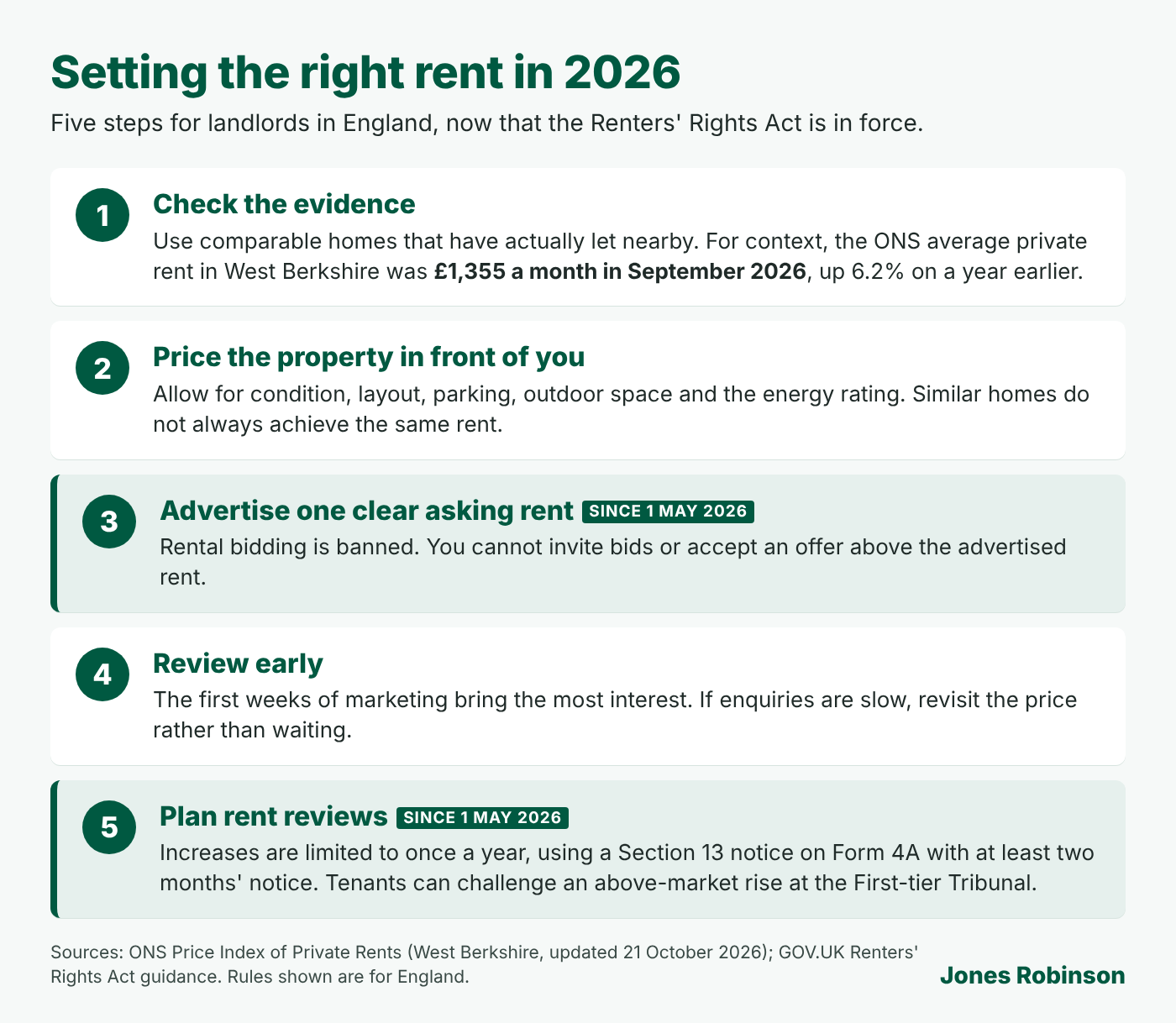
According to the Office for National Statistics (ONS), the average private rent in West Berkshire was £1,355 a month in September 2026, up 6.2% from £1,277 a year earlier. That is faster growth than the South East as a whole, where rents rose 3.5% over the same period.
| Area | Average monthly rent, September 2026 | A year earlier |
|---|---|---|
| West Berkshire | £1,355 | £1,277 (up 6.2%) |
| South East | £1,438 | £1,390 (up 3.5%) |
| United Kingdom | £1,406 | £1,354 |
Source: ONS, Housing prices in West Berkshire (Price Index of Private Rents, updated 21 October 2026).
Two points are worth keeping in mind before you use these figures to price a home. First, the ONS index covers all private tenancies, including existing and renewed ones, not just new lets, so it is a guide to the overall market rather than an asking price. Second, the average blends one-bedroom flats with large detached houses. For a breakdown by bedrooms, property type and town, see our guide to average rents across West Berkshire by town.
How the Renters' Rights Act Changes Setting Rent
The Renters' Rights Act came into force in England on 1 May 2026. Several of its changes bear directly on how you price a rental, and together they reward getting the figure right at the start.
| Rule since 1 May 2026 | What it means for your asking rent |
|---|---|
| No rental bidding | Every advert must show an asking rent. You cannot invite or encourage bids, and you cannot accept an offer above the advertised rent. Pricing low to 'start a bidding war' no longer works. |
| One rent increase a year | Increases go through the Section 13 process: Form 4A, at least two months' notice, no more than once a year. Rent review clauses in tenancy agreements no longer work. |
| Increases can be challenged | A tenant who thinks a new rent is above market level can apply to the First-tier Tribunal before it takes effect. The tribunal cannot set a rent higher than you proposed, and the new rent normally applies from the date of its decision. |
| Limits on rent in advance | No rent can be taken before the tenancy agreement is signed, and then no more than one month's rent in advance. Large upfront payments can no longer offset a weak application. |
Sources: GOV.UK, Renters' Rights Act: an overview for landlords; GOV.UK, Guide to the Renters' Rights Act.
The practical effect is simple. If you start too low, you cannot correct it with a bid or a quick mid-tenancy rise, and any increase you propose has to stand up as a market rent if it is challenged. If you start too high, there is no longer a fallback of an applicant offering more rent upfront; the property simply sits. An evidence-based asking rent is the safest position in both directions. For a wider look at how the new rules are working in practice, read the Renters' Rights Act five months on.
The Risk of Overpricing in a Busy Market
It can be tempting to assume that strong spring demand allows for higher rents. However, the early weeks of marketing are usually when a property receives the greatest level of attention. If a rental is priced above its realistic market level, initial enquiries may be limited.
A property that lingers on the market can begin to lose momentum. Tenants may question why it has not been secured quickly, even if the reason is simply pricing. Extended void periods can ultimately cost more than a modest adjustment at the outset. As a rough illustration, a home at West Berkshire's average rent of £1,355 loses £1,355 of income for every month it stands empty, roughly the same as cutting the rent by £50 a month for more than two years.
Overpricing also affects the tenant profile. Unrealistic rent levels may attract fewer suitable applicants or lead to negotiation pressures later in the process. In contrast, a well-judged rent encourages stronger interest and allows landlords to select from a broader pool of applicants.
In competitive areas such as Newbury and Didcot, where tenants often have multiple options, accurate pricing is particularly important. In villages around Lambourn and Pewsey, where supply may be limited, tenants still compare value carefully before committing.
Understanding Value from a Tenant Perspective
Tenants in 2026 are not solely focused on headline rent. They are assessing value in a wider sense. Condition, presentation, energy efficiency and the quality of management all influence decision-making.
Professional tenants often prioritise convenience, layout and clarity around running costs. Family tenants may look more closely at space, storage and long-term suitability. Across Marlborough, Devizes and surrounding villages, longer-term stability is often as important as monthly rent.
Energy performance and overall running costs also contribute to perceived value. Clear information about heating systems, insulation and typical bills helps tenants feel confident. Transparency around terms and responsibilities supports trust from the outset. For more on what renters now look for, see what tenants expect from a rental in 2026.
This shift towards value rather than price alone sits alongside wider changes in the sector. The Renters' Rights Act reinforces expectations around fairness, communication and professional standards. As regulation evolves, tenants are increasingly drawn to properties that feel well managed and straightforward, which is where professional property management can make a difference.
Evidence-Based Pricing Strategy
Setting the right rent requires more than reviewing online listings. An effective strategy considers comparable properties, current enquiry levels, local demand patterns and the specific features of the home.
Not all similar homes achieve the same rent. Small differences like condition, layout, parking or outdoor space can have a real impact. Character features often matter more in Marlborough and Devizes, while in Didcot and Newbury, proximity to transport and jobs is key. In Lambourn and Pewsey, presentation and setting usually carry the most weight.
Getting the price right is about where your property sits in the market. It needs to match what tenants expect, while still delivering a reliable return. When the rent is set correctly from the start, interest tends to build steadily, giving you more choice of tenant and helping you reach an agreement more quickly.
A simple way to structure the exercise:
- Find true comparables: homes with the same number of bedrooms, a similar type and condition, in the same town or village, that have actually let recently rather than those still advertised.
- Adjust for what is different: parking, a garden, an extra bathroom, the energy rating and whether the home is furnished all move the figure.
- Sense-check against the wider market: the ONS average tells you whether rents locally are rising or flattening, even if it cannot price an individual home.
- Keep your evidence: the same comparables help justify a future Section 13 increase if a tenant ever challenges it.
How Jones Robinson Sets the Right Rent
At Jones Robinson, rental valuations are grounded in detailed local knowledge and current market evidence. With established offices in Newbury, Lambourn, Didcot, Devizes, Marlborough and Pewsey, the lettings team monitors enquiry levels, tenant behaviour and comparable lettings across each area.
Rather than relying on optimism or headline figures, we assess each property individually. Condition, location, presentation and target tenant profile are all considered before recommending a rent.
Professional marketing presents your property clearly from day one, using high-quality photography and reaching a strong pool of registered tenants. For landlords who choose full management, ongoing support and compliance guidance help keep the tenancy on track under the Renters' Rights Act, including annual rent reviews served correctly through the Section 13 process.
The aim is not simply to achieve the highest possible rent. It is to secure the right tenant, within the right timeframe, at a sustainable level that supports long-term income.
Looking Ahead
Spring can offer genuine opportunity in the lettings market, but it rewards accuracy rather than assumption. When supply and demand both increase, realistic pricing becomes a key differentiator.
Landlords who approach the season with a structured, evidence-based strategy are better placed to reduce voids, attract reliable tenants and maintain steady returns. The same principles apply whenever you let: with bidding banned and increases limited to once a year, the asking rent you choose at the start carries more weight than it used to.
Frequently Asked Questions
Can I accept an offer above the advertised rent?
No. Since 1 May 2026, landlords and agents in England must advertise an asking rent and cannot ask for, encourage or accept offers above it. If demand turns out stronger than expected, the advertised rent is still the most you can take for that let.
How often can I put the rent up?
Once a year. You serve a Section 13 notice on Form 4A giving at least two months' notice of the new rent. Rent review clauses in tenancy agreements can no longer be used to raise rent.
Can a tenant challenge a rent increase?
Yes. A tenant who believes the proposed rent is above the market rate can apply to the First-tier Tribunal before the new rent starts. The tribunal cannot set a rent higher than the one you proposed, which is why a well-evidenced figure matters.
What is the average rent in West Berkshire?
The ONS put the average private rent in West Berkshire at £1,355 a month in September 2026, up 6.2% on a year earlier. Rents for individual homes vary widely by size, type and location, so a property-specific valuation is the best guide.
How much rent can I take in advance?
Nothing before the tenancy agreement is signed, and then no more than one month's rent before the tenancy starts.
Speak to Our Lettings Team
Speak to the Jones Robinson lettings team to understand current rental demand in your area and make sure your property is positioned correctly. You can book a valuation, find out more about our services for landlords, or contact your local office in Newbury, Didcot, Marlborough, Devizes, Pewsey or Lambourn.