

Struggling to find a guarantor can be a major hurdle, especially for first time renters or those with limited credit history. This guide explains your options clearly and shows how Jones Robinson can help you move forward with confidence.
What is a rent guarantor? A rent guarantor is someone, often a parent, relative or close friend, who signs a legal agreement promising to pay your rent if you don’t, and often to cover the cost of damage too. Landlords and letting agents ask for one when they want extra security that the rent will be paid.
In this blog
- Why do landlords ask for a guarantor?
- What does a rent guarantor agree to?
- Who can be a guarantor, and how much do they need to earn?
- Why might you not have a guarantor?
- What can you do if you can’t get a guarantor?
- How has the Renters’ Rights Act changed things?
- How does Jones Robinson help renters without a guarantor?
- What should you avoid?
- FAQs
Why landlords ask for a guarantor
When you’re applying to rent a property, you might be asked to provide a rent guarantor. Landlords request guarantors as a form of financial security. Essentially, a guarantor promises to cover your rent if you can’t pay. This reduces the landlord’s risk and helps protect their investment.
Typically, landlords ask for a guarantor when applicants have limited credit history, low income, or are students or new to renting. A guarantor is usually a family member or close friend with a steady income and good credit, who agrees to back your rental agreement.
In most cases it comes down to referencing. If your income doesn’t meet the landlord’s affordability check, or you have little or no UK credit or rental history, a guarantor fills that gap. Understanding why a guarantor is needed helps you see the landlord’s point of view and prepare your application accordingly.
What does a rent guarantor agree to?
A guarantor signs a guarantor agreement (often called a deed of guarantee) alongside your tenancy agreement. It must be in writing and signed by the guarantor, and it sets out exactly what they could be asked to pay. In practice, that usually means:
- Unpaid rent: if you fall behind, the landlord can ask your guarantor to pay. The landlord should contact you first, and can go to court for a county court judgment (CCJ) against you, your guarantor or both.
- Damage: a guarantor may also have to pay for damage you cause, if the agreement covers it.
- Shared homes: in a joint tenancy, each tenant is usually liable for the whole rent, so a guarantor could be asked to cover a housemate’s unpaid share unless the agreement limits them to yours. It’s worth asking whether each guarantor can be capped at their own tenant’s share.
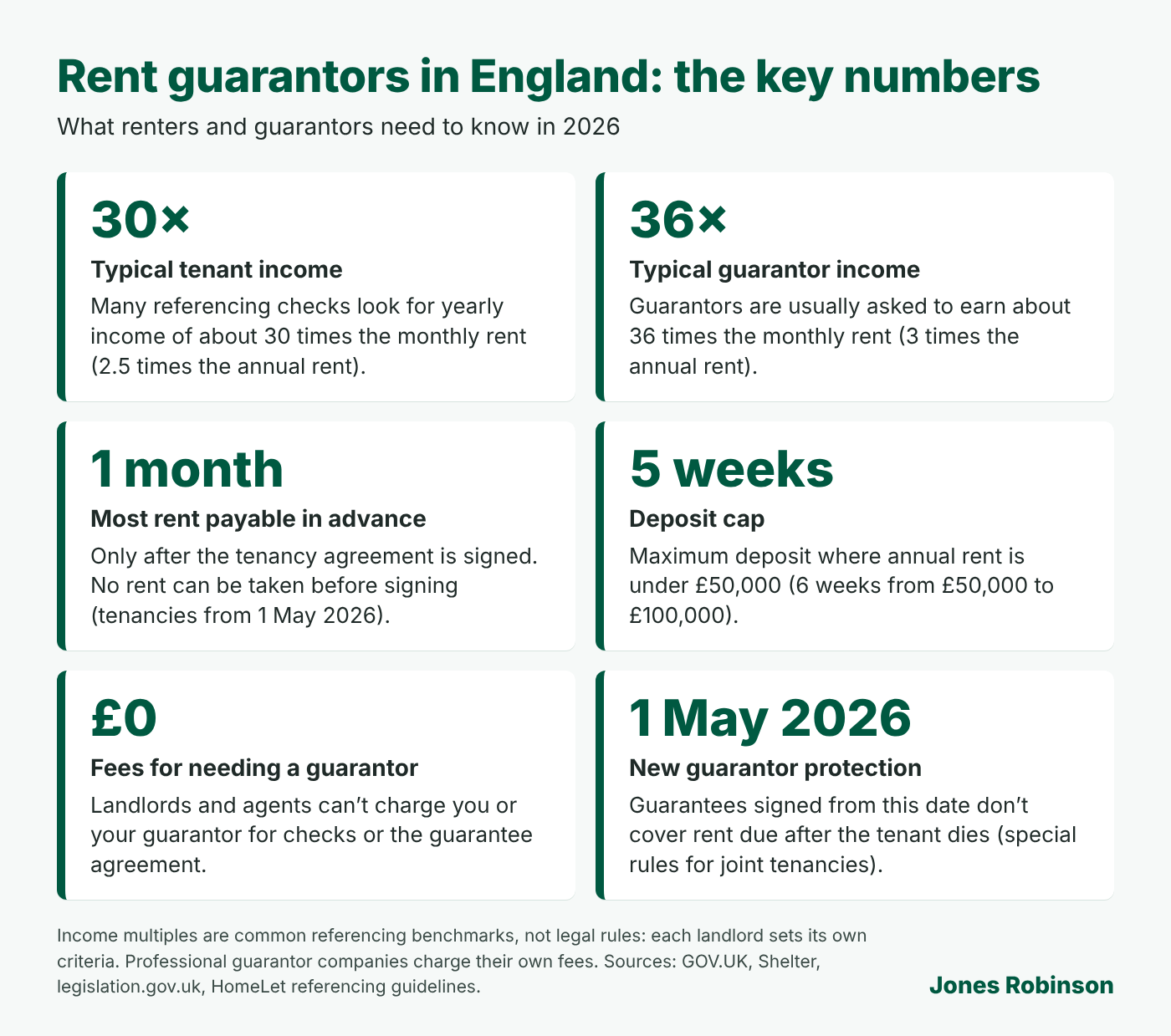
Since 1 May 2026, most private tenancies in England are rolling (periodic) tenancies with no fixed end date, so check how long the guarantee lasts. If your guarantor signed before 1 May 2026, the agreement may only have covered the original fixed term, and Shelter advises checking whether it still applies. For guarantees signed from 1 May 2026 on a private assured tenancy, a guarantor is no longer liable for rent due after the tenant dies (section 19 of the Renters’ Rights Act 2025). In a joint tenancy, this applies where the tenant who dies is a family member of the guarantor, or when all the joint tenants have died.
Your guarantor should see a copy of both the tenancy agreement and the guarantor agreement before signing. Your landlord or letting agent can’t charge you or your guarantor extra fees for needing a guarantor, including for checks or the agreement itself.
Who can be a guarantor, and how much do they need to earn?
There’s no legal list of who can be a guarantor: each landlord or letting agent sets its own criteria. A guarantor will normally need to:
- pass their own credit and income checks
- earn comfortably more than the rent (see the table below)
- be based in the UK, as many landlords and referencing companies won’t accept an overseas guarantor
- in some cases, own their home
Affordability is the main hurdle. Many referencing companies look for a tenant to earn around 2.5 times the annual rent (30 times the monthly rent), and a guarantor to earn around 3 times the annual rent (36 times the monthly rent). If you’re sharing, your own affordability is usually assessed on your share of the rent. These are common benchmarks rather than legal rules. Landlords should apply the same income requirement to every applicant and treat all forms of income, including benefits and pensions, equally.
| Monthly rent | Typical tenant income needed (30 times monthly rent) | Typical guarantor income needed (36 times monthly rent) |
|---|---|---|
| £1,000 | £30,000 a year | £36,000 a year |
| £1,216 (average two-bedroom rent in West Berkshire, August 2026) | £36,480 a year | £43,776 a year |
| £1,500 | £45,000 a year | £54,000 a year |
Source: ONS Price Index of Private Rents, West Berkshire (August 2026). Income multiples based on HomeLet’s referencing guidelines; individual landlords and agents may use different criteria.
For a closer look at what homes let for locally, see our guide to average rents across West Berkshire by town.
Common reasons you might not have a guarantor
Many renters face challenges finding a guarantor, and it’s more common than you might think. You might be new to the UK without family nearby, or perhaps your close contacts don’t meet the financial requirements. Self-employed individuals or those with a less traditional income can also struggle to provide a suitable guarantor.
Because a guarantor is often expected to earn around three times the annual rent, even willing parents may not qualify, particularly if they’re retired, on a modest income or renting themselves.
Poor credit history or a lack of previous rental references can be another barrier. These situations don’t mean you won’t be able to rent; they just mean you need to explore alternatives. Knowing these common reasons helps you approach the process with confidence and clarity.
What to do if you can’t get a guarantor
If you can’t provide a guarantor, don’t worry, there are several alternatives to help you secure a property:
- Use a professional rent guarantor service: a company acts as your guarantor in return for a fee (more on this below).
- Show proof of stable income or savings: detailed payslips or bank statements can strengthen your application. Some referencing companies accept savings as evidence of affordability, although the amount needed is usually substantial compared with the total rent.
- Ask your employer to act as guarantor: some employers provide this, especially for employees relocating or on probation. The referencing company will usually check the business as well.
- Ask your council or university for help: councils and charities run schemes that can help with a deposit or first month’s rent, mainly for people on a low income who are homeless or at risk of homelessness. West Berkshire Council and Wiltshire Council (through its WiltsLet deposit scheme) both offer this, subject to eligibility. Students can ask their university about hardship funds or landlords who don’t require a guarantor.
- Paying several months’ rent upfront is no longer the answer: before 1 May 2026, offering rent in advance was a common way round needing a guarantor. For new tenancies in England, landlords and agents can now ask for no more than one month’s rent in advance (see the Renters’ Rights Act section below).
Among these, professional rent guarantor services have become a trusted solution for many renters. These companies act as a financial backup, guaranteeing your rent to the landlord for a fee. This option is especially helpful if you lack a suitable guarantor but want to secure a property quickly and confidently. Fees and cover vary between providers: some charge an annual fee, others a one-off payment, so compare what’s included before you sign. A landlord or agent can suggest a provider, but can’t insist you use a particular one. You can explore trusted providers like Rent Guarantor, which we recommend to our clients.
| Option | Who it suits best | Key requirement | Pros | Considerations |
|---|---|---|---|---|
| Rent guarantor service | Students, international renters, anyone without a UK guarantor | Pass the provider’s checks and pay its fee | Accepted by many landlords | Requires approval from landlord; fees vary by provider |
| Savings as proof of affordability | Those with savings but irregular or low income | Recent bank statements showing substantial savings | Can remove the need for a guarantor | Not every landlord or referencing company accepts it |
| Employer guarantor | Professionals | Employer agreement | Builds trust | Rarely offered |
| Council or charity scheme | People on a low income who are homeless or at risk of homelessness | Meet the scheme’s eligibility rules | Help with a deposit and first month’s rent | Limited eligibility; money may have to be repaid |
| Pay rent upfront | No longer an option for new tenancies in England | Maximum one month’s rent in advance, after signing | You can still pay your first month before moving in | Landlords can’t ask for or encourage more than one month upfront |
| Higher deposit | Not permitted above the legal cap | Maximum 5 weeks’ rent where annual rent is under £50,000 | None as a substitute for a guarantor | Landlords can’t ask for more than the cap to offset risk |
Source: GOV.UK, fees you can charge as part of a tenancy; Shelter.
These alternatives can open doors even without a traditional guarantor.
How the Renters’ Rights Act changed renting without a guarantor
The Renters’ Rights Act came into force in England on 1 May 2026. Several of its changes directly affect renters who don’t have a guarantor:
- Limits on rent in advance: a landlord or agent can’t ask for, encourage or accept rent before you’ve signed the tenancy agreement. Once it’s signed, they can ask for a maximum of one month’s rent (or 28 days’ rent where rent is due more often than monthly) before the tenancy starts. You can still choose to pay early during a tenancy, but a landlord can’t require it.
- Guarantors are still allowed: landlords can still ask for a suitable guarantor as a condition of the tenancy. What they can’t do is require one only from applicants who receive benefits.
- No blanket bans on benefits or children: landlords and agents can’t refuse to rent to you because you receive benefits or have children. They can still check that the rent is affordable, but government guidance says they should set the same income requirement for everyone and count all types of income, including benefits and pensions.
With large upfront rent payments off the table for new tenancies, professional guarantor services are now one of the main alternatives for many international students, overseas professionals and others without a UK guarantor. You can read the government’s Renters’ Rights Act overview for tenants, and for the wider picture, our guide to what the Renters’ Rights Act changed and how it affects how landlords choose tenants.
How Jones Robinson supports renters without a guarantor
At Jones Robinson, we understand that not everyone can provide a guarantor. That’s why we work closely with landlords who are open to flexible options, such as accepting a professional guarantor service in place of a family member or friend. Our lettings team has extensive experience helping renters in varied situations, including students, professionals, and those new to the UK.
We also work with professional guarantor services, including Goodlord and Rent Guarantor. This option provides an alternative route for tenants who cannot secure a traditional guarantor, making the renting process more accessible and less stressful. If upfront costs are also a worry, we offer a no deposit option through Flatfair, where you pay a one-off check-in fee instead of a deposit. You can find both on our tenant alternative options page.
One practical tip: line up your guarantor, or your professional guarantor, before you apply. Under our tenant terms and charges, a holding deposit may not be refunded if a guarantor withdraws or doesn’t sign the deed of guarantee within the deadline, which is usually 15 calendar days.
We guide you through every step, advising on the best alternatives and helping you find a suitable property with confidence. You can browse our homes to let across Newbury, Hungerford, Lambourn, Marlborough, Pewsey, Devizes, Didcot and the villages in between.
What not to do if you can’t get a guarantor
When you don’t have a rent guarantor, it’s important to avoid common mistakes that could hurt your chances:
- Don’t submit incomplete or misleading applications. It damages trust, and giving false or misleading information can cost you your holding deposit.
- Avoid panicking and rushing into unsuitable or overpriced properties.
- Stay away from guarantor services you can’t verify or offers that look too good to be true, as they may be scams. Check the company is registered at Companies House, and read its terms and independent reviews.
- Don’t pay rent before you’ve signed a tenancy agreement. Since 1 May 2026, a landlord or agent shouldn’t ask for or accept it.
- Always keep open communication with your letting agent to explore all options honestly.
Being cautious and transparent helps you maintain credibility and find the best rental solution.

FAQs
Can I rent without a guarantor in the UK?
Yes, it’s possible to rent without a guarantor, but it depends on the landlord’s requirements. If you pass referencing on your own income, you may not need one at all. If not, some landlords accept alternatives such as a professional rent guarantor service, evidence of savings or an employer guarantee. In England, paying several months’ rent upfront is no longer an option for new tenancies: since 1 May 2026, rent in advance has been capped at one month.
What income do I need to avoid needing a guarantor?
Many referencing companies look for an annual income of around 30 times the monthly rent (2.5 times the annual rent). For a £1,000 a month home, that’s about £30,000 a year. Meeting this threshold can reduce the need for a guarantor, but requirements vary by landlord and property.
How do rent guarantor companies work?
Rent guarantor companies act as a third party who guarantees your rent payments to the landlord. You pay a fee to the company, which then covers your rent if you’re unable to pay, giving landlords financial security. You remain responsible for the rent, so it’s a safety net for the landlord rather than insurance for you.
Will offering a larger deposit help me avoid needing a guarantor?
Not in England. Under the Tenant Fees Act 2019, a tenancy deposit is capped at five weeks’ rent where the annual rent is under £50,000, and six weeks’ rent where it is £50,000 to £100,000. A landlord can’t ask for more than this to make up for not having a guarantor.
Can my employer act as my rent guarantor?
In rare cases, employers may agree to act as a guarantor, especially for employees relocating or on probation. However, this is not common and depends on the employer’s policies.
Are rent guarantor services safe and reliable?
Reputable rent guarantor services, like the ones Jones Robinson works with, are widely used and accepted by many landlords and letting agents. Before you pay, check the company is registered at Companies House, read the terms carefully, including how long the cover lasts and what it costs to renew, and look at independent reviews.
What are my rights if I’m denied a property due to no guarantor?
While landlords can set their own criteria, they must not discriminate based on protected characteristics like race or disability. Since 1 May 2026, they also can’t refuse you because you receive benefits or have children, or ask only benefit claimants for a guarantor. Local councils can issue civil penalties of up to £7,000 for this kind of discrimination. If you believe you’ve been unfairly treated, you can seek advice from organisations like Citizens Advice.
Can my guarantor live abroad?
Sometimes, but many landlords and referencing companies require a UK-based guarantor. If your guarantor lives overseas, a professional guarantor service is often the more practical option.
How long is a guarantor responsible for?
It depends on the guarantor agreement. Some cover the tenancy for as long as it runs, others for a set period. Read the agreement carefully before signing, especially now that tenancies in England are rolling with no fixed end date. If a guarantor later wants to be released, they should check what the agreement says and speak to the landlord or letting agent.
Conclusion
Navigating the rental market without a rent guarantor can feel challenging, but it’s far from impossible. By understanding your options, whether that’s using a professional rent guarantor service, showing savings or asking your employer, you can increase your chances of securing the right home. Jones Robinson is here to support you every step of the way, with practical advice and access to trusted alternatives. Speak to your nearest Jones Robinson branch to explore your options.
Devizes: 01380 730200
Didcot: 01235 816222
Lambourn & Hungerford: 01488 73337
Marlborough: 01672 556640
Newbury: 01635 35010
Pewsey: 01672 556640