

In this blog
- What type of home layout do buyers prefer in 2026?
- Do buyers care about energy efficiency and running costs in 2026?
- How important is location to buyers when selling a house in 2026?
- Do I need to renovate my house before selling in 2026?
- What puts buyers off when buying a house in 2026?
- What does the latest market data say about buyers?
- How can I prepare my house to sell in 2026?
- FAQs
- How can I make my house more appealing to buyers in 2026?
The start of a new year often brings a sense of possibility, especially for homeowners thinking about their next move. As 2026 begins, many homeowners across West Berkshire, South Oxfordshire and Wiltshire are asking the same question: what are buyers really looking for now?
The answer is not defined by a single trend or headline. Instead, buyer priorities have evolved gradually, shaped by how people live, work and plan for the future. Buyers are still motivated, but they are more considered. They are taking time to understand a home, its running costs and how it fits into their wider lifestyle. Properties that align well with these expectations are attracting strong interest. Those that do not are often taking longer to sell, even in traditionally popular areas.
Across Newbury, Lambourn, Didcot, Devizes, Marlborough and Pewsey, five clear themes are influencing buyer decisions in 2026. Understanding them can help sellers prepare more confidently and avoid unnecessary surprises once a property comes to market.
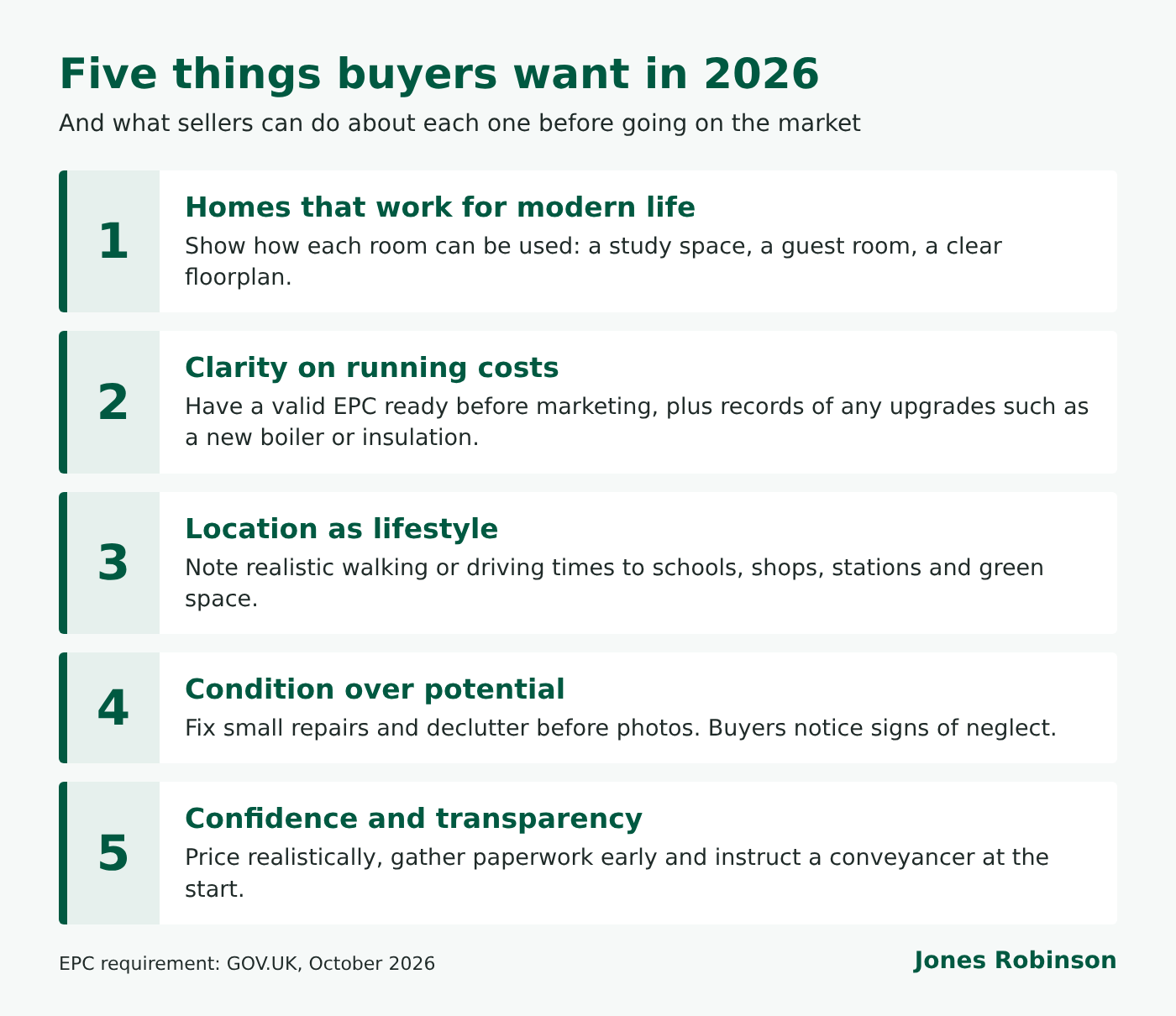
Homes That Work for Modern Life
The way people use their homes has changed, and buyers are now far more focused on how a property functions day to day. This goes beyond the number of bedrooms or reception rooms. Buyers want to see how space can adapt to real life.
Hybrid working remains common, particularly around Newbury and Didcot, where commuting patterns often mix office days with time spent working from home. As a result, buyers value homes with flexible layouts. A spare bedroom that works comfortably as a study, a dining room that can double as a workspace, or a clear separation between living and working areas can all make a property more appealing.
In rural areas around Lambourn and Pewsey, flexibility is also important for different reasons. Buyers are often thinking about future needs, such as accommodating older family members, creating guest space, or allowing children to stay at home for longer. Ground-floor rooms, adaptable layouts and sensible flow between spaces all contribute to a feeling that a home will work not just now, but in years to come.
Buyers are not necessarily looking for larger homes. They are looking for homes that feel well thought through, with space that makes sense and is easy to live in.
What sellers can do: help buyers picture how the space works. A box room set up with a desk reads as a home office; an empty one reads as storage. A clear, measured floorplan matters too, because many buyers study it online before deciding whether to book a viewing. Our guide on how to prepare to sell your house covers staging and photography in more detail.
Clarity On Running Costs and Efficiency
Energy efficiency and running costs are now part of most buying conversations, but expectations are realistic. Buyers understand that a period cottage near Marlborough or a character home in Devizes will not perform in the same way as a newer property. What they want is clarity and reassurance.
Buyers are asking practical questions. How expensive is the home to heat? What improvements have been made? Are there straightforward ways to improve efficiency over time? Homes that can answer these questions clearly tend to inspire more confidence.
Simple measures, such as modern boilers, improved insulation or double glazing where appropriate, can make a noticeable difference. In more modern homes, particularly around Didcot and newer developments in Newbury, buyers are increasingly aware of energy ratings and future-proofing. They are thinking about both day-to-day costs and longer-term value.
For sellers, this does not mean undertaking major upgrades. It means understanding how the property performs and being able to explain it honestly.
Monthly outgoings are under extra scrutiny this year. Rightmove's House Price Index for October 2026 puts the average two-year fixed mortgage rate at 5.55%, up from 4.25% before February, which it estimates has added around £250 a month to the cost of a typical new mortgage. When the mortgage takes more of the budget, buyers look harder at heating and energy bills too.
The starting point is your Energy Performance Certificate (EPC). Under GOV.UK guidance, you must have an EPC ordered for buyers before you market your home for sale. It rates the property from A (best) to G (worst), shows typical energy costs and lists recommended improvements, and it is valid for 10 years. You can check whether your home already has a valid certificate using the government's find an energy certificate service. If your EPC is old and you have since added insulation, a new boiler or new windows, a fresh assessment may show a better rating. Read more on why a good EPC rating is a selling point.
Location As Lifestyle, Not Just Postcode
Location has always mattered, but buyers in 2026 are looking beyond broad postcodes. They are far more interested in how a location supports their lifestyle.
In market towns such as Newbury and Devizes, buyers often want walkable access to shops, schools, cafés and green space. In villages around Pewsey and Lambourn, the focus may be on community feel, countryside access and day-to-day convenience. In Marlborough, buyers are often balancing heritage, schools and long-term value, while Didcot continues to attract professionals drawn by transport links and employment hubs.
Buyers are increasingly researching micro-locations. They want to understand the feel of a street, the practicality of the setting and how it fits into daily routines. A home that clearly demonstrates its local advantages often stands out more quickly than one that relies on a general location description.
What sellers can do: make a short list of what is genuinely close by and how long it takes to reach it: the station, the primary school, the nearest shop, a footpath or park. Accurate, specific details are more persuasive than general phrases, and your agent can use them in the listing. For a sense of what draws people to our towns, see our Didcot area guide.
Condition and Presentation Over Potential
Buyers in 2026 are generally less willing to take on projects unless they are priced accordingly. Many are prepared to decorate, but fewer are keen to tackle significant repairs or unresolved maintenance issues.
This does not mean homes need to be perfect. It does mean that first impressions matter more than ever. Clean, well-maintained spaces, good natural light and a sense that a home has been cared for all influence how buyers feel during a viewing.
Across all six areas, homes that are presented clearly and honestly tend to attract more serious interest. Buyers are quick to notice signs of neglect, even small ones, and these can create hesitation. Addressing straightforward issues before marketing often helps a property feel more straightforward and easier to proceed with.
Small jobs usually give the best return on time and money before a sale:
- Fix dripping taps, sticking doors, cracked tiles and blown bulbs.
- Refresh tired or bold paintwork in neutral colours.
- Clear gutters and tidy the front garden, since this is the first thing buyers see.
- Deal with any signs of damp or condensation and find the cause, not just the mark.
- Declutter and clean thoroughly before photographs are taken.
Larger renovations are a different matter. Not every improvement adds value, and some cost more than they return. Our guide to home improvements that do not add value is worth reading before you commit to a big project. It also helps to remember that many buyers will commission a survey (see Level 2 vs Level 3 surveys explained), so known issues are better addressed or disclosed up front than discovered later and renegotiated.
Confidence and Transparency in the Buying Process
Alongside the physical aspects of a home, buyers are placing greater value on confidence and transparency. They want clear information, realistic pricing and fewer surprises as the transaction progresses.
Homes that feel straightforward to buy often appeal more strongly than those that raise unanswered questions. Clear details, sensible pricing and an organised approach all help buyers feel comfortable making decisions.
This is particularly important in a market where buyers are taking more time to compare options. Confidence does not come from pressure. It comes from clarity.
Transparency is also expected of property listings. National Trading Standards guidance on material information, summarised by RICS, sets out what property listings should include: basics such as council tax band, tenure and price; details that apply to every home, such as utilities and parking; and further information where relevant, such as flood risk, restrictive covenants or building safety issues. Sellers who have this information ready help their agent produce an accurate listing from day one.
Paperwork worth gathering before you go on the market includes:
- Your EPC and any certificates for replacement windows, electrical work or a new boiler.
- Planning permissions and building regulations sign-off for extensions or conversions.
- Guarantees and warranties, for example for damp-proofing, roofing or solar panels.
- For leasehold homes, the lease and recent service charge and ground rent details.
Instructing a conveyancer as soon as you decide to sell, rather than once an offer arrives, can also save time later on. Find out more about our conveyancing services.
Realistic pricing is the other half of buyer confidence. A home priced too high often sits unviewed while buyers wait for a reduction. Our article on the real cost of overpricing your home explains why.
What The Latest Data Says About Buyers
Updated October 2026: Rightmove's latest figures support the picture above. Buyers are active, but they have plenty of choice and are sensitive to price.
| Measure | Latest figure |
|---|---|
| Average asking price of newly listed homes (Great Britain) | £371,015, down 0.1% on a year earlier |
| Average asking price, South East (includes West Berkshire and South Oxfordshire) | £475,582, average 74 days to find a buyer |
| Average asking price, South West (includes Wiltshire) | £376,189, average 76 days to find a buyer |
| Sales agreed compared with a year earlier | 8% lower |
| New buyers contacting agents compared with a year earlier | 9% lower |
| Average two-year fixed mortgage rate | 5.55% |
Source: Rightmove House Price Index, October 2026 (published 19 October 2026).
Rightmove also reports that the number of homes for sale is at its highest level for the time of year since 2014. With more choice available, buyers can afford to be selective, which is why the five themes above matter. Rightmove's own advice to sellers is that competitive pricing from the first day of marketing is critical.
Helping Sellers Prepare For 2026
At Jones Robinson, helping people move on with their lives starts with clear, honest advice. Preparing a home for sale in 2026 is not about chasing trends or making unnecessary changes. It is about understanding how buyers are behaving right now and making informed decisions that suit the property and the local market.
With offices in Newbury, Lambourn, Didcot, Devizes, Marlborough and Pewsey, we combine detailed local knowledge with a wider regional view. This allows you to focus on what will genuinely make a difference for your home, whether that is presentation, pricing, timing or marketing strategy.
From explaining buyer priorities in a specific street or village to setting realistic expectations from the outset, Jones Robinson's role is to guide sellers with clarity and care. The most successful sales are those shaped by real local insight, professional marketing and advice that is grounded in experience, rather than assumptions.
FAQs
Do I need an EPC to sell my house?
Yes. In England you must have an Energy Performance Certificate ordered before you market your home for sale, and buyers must be shown it. An EPC is valid for 10 years, so check whether yours is still in date. You can be fined if you do not have one when you need it.
Should I renovate my house before selling?
Usually not on a large scale. Fixing small repairs, decorating in neutral colours and presenting the home well tend to make more difference than major projects, which may not recover their cost. If there is a significant known issue, ask your agent whether it is better to fix it or reflect it in the price.
How long does it take to find a buyer in 2026?
According to Rightmove's October 2026 House Price Index, homes are taking an average of 74 days to find a buyer in the South East and 76 days in the South West. That is the time to agree a sale, and the legal process to completion comes after it. Realistic pricing and good preparation help shorten both.
What information will buyers expect to see in my listing?
National Trading Standards guidance expects listings to include material information such as price, tenure, council tax band, utilities and parking, plus any issues that apply, such as flood risk or restrictive covenants. Having this ready before you list avoids delays and awkward questions later.
Looking Ahead
Buyer priorities in 2026 are sensible, measured and achievable. They reflect a desire for homes that work well, feel reassuring to run, suit everyday life and come to market with clarity.
For sellers, the key is not to do everything, but to do the right things. Taking time to understand buyer expectations, and seeking informed local advice early, can make the selling process smoother and more predictable.
With the right preparation, 2026 offers positive opportunities for those ready to sell with confidence.
If a move is on the horizon this year, an early conversation with Jones Robinson can help set expectations and shape the right approach from the outset. Our professional valuations provide clear insight into current buyer demand, realistic pricing and how your property can be positioned to appeal to today's market. Our local teams in Marlborough and Didcot, as well as our other offices, are happy to talk through your plans.
Booking a valuation is a simple way to start the process with clarity and confidence, guided by local expertise.